
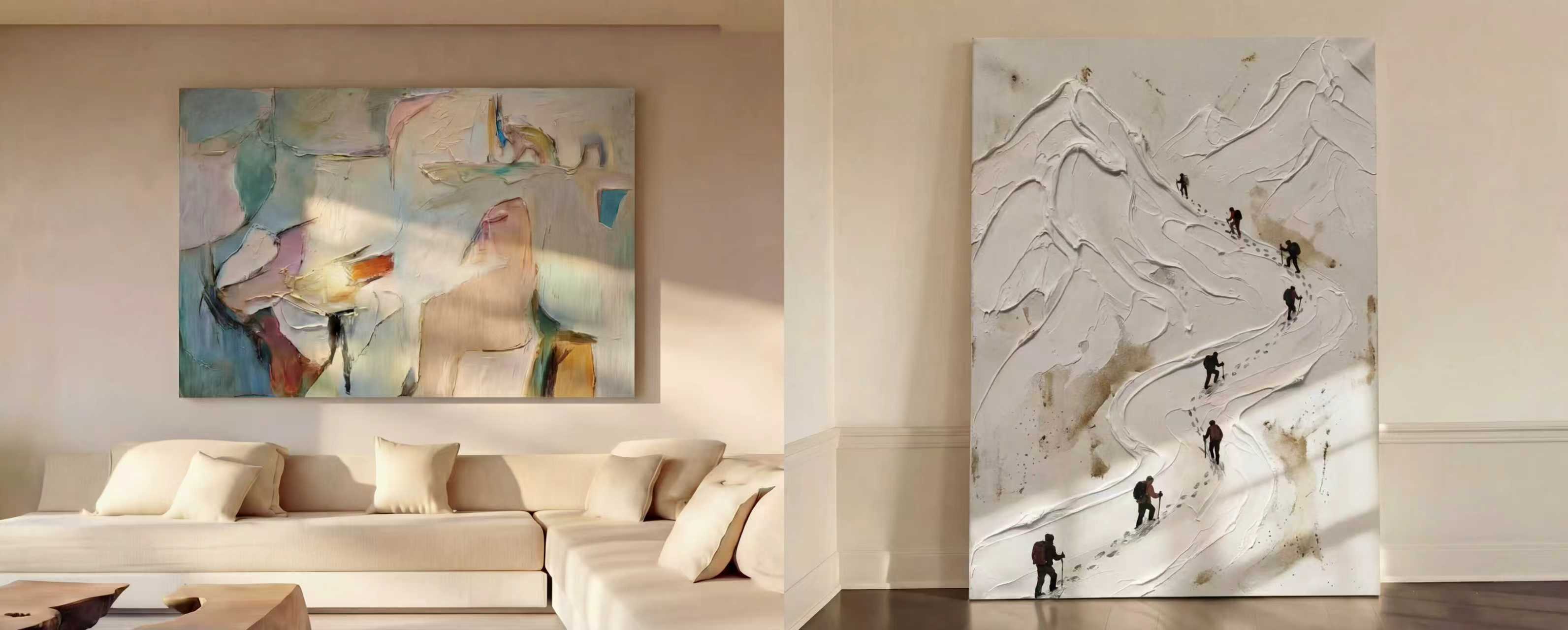
Hanging 2 Pictures Above a Couch: Spacing, Size, and Balance
Two pieces over a sofa work best when they read as one composition: matched frame heights, a tight inner gap, a combined width near two-thirds of the couch, and the visual center sitting just above the cushion line. The rest is just adjusting for ceiling height, frame weight, and the artwork itself.
Quick read
A pair only looks intentional when the gap between the two pieces is smaller than the gap to anything else around them.
Browse related artQuick answer: when hanging 2 pictures above a couch, aim for a combined width of roughly two-thirds the sofa length, a gap of 2 to 5 inches between the two pieces, and a visual center about 6 to 10 inches above the back cushions. Match frame heights, and treat the pair as one rectangle.
That covers 90% of cases. The rest of this guide is the nuance: when a pair beats a single canvas, when it doesn't, and the small mistakes that make two prints look accidental instead of intentional.
Myth vs reality: what people get wrong about hanging 2 pictures above a couch
Myth: Two pieces should be spaced evenly across the full length of the sofa.
Reality: Spreading them out is the single most common mistake. When the gap between the two frames is wider than 6 inches, they stop reading as a pair and start looking like two unrelated decisions.
Myth: The art should be as wide as the couch.
Reality: Art that matches or exceeds sofa width feels heavy and crowds the armrests. Two-thirds is the sweet spot for most living rooms.
Myth: Higher is more elegant.
Reality: Floating art near the ceiling disconnects it from the furniture. The pair should feel anchored to the sofa, not the wall above it.
The sizing rule that actually works
Measure your sofa from arm to arm. Multiply by 0.66. That number is your target combined width for the pair, including the small gap between them.
- 72 inch sofa: aim for about 48 inches of total artwork width
- 84 inch sofa: about 55 to 58 inches
- 96 inch sofa: about 62 to 66 inches
So for an 84 inch couch, two 24 by 36 vertical prints with a 3 inch gap (totaling 51 inches) sit comfortably. Two 30 by 40 verticals with a 3 inch gap (63 inches) would feel a touch wide but still acceptable if the wall is generous.
Gap, height, and the visual center
The inner gap between the two pieces matters more than people realize. Keep it between 2 and 5 inches. Tighter gaps read as a single diptych; wider gaps read as a gallery wall that didn't finish.
For height, the bottom edge of the frames should sit roughly 6 to 10 inches above the top of the back cushions. On standard 8 foot ceilings with a 32 to 34 inch sofa back, that usually puts the center of the pair around 57 to 60 inches off the floor, which lines up with gallery standard eye level.
If your ceilings are 9 feet or taller, you can lift the pair slightly, but resist the urge to float it. The art belongs to the sofa, not the ceiling.
When two pieces beat one large canvas
A diptych above a sofa is the right move when:
- Your wall is wide but interrupted by a window, sconce, or vent that breaks up a single large piece
- You want vertical emphasis under a high ceiling, where two tall verticals draw the eye up
- You like the rhythm of a pair, which adds movement without the busyness of a full gallery wall
- Shipping a single oversized canvas isn't practical for your space
One large piece tends to win when the wall is clean and uninterrupted, the sofa is low and long, or the room already has a lot of visual activity competing for attention. If you're weighing the tradeoff, our guide to art over sofa proportion breaks down the math in more detail.
Choosing two pieces that actually belong together
A real pair has at least two of these in common: palette, subject, frame, or scale. Without that thread, you're just hanging two prints near each other.
The safest combinations:
- True diptych: one image split across two panels, sold as a set
- Series pieces: two works by the same artist or from the same collection
- Tonal pairs: different subjects, identical palette and frame
- Mirrored compositions: two pieces with opposing movement, like a left-leaning and right-leaning abstract
Avoid pairing a busy print with a minimalist one, or mixing a heavy black frame with a thin natural wood frame on the same wall. The eye reads the mismatch before it reads the art.
Mistakes to avoid
- Hanging too high. If you can fit a third piece between the art and the sofa, the pair is floating.
- Uneven bottom edges. If the two frames are different sizes, align bottoms, not centers. The eye reads the baseline.
- Skipping the level. Two pieces amplify any tilt. Use a long level across both frames, not one at a time.
- Forgetting the lamps. Table lamps on either side narrow the usable wall. Measure between lampshades, not arm to arm, if the lamps are tall.
- Matching the sofa color exactly. A pair that blends into the upholstery disappears. Aim for related, not identical.
Quick examples for real living rooms
Organic modern, 84 inch linen sofa: two 24 by 36 textured neutrals with light oak frames, 3 inch gap, bottom edge 8 inches above cushions. Calm, layered, low contrast.
Transitional, 96 inch gray sectional: two 30 by 40 abstract landscapes in soft black frames, 4 inch gap, anchored just above cushion line. Adds weight without going dark.
Small apartment, 72 inch loveseat: two 18 by 24 botanical prints in thin brass frames, 2 inch gap. Keeps the wall feeling intentional without overwhelming a tight room.
FAQ
Should the two pictures be the same size?
Almost always yes. Matched sizes are the easiest way to make a pair read as one composition. Mismatched sizes can work, but only if frames, palette, and bottom alignment are tightly controlled.
How far apart should two pictures be above a couch?
2 to 5 inches between the inner edges of the frames. Closer than 2 inches feels cramped; wider than 5 inches breaks the pair.
Can I hang two pictures above a couch if the wall has a window nearby?
Yes, and it often works better than one large piece. Treat the window as part of the composition and keep the pair centered on the sofa, not the wall.
What if my sofa is against an off-center wall?
Center the art on the sofa, not the wall. The eye reads the furniture grouping first.
Do the two pieces need to be by the same artist?
No, but they should share a palette, frame, or scale. A common thread is what makes a pair feel deliberate.
When you're ready to choose the pieces themselves, browse our paired wall art for living rooms for diptychs and pairs sized for standard sofas.