
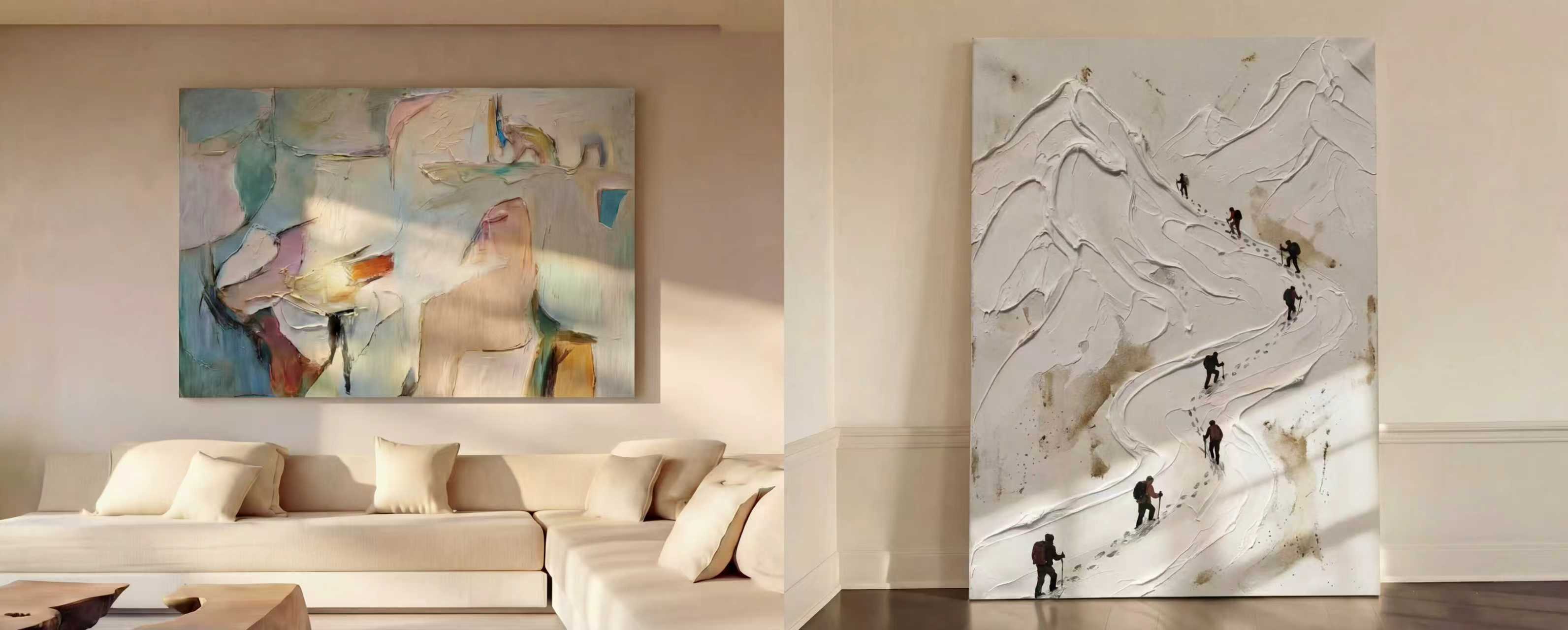
The Quiet Grid: Inside a Monochrome Textured Abstract That Reads Like Built-Up Time
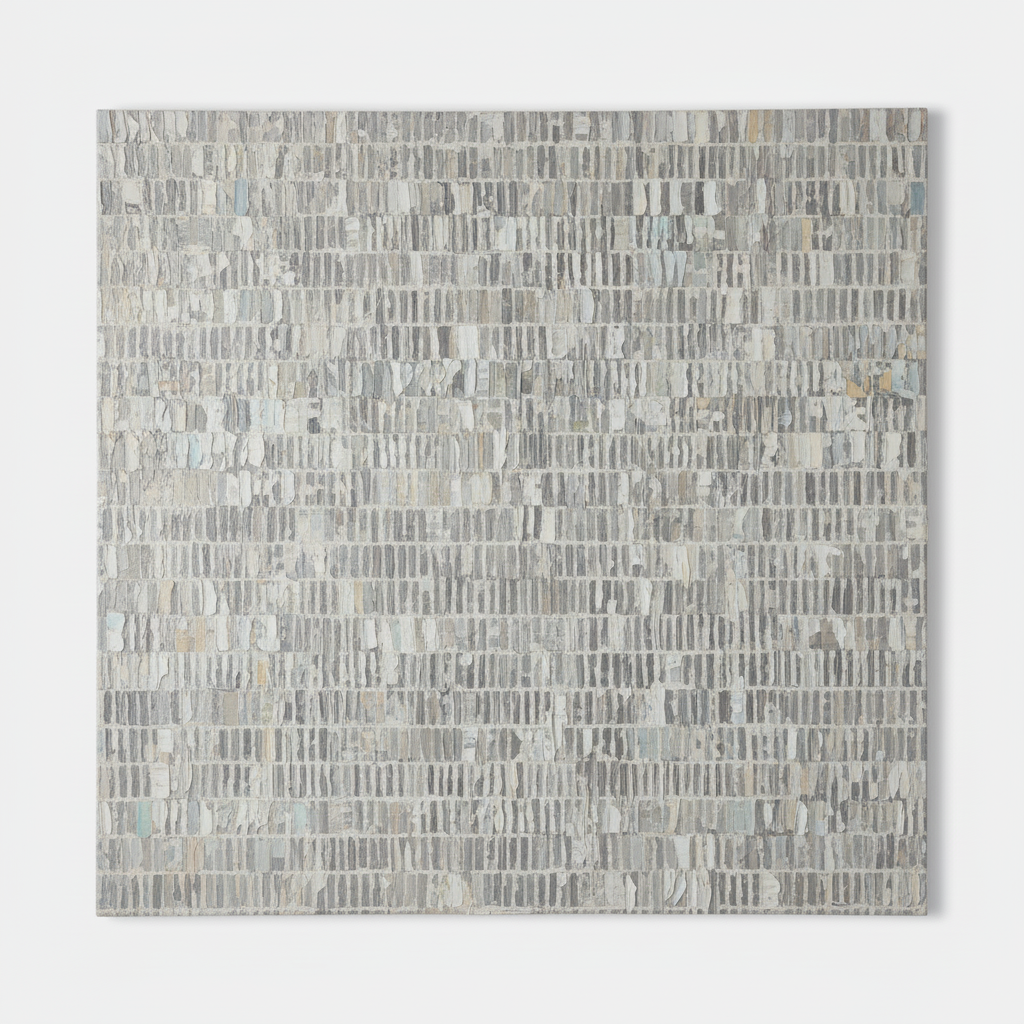
Monochrome Textured Abstract Still Grid is a hand-painted neutral canvas built on rhythm rather than contrast. Dense vertical marks repeat in horizontal bands, with weathered whites, ash greys, and quiet hints of pale blue and sand. It suits minimalist, Japandi, and soft modern interiors, working especially well above a low sofa, opposite a desk, or on a corridor wall where restraint is already part of the room.
Quick read
Restrained order, accumulated by hand — a neutral abstract that holds the wall through rhythm rather than statement.
Product reference
Piece: Monochrome Textured Abstract Still Grid
Format: Hand-painted
Size family: large
View the productAt first glance, it reads as a soft grey field. Look longer and the surface breaks into something else — tightly packed vertical marks stacked in horizontal rows, each one slightly different in weight, edge, and shade. Some marks are compressed and dark, others worn almost to white. The piece is built up rather than painted on, and that distinction is what gives it weight on the wall.
This is a large hand-painted abstract canvas working in a strictly neutral range: cool white, ash grey, soft charcoal, with only the faintest flickers of pale blue and warm sand surfacing on close inspection. There's no focal burst, no gestural sweep. The composition distributes its tension evenly, edge to edge.
What the piece actually does in a room
Because the rhythm is so even, the canvas behaves more like a textured surface than a traditional painting. It calms a wall instead of activating it. In rooms with hard lines — a low sofa, a long console, a plaster wall — the horizontal banding of marks echoes the architecture and settles the space. In daylight, the cool tones lean almost stone-like. Under warm lamplight in the evening, the sand and oat notes come forward and the whole canvas softens.
It works as a primary piece on a wide feature wall, but it doesn't behave like a loud focal point. Think of it as a quiet anchor — present, but not demanding.
Who it's really for
This piece suits people who have already pared down. If your interior leans minimalist, Japandi, or soft modern — light oak, warm white linen, pale concrete, washed plaster — it slides in without negotiation. It's less suited to high-contrast or heavily decorated rooms, where its restraint can read as flat rather than considered.
A common mistake is expecting a textured monochrome abstract to deliver impact the way a graphic black-and-white print does. It won't. Its value is accumulation: the longer you live with it, the more the surface reveals.
How it compares to other neutral wall art
Against a smooth printed canvas in similar tones, this piece reads as more dimensional and more handmade — the marks have real edges and depth. Against a heavier wabi-sabi plaster work, it feels lighter and more rhythmic, closer to a woven or written surface than a sculpted one. If you've been comparing minimalist grid wall art or considering a textured grey abstract for a living room, this sits in the middle ground: structured enough to feel composed, soft enough to disappear when you want it to.
A short styling scenario
Picture a living room with a low linen sofa in warm white, a pale oak coffee table, and a concrete-toned rug. The wall behind the sofa is empty and slightly too tall. Hung centered above the sofa with a generous margin of wall above and below, the canvas locks the seating area into the room. The horizontal bands line up with the sofa's silhouette, and the grey palette pulls the concrete and linen tones together without introducing a new color story.
Product details
- Type: Hand-painted abstract canvas, not a print
- Size: Available in large-scale formats suited to feature walls and above-sofa placement
- Palette: Cool white, ash grey, soft charcoal, with subtle pale blue and warm sand accents
- Surface: 3D textured, built up through repeated vertical marks; reads as layered rather than flat
- Style direction: Abstract, minimalist, wabi-sabi, geometric grid
- Best rooms: Living room (above a low sofa or on a wide feature wall), home office (opposite the desk, near concrete or plaster surfaces), bedroom (above the headboard or on a corridor wall near a reading chair)
- Pairs with: Light oak wood, warm white linen, pale concrete grey, washed plaster
Realistic expectations
The canvas is intentionally quiet. It won't carry a visually busy room on its own, and it isn't designed to be the conversation piece in a high-contrast space. What it does well is hold a large wall with calm authority, add tactile depth to a neutral palette, and shift subtly with the light through the day.
For rooms already built on restraint, see Monochrome Textured Abstract Still Grid.