
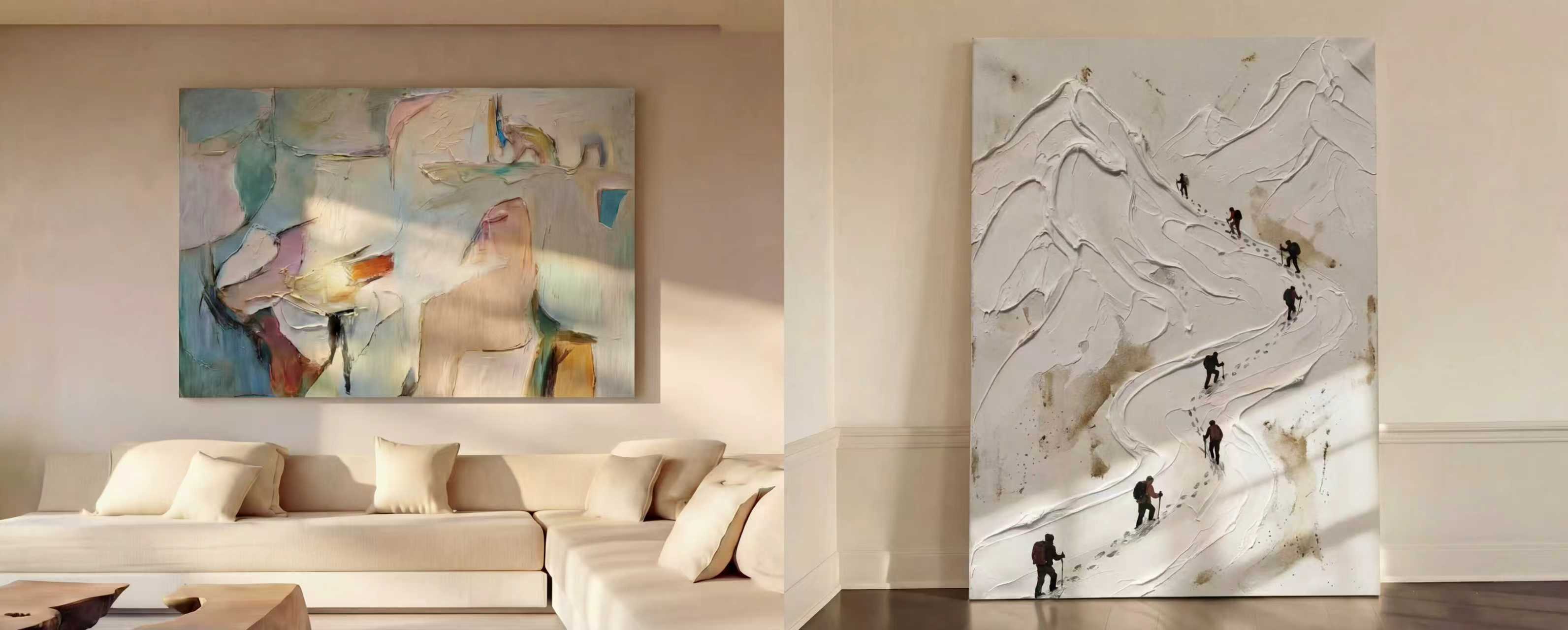
What Makes Plaster Art Painting So Unique: A 101 Guide for Texture-Led Rooms
Plaster art is sculptural painting. Pigment sits inside ridges, troughs, and trowel marks, which means the work behaves more like architecture than a print, reading differently at noon, at dusk, and from across the room.
Plaster art painting is unique because the surface itself is the artwork. Built up by hand with troweled, layered material, it catches real light and throws small shadows, so the piece looks different at 9 a.m. than it does at 7 p.m. A flat print cannot do that.
That single quality, a living surface, is the reason texture-led shoppers keep returning to it. Below is a practical 101 on how plaster art behaves, where it works, and what to look for before you buy.
What Makes Plaster Art Painting So Unique
Three things separate plaster work from standard canvas or print art:
- Physical depth. Ridges, peaks, and recessed areas create actual relief on the wall, not a printed illusion of it.
- Light response. Because the surface is uneven, it produces real highlights and shadows that move as daylight moves.
- Material honesty. Plaster reads as stone, lime wash, or aged wall, which is why it sits naturally inside wabi-sabi, Mediterranean, and warm minimalist rooms.
You are essentially hanging a small piece of architecture. That is also why scale and placement matter more than they would for a flat poster.
Why Texture Reads Differently in Daylight and at Distance
Plaster art has two viewing modes, and good rooms use both.
Up close, within about three feet, the eye reads the marks: trowel sweeps, fingerprints in the medium, the grain of pigment settling into low spots. It feels handmade because it is.
From across the room, the texture compresses into tonal shifts. A piece that looked busy up close becomes a calm field of warm shadow and soft light. This is why plaster pieces tend to anchor a room without shouting.
Daylight changes the read again. Morning light skimming across a textured surface exaggerates every ridge. Midday overhead light flattens it. Evening lamp light pulls warmth into the recessed areas and makes the piece feel deeper. If you can, hang plaster art on a wall that gets directional light from a window or a sconce, not flat overhead light alone.
Where Plaster Art Painting Works Best
Plaster suits rooms that already lean tactile. A few examples that consistently land:
- Above a low, linen sofa. The softness of upholstery plus the chalky weight of plaster is a classic warm-minimalist pairing.
- Bedroom headboard wall. One large piece, centered, behaves like a quiet architectural detail and helps the room feel grounded.
- Dining nook with a pendant light. Directional light from above turns the texture on at night.
- Entry hallway. A narrow vertical plaster piece at eye level adds presence without crowding the path.
- Bathrooms with natural materials. Stone, oak, and lime-washed walls all flatter plaster art.
Rooms that fight it: glossy, high-contrast, very colorful spaces. Plaster wants neutrals and natural materials around it so the surface can do the talking.
Scale, Color, and Framing
A few practical rules that save people from common regrets:
- Go larger than you think. Texture loses its impact when the piece is undersized. Over a sofa, aim for art that spans roughly two-thirds of the sofa width.
- Stay tonal. Bone, oat, clay, warm gray, and soft terracotta read best. Highly saturated plaster pieces tend to feel costume-like.
- Frame minimally or not at all. A thin natural wood float frame or no frame at all keeps the focus on the surface. Heavy ornate frames compete with the texture.
- Mind the hanging height. Center of the artwork at roughly 57 to 60 inches from the floor for standard rooms. Lower it slightly when hanging above furniture so the bottom edge sits 6 to 10 inches above the piece below.
Mistakes to Avoid
- Hanging it under flat ceiling light only. You lose the entire point of the texture. Add a wall sconce, a picture light, or rely on side window light.
- Buying small to be safe. A small plaster piece on a large wall reads as an afterthought. Texture needs presence.
- Mixing too many tactile finishes. Plaster art near boucle, jute, and rough linen can be beautiful, but pair it with at least one smooth surface, like a glass table or a polished floor, so the eye gets to rest.
- Treating it like a print. Plaster is dimensional. Avoid stacking heavy objects in front of it, and dust gently with a soft brush rather than a damp cloth.
- Forcing it into a maximalist gallery wall. Plaster prefers solo or duo placement. Let it breathe.
How Plaster Connects to Wabi-Sabi and 3D Texture Trends
The current interest in plaster art is part of a broader move toward imperfect, handmade-feeling surfaces. It overlaps with wabi-sabi inspired wall art, where asymmetry, restraint, and natural aging are the point. If you are drawn to plaster, you will likely also respond to lime wash walls, raw oak, unglazed ceramics, and undyed textiles.
Texture art painting, as a broader category, simply means any work where the physical surface carries meaning. Plaster is one of the most architectural members of that family, which is why it tends to anchor a room rather than decorate it.
FAQ
Is plaster art painting fragile?
It is more dimensional than a flat canvas, so handle by the edges and avoid knocks. Once hung, it is stable. Dust with a soft, dry brush.
Does plaster art work in small rooms?
Yes, if you scale appropriately and keep surrounding decor calm. A single mid-sized plaster piece can make a small room feel more intentional, not more crowded.
What colors suit plaster art best?
Neutrals from the natural world: bone, oat, sand, clay, warm gray, soft black, muted terracotta. These let the texture lead.
Can I hang plaster art in a bathroom?
In a well-ventilated bathroom, generally yes. Avoid placing it directly above a shower or in a space with constant heavy steam.
Plaster art vs. textured canvas, what is the difference?
Textured canvas usually adds raised paint or medium on top of a printed or painted image. Plaster art is built primarily from the plaster medium itself, so the relief is deeper and the surface reads as material first.
If this kind of surface speaks to you, browse our Textured and plaster-inspired wall art collection to see how it lives on real walls.