
Best Paintings for Home Decor: What Actually Works (and What Most People Get Wrong)
Choosing art for your home feels harder than it should. This guide cuts through the common assumptions—about size, style, and placement—and offers specific, room-by-room guidance on what actually tends to work, from living rooms to hallways.
Quick read
Great wall art doesn't complete a room—it reveals what the room was always trying to say.
Browse related artMost people approach buying wall art the way they approach buying throw pillows—as a finishing touch, something to fill the gap. The result is usually a painting that's too small, hung too high, and quietly wrong for the room it's in. The best paintings for home decor aren't chosen last. They're chosen with the same intention as furniture.
This guide is built around the rooms where art decisions actually get made—and the myths that derail those decisions before they start.
Myth vs. Reality: What People Get Wrong About Choosing Art
Myth: Art should match the color of your couch or curtains.
Reality: Art that matches too closely disappears. The goal isn't coordination—it's contrast with coherence. A painting with one color pulled from your palette and two unexpected ones will always read better than a piece engineered to blend in.
Myth: Big rooms need big art.
Reality: Scale matters, but proportion to the wall matters more. A single oversized canvas on a small wall can work beautifully. A gallery wall crammed into a large space can feel like visual noise. Think about the wall, not the room footprint.
Myth: Abstract art is safe and universally neutral.
Reality: Abstract work has strong visual weight. A chaotic abstract in a bedroom can feel restless. A stark, minimal abstract in a warm, layered living room can feel cold. Abstract isn't a default—it's a deliberate choice with real consequences.
Living Room: The Case for One Strong Anchor
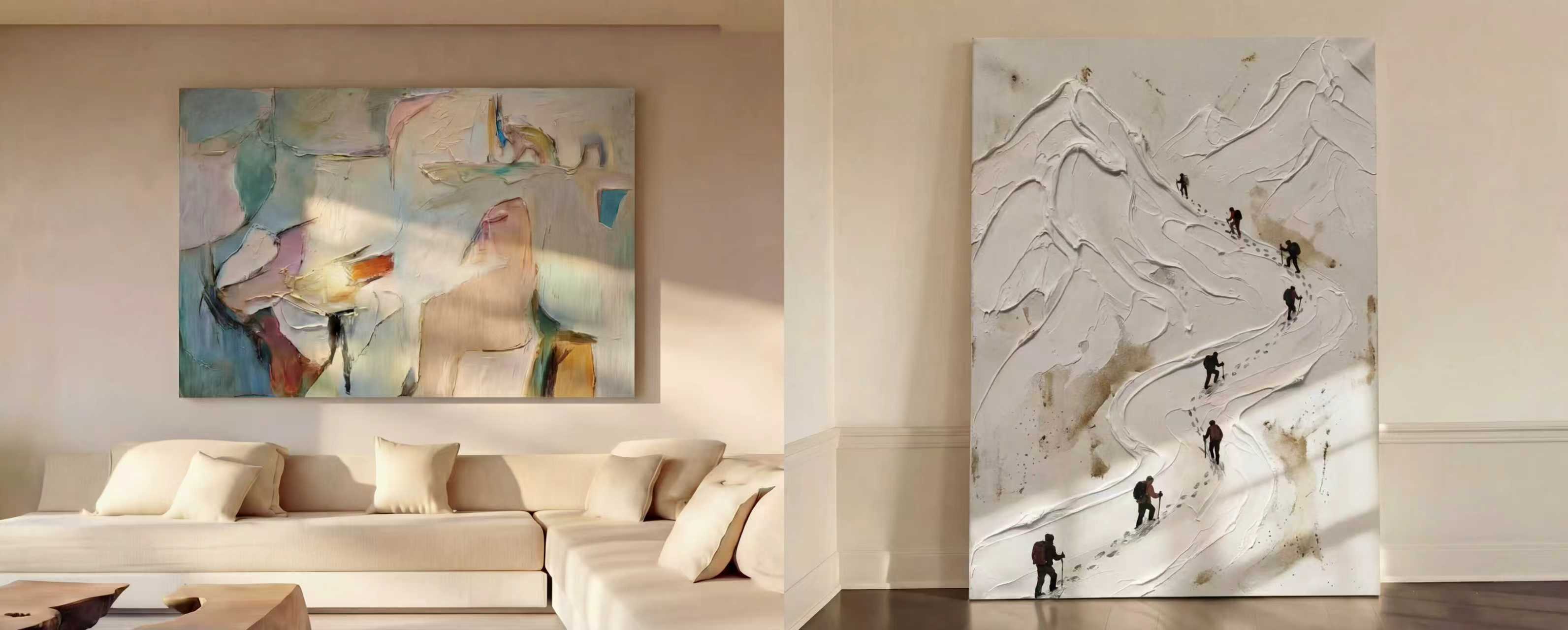
The living room is where most people over-complicate things. Gallery walls, mixed frames, rotating prints—there's a version of that which works, but it requires real intention. The simpler move, and often the more effective one, is anchoring the main wall with a single large-format painting.
For rooms with warm, earthy tones—terracotta, cream, warm gray—organic modern paintings with soft botanical or abstract forms tend to integrate without competing. For cooler, more neutral interiors, a painting with a clear focal point (a horizon, a figure, a strong geometric element) gives the room somewhere for the eye to land.
Hang it so the center of the painting sits roughly at eye level when standing—around 57 to 60 inches from the floor. Not higher. Higher is one of the most common and most fixable mistakes in residential art placement.
Bedroom: Softer Isn't Always the Answer
The assumption is that bedrooms need calming, soft art. Pale watercolors. Muted florals. That works for some rooms, but it's not a rule. What the bedroom actually needs is art that doesn't create anxiety—which is different from art that's pale or quiet.
A bold impressionist landscape in deep blues and greens can be deeply restful. A high-contrast black-and-white photograph can feel clean and grounding. What tends to fail in bedrooms is art that feels unresolved—too many competing elements, too much visual busyness, a palette that pulls in multiple directions at once.
Size-wise, over the bed is the most common placement and, done right, one of the most satisfying. Aim for a painting roughly two-thirds the width of the headboard. Going narrower makes it look like an afterthought.
Dining Room: Where People Underinvest
The dining room gets neglected. Most people spend their art budget on the living room and treat the dining space as secondary. But dining rooms are where people sit, talk, and look around for extended periods—they reward good art more than almost any other room in the house.
Scale up here. A large figurative work, a landscape, or a rich still life does well in dining rooms because there's typically a large uninterrupted wall opposite or adjacent to the table. Lighting helps enormously—if you have a dimmer and warm-toned bulbs, paintings with depth and texture come alive in a way they simply don't under overhead fluorescents.
Impressionist-style paintings work particularly well in dining rooms. The loose brushwork, the sense of light and atmosphere—they feel alive under warm lighting and suit the longer, more relaxed pace of a dinner table.
Entryway and Hallway: Make It Count Immediately
The entry is the first thing people see and the first thing they form an impression from. A blank hallway isn't neutral—it reads as unfinished. But a hallway with one well-chosen painting reads as intentional from the moment someone walks in.
Narrow entryways call for vertical formats. A tall, slim painting or a stacked pair of smaller works fits the proportions naturally. Don't crowd a narrow hallway with a horizontal canvas—it'll feel jammed.
Entryways also tolerate bolder choices than people usually make. Dark backgrounds, strong compositions, vivid color—things that might feel like too much in a living room often feel exactly right in a compact, transitional space where you're moving through rather than settling in.
How to Match Art in a Room Without Overthinking It
Learning how to match art in a room is less about rules and more about a few consistent anchors. Pick one or two colors from the painting that also appear somewhere else in the room—upholstery, a rug, a lamp—and the painting will feel like it belongs. You don't need a perfect match. You need a thread.
Frame consistency helps with gallery arrangements. If you're hanging multiple pieces, keeping frames in the same finish (all black, all natural wood, all white) creates order even when the prints themselves vary in subject and style.
And don't overlook the wall color. A painting that looks flat against white can become dramatic against a deep navy or a warm sage. If you're repainting anyway, consider what art you want to hang before you commit to the color—not after.
Common Mistakes Worth Avoiding
- Hanging art too high. Eye level means eye level, not ceiling-adjacent. This is the single most common mistake and the easiest to fix.
- Going too small on a large wall. A tiny print on a wide wall looks lost. When in doubt, size up.
- Buying art to match the sofa. Coordination isn't the same as cohesion. Let the art lead a little.
- Treating every room the same. The bedroom, dining room, and living room have different functions and different needs. What works in one won't automatically work in another.
- Defaulting to abstract because it feels safe. Abstract isn't neutral. It has weight, mood, and character just like any other style.
Frequently Asked Questions
What size painting works best for a living room wall?
For a primary living room wall, aim for a painting that's at least 60 inches wide if the wall spans 8 feet or more. Over a sofa, the painting should cover roughly two-thirds of the sofa's width.
Is it okay to mix different art styles in the same room?
Yes—mixed styles can work well when there's a consistent thread, whether that's a shared color palette, similar frame finishes, or a common subject matter. Without that thread, mixed styles tend to feel accidental rather than curated.
How do I choose art for a room that already has a lot going on?
In a visually busy room, reach for a painting with a simpler composition—one dominant element, a restrained palette, or a lot of breathing room within the canvas. A complex painting in a complex room compounds the visual noise.
Does the lighting in a room affect which paintings look best?
Significantly. Warm lighting (2700K–3000K) enriches yellows, reds, and earthy tones. Cool lighting can flatten those same colors but makes blues and greens more vivid. If possible, view a painting under lighting similar to your room's before buying.
Can I hang art in a bathroom or kitchen?
Yes, with some caution around humidity. Canvas prints and framed prints with glazing hold up reasonably well in most bathrooms and kitchens. Avoid placing art directly above a stove or in a steam-prone shower wall position.
Ready to find something that actually fits your room? Browse wall art by style and filter by the look and scale you're working with.