
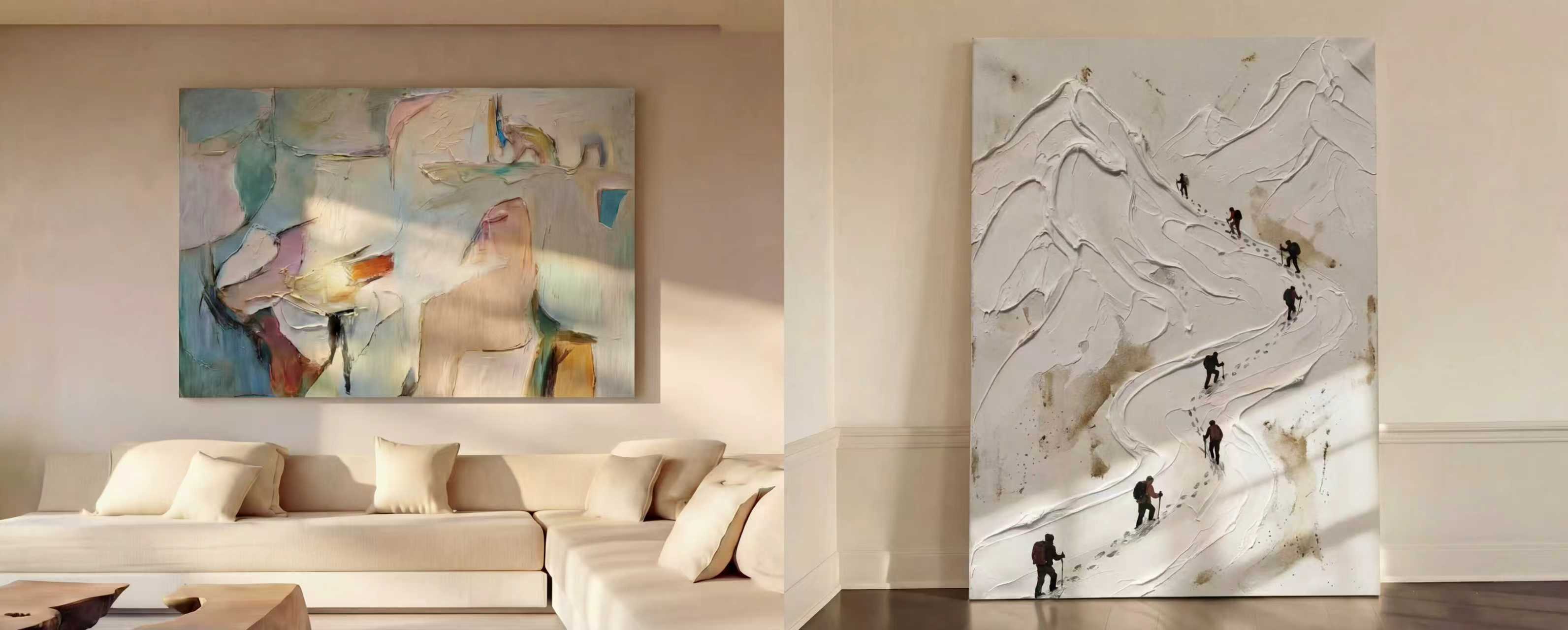
The Quiet Intensity of a Cubist Violinist on Canvas
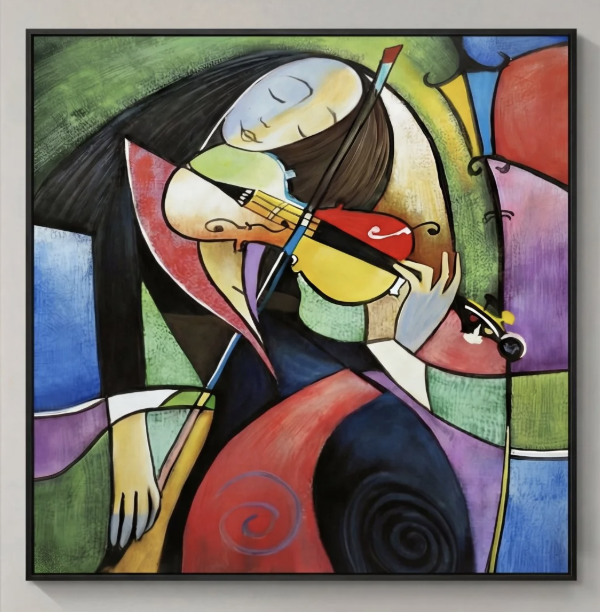
Cubist Violin Player Serenade is a hand-painted figurative canvas where a musician leans into the instrument in overlapping geometric planes. The palette runs deep navy, olive, dusty rose, and ochre yellow, with built-up paint texture you can read up close. It works best as a focal point above a sofa, credenza, or in a creative space where its density and color rhythm have room to breathe.
Quick read
Fragmented, warm, and absorbed in its own music — a cubist figure that holds the wall without shouting.
Product reference
The first thing you notice is the lean — a figure curved into the violin, eyes closed, the whole body folded into the act of listening to itself play. The second thing is the color. Deep navy presses against olive, dusty rose meets ochre yellow, and the violin's warm wood tone sits dead center like the heartbeat of the composition. This is cubist figurative painting at its most absorbed: planes broken apart, then reassembled into something unmistakably human.
Cubist Violin Player Serenade is a hand-painted canvas, built in the tradition of bold figurative music wall art. It reads as expressive rather than decorative — the kind of piece that gives a wall a point of view.
How It Reads in a Room
The composition is dense. Negative space is minimal, and the figure expands to fill the frame, which means the canvas carries visual weight without feeling crowded. In daylight, the olive and rose come forward and the geometry feels graphic. Under lamplight, the navy deepens and the ochre violin glows warmer, pulling the eye to the center.
Because the palette runs warm and grounded, it doesn't fight a room with strong wood tones or saturated upholstery. It settles in. You'll see the built-up paint texture from a few feet away — not a flat print surface, but layered brushwork with real dimension.
Who It's For
This piece suits buyers leaning bohemian, mid-century modern, or transitional. If your home already includes warm walnut furniture, mustard accent chairs, or matte black metal accents, the canvas slots in without much styling effort. It's also a natural fit for music rooms, creative studios, and home offices where a figurative subject feels contextually meaningful.
It's less suited to minimalist interiors built around white walls and pale oak — not because it clashes, but because the density of the composition wants company. Rooms with some color confidence handle it best.
Realistic Expectations
A common assumption with cubist work is that it will feel chaotic on a wall. This one doesn't. The geometry is bold, but the figure is clearly readable, and the palette holds together rather than scattering. What you're committing to is a focal piece — not a quiet supporting canvas. If you hang it above a sofa, it becomes the wall's anchor. Plan accordingly.
The other thing worth knowing: scale matters here. The composition is built for generous wall space. In a narrow hallway or above a small console, the density can feel compressed. Give it room.
A Styling Scenario
Picture a living room with a low charcoal sofa, a walnut coffee table, and walls in dusty sage or warm off-white. The canvas hangs centered above the sofa, roughly six to eight inches above the back cushion. A mustard throw pillow picks up the ochre in the violin. A floor lamp on one side casts evening light across the textured surface, and the navy deepens as the room warms up. That's the kind of room this piece was made for — layered, lived-in, color-aware.
It also performs well above a dark wood credenza in a dining room, where the compressed geometry plays against the horizontal line of the furniture below.
Product Details
- Type: Hand-painted canvas, original brushwork with visible texture
- Style: Cubist figurative, abstract, surreal dreamscape
- Subject: Violinist, geometric figure composition
- Palette: Deep navy, olive green, dusty rose, ochre yellow, warm gold
- Size tag: Medium — suited to generous wall space rather than narrow corridors
- Best rooms: Living room above a wide sofa, dining room above a dark wood credenza, home office opposite the desk
- Pairs with: Warm walnut wood, mustard upholstery, matte black metal, off-white or dusty sage walls
- Interior directions: Bohemian, mid-century modern, transitional
Comparing It to Other Wall Art Options
If you've been weighing framed prints versus hand-painted canvas, this piece falls firmly in the latter camp — you're paying for surface texture and brushwork, not reproduction. Compared to abstract color-field paintings, it offers a clear subject and narrative. Compared to literal portraiture, it gives you geometry and color rhythm instead of realism. It's a middle path that suits buyers who want figurative meaning without traditional figurative style.
For the right room, it's the kind of canvas you stop noticing as decor and start treating as part of the architecture. Explore the full piece here: Cubist Violin Player Serenade.