
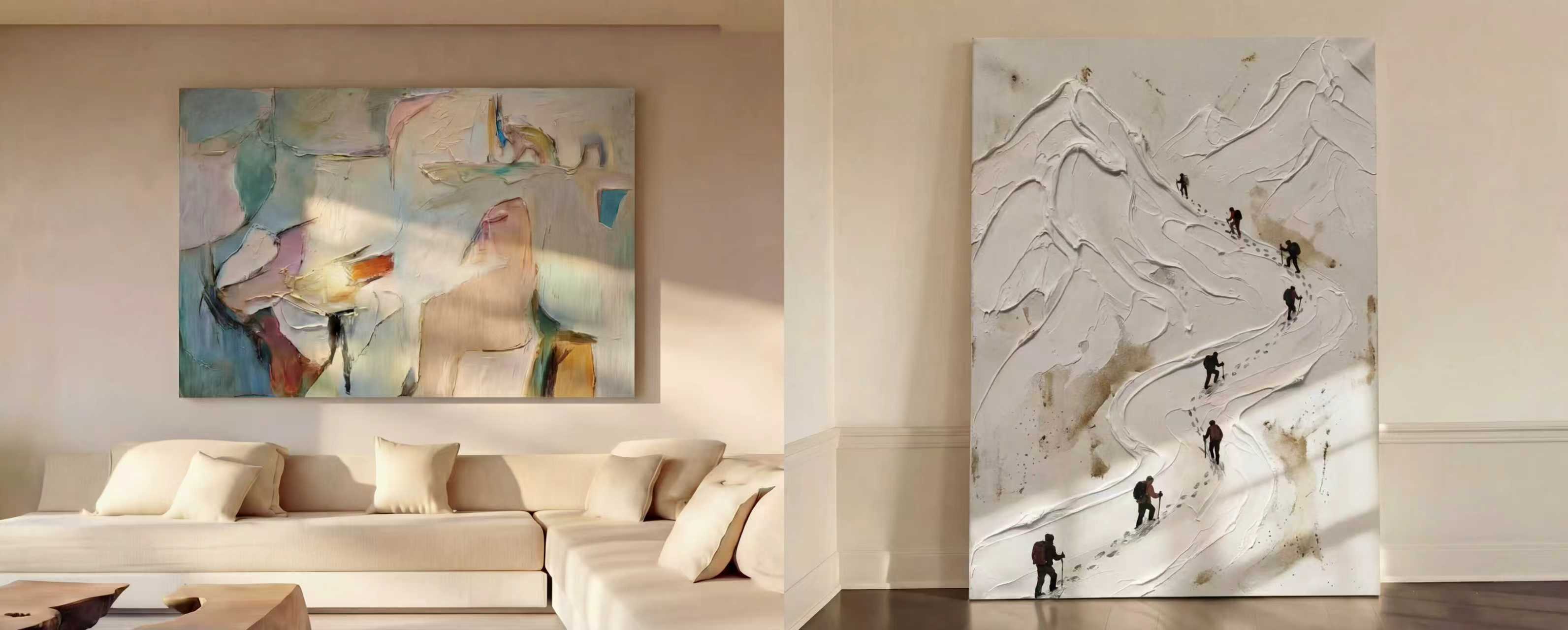
Extra Large Horizontal Wall Art Ideas for Long Walls and Sofas
Long walls and wide sofas create one of the most common decorating dilemmas: the space feels unfinished but nothing seems to fill it right. This guide walks through scale rules, placement decisions, format tradeoffs, and the most common buying mistakes — so you can choose confidently before anything ships.
Quick read
Scale is a commitment. Get the width right first, then worry about the subject matter.
Browse related artA sofa that runs eight feet across a living room wall is not a small problem. Neither is a dining room with a banquette that stretches under six feet of blank plaster, or a hallway so long it feels more like a corridor than part of the home. These are the situations where extra large horizontal wall art ideas stop being decorating inspiration and start being an actual decision you need to make — with real dimensions, real shipping costs, and a real wall on the other end.
This guide is structured as a buying advisor. It covers scale criteria, format tradeoffs, room-specific placement, and the mistakes that are easy to make when you're ordering something you can't physically hold up first.
Start With Width, Not Style
Most people shop by subject — landscapes, abstracts, photography — before they've confirmed a single measurement. That's the order that causes returns.
The reliable starting rule: a horizontal piece should span 60 to 80 percent of the furniture or wall feature it anchors. For a 96-inch sofa, that means roughly 58 to 77 inches of art. A 72-inch sofa calls for something in the 43-to-58-inch range at minimum — though for truly dramatic impact, erring toward the upper end almost always reads better in person than it does on a mood board.
Height matters too, though it's less discussed. For above-sofa placement, a horizontal piece between 24 and 36 inches tall tends to feel proportionate without competing with the furniture. Anything under 20 inches tall will float awkwardly regardless of how wide it is.
Room-by-Room: Where Extra Large Horizontal Art Actually Lives
Above a Long Sofa
This is the classic application. Hang the piece so its bottom edge sits 6 to 8 inches above the sofa back — close enough to read as a unit with the furniture, not a separate wall element drifting upward. In rooms with 9-foot or higher ceilings, you have more vertical breathing room, but the 6-to-8-inch rule still applies at the bottom.
One single wide canvas usually reads cleaner here than a grid of smaller prints. If you go the diptych or triptych route, keep gaps tight — 2 to 3 inches between panels — or the eye starts treating them as separate objects rather than one composition.
Dining Banquette or Sideboard Wall
Banquette walls are underutilized. The seating arrangement runs horizontal by nature, and a wide piece above it ties the whole dining area together without requiring ceiling-height drama. Because diners sit rather than stand, you can hang slightly lower here — center point around 54 to 56 inches from the floor rather than the standard 57 to 60.
Abstract or impressionist work tends to perform well in dining environments. The visual complexity gives people something to look at during long meals without the literalism of portraiture or photography that can feel watched.
Wide Hallways and Entry Corridors
Long hallways are awkward precisely because they reward horizontal thinking. A single oversized horizontal piece — or two spaced wide pieces at the same hanging height — converts what feels like a pass-through into an intentional gallery moment. Keep the bottom edge at roughly 54 inches from the floor since people move through rather than stand still, and the sightline is slightly different in motion.
In narrow hallways under 4 feet wide, be careful with anything that protrudes significantly. Canvas depth matters here — a deep gallery-wrap frame in a tight space can feel like an obstacle.
Format Tradeoffs: Single Canvas vs. Multi-Panel
Both work. The choice depends on your wall architecture more than personal taste.
- Single canvas: Cleaner, more confident, easier to hang. Works on walls with no interruptions — no switches, no vents, no architectural breaks. Also ships in one piece, which simplifies the process.
- Diptych (2 panels): Easier to manage physically and often less expensive to ship. Creates a subtle implied break in the image that can read as intentional or slightly awkward depending on the composition. Best when the image itself has a natural center divide.
- Triptych (3 panels): The most common multi-panel format. Works well with panoramic subjects — landscapes, cityscapes, abstracted horizons. Requires precise spacing to avoid looking haphazard. Use a level and measure twice.
The Buyer Checklist: Decision Criteria Before You Add to Cart
Run through these before committing to any extra large horizontal piece:
- Measured width of the anchor point — sofa, console, banquette, or empty wall span. Write it down.
- Available wall height — from furniture top to ceiling, or from floor to ceiling if it's a standalone wall. This determines how tall the piece can realistically be.
- Color temperature of the room — warm rooms (amber lighting, wood tones, warm neutrals) read differently against cool blues or stark blacks. Impressionist palettes tend to bridge this more gracefully than high-contrast photography.
- Existing focal points — is there a fireplace, window, or architectural feature competing for attention? If yes, the art should complement rather than fight.
- Shipping and handling reality — pieces over 60 inches wide often require freight or oversized shipping. Confirm the dimensions and delivery method before purchasing, not after.
For abstract and impressionist options that scale well to large horizontal formats, mipiece's abstract collection is worth browsing with your measurements already in hand.
Mistakes Worth Avoiding
Hanging too high. The single most common error. Art that climbs toward the ceiling disconnects from the room and from the furniture below it. Center point at 57 to 60 inches from the floor is the standard for a reason.
Choosing a piece that's too small. A 40-inch canvas above a 90-inch sofa will look lost. Bigger almost always reads better in large rooms — people consistently underestimate scale when ordering online.
Ignoring frame depth on gallery-wrap canvases. A 1.5-inch depth looks different on a wall than a 0.75-inch depth. In rooms with other framed pieces, mixing depths can feel unintentional unless you're deliberate about it.
Treating multi-panel spacing casually. Gaps that are too large — more than 3 or 4 inches — make triptychs feel like three separate artworks. Gaps that are uneven look like a hanging error. Use spacers or a template.
Ordering before confirming the return or exchange policy. With oversized art, returns are often expensive or impractical. Know your options before the piece arrives.
Frequently Asked Questions
How wide should wall art be above a sofa?
A reliable guideline is two-thirds the width of the sofa. For a standard 84-inch sofa, that means art in the 56-to-68-inch range. Going slightly wider than two-thirds is generally fine; going significantly narrower tends to look underpowered.
What counts as extra large horizontal wall art?
There's no universal standard, but most retailers and designers treat anything 48 inches or wider — with width exceeding height — as extra large horizontal. Some pieces in this category run 72 to 96 inches wide, particularly for commercial or loft-scale spaces.
Can I use a vertical piece on a long horizontal wall?
Yes, but it works differently. A single tall vertical piece on a long wall creates an accent moment rather than filling the span. If that's your intent, it can be striking. If you're trying to address the full width of the wall, a horizontal format or a grouped arrangement will read more completely.
How high should large wall art hang in a dining room?
Since diners are seated, the standard eye-level center point drops slightly — aim for 54 to 57 inches from the floor rather than the standing 57 to 60 inches. This keeps the art within the natural sightline of people at the table.
Is impressionist art a good choice for large horizontal formats?
Often yes. Impressionist compositions — particularly landscapes and atmospheric scenes — tend to carry scale well because the style is built around suggestion and light rather than sharp detail that can feel overwhelming at large sizes. They also work across a wide range of room palettes without requiring a specific color scheme to match.
When you're ready to see what actually works at scale, browse Large horizontal wall art from mipiece and keep your measurements open in another tab.