
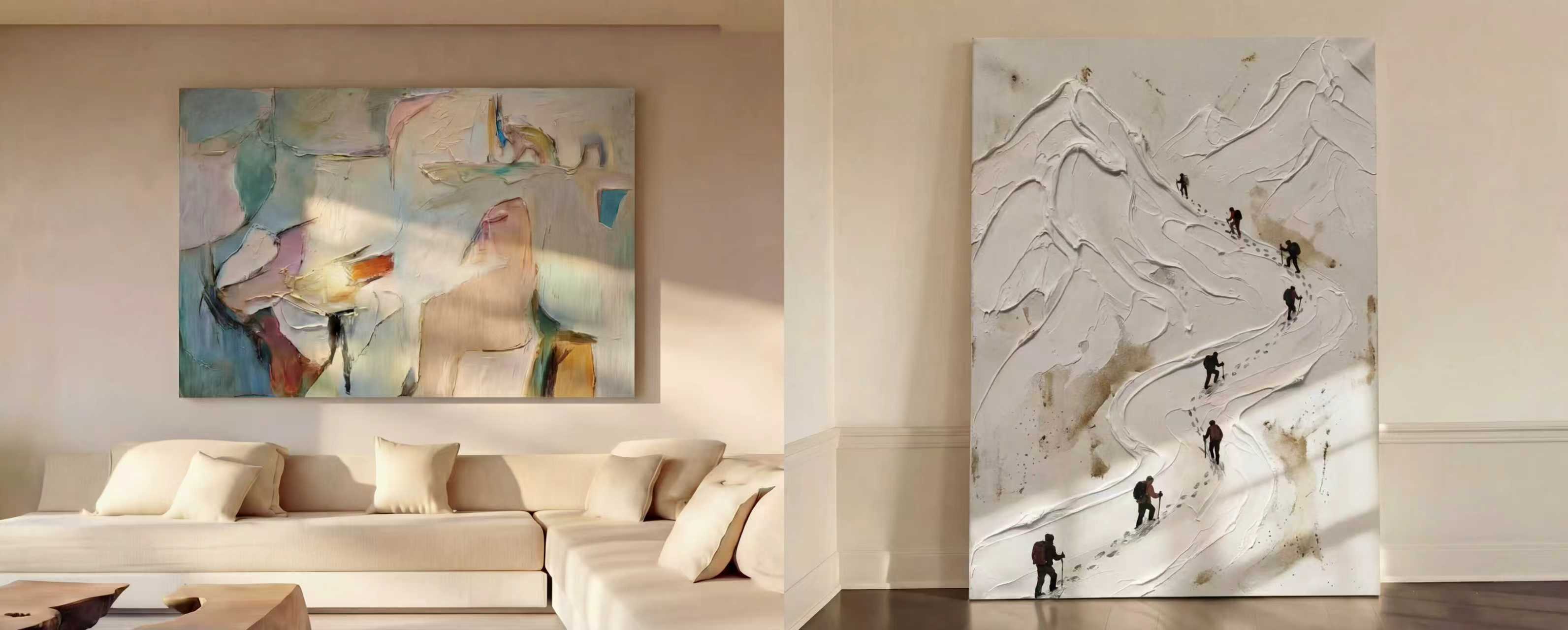
Gallery Wall Above Couch Ideas That Do Not Look Messy
Getting a gallery wall above the sofa to look intentional rather than cluttered comes down to three things: proportion relative to the couch, a consistent visual thread running through the frames, and controlled spacing. This guide walks through real-room scenarios so you can picture exactly how each approach plays out before you buy a single frame.
Quick read
The best gallery walls above a couch look effortless because someone made deliberate decisions before a single nail went in.
Browse related artA gallery wall above the couch is one of the most searched decorating moves in American living rooms, and also one of the most abandoned halfway through. Frames get hung too high, the grouping floats without an anchor, or every piece feels like it arrived from a different house. None of that is hard to fix once you understand the underlying logic.
The short answer: treat the sofa as your baseline, keep the bottom edge of the arrangement about eight to ten inches above the back cushions, and make sure the total width of the grouping stays within the sofa's footprint — or extends no more than a few inches beyond each arm. Everything else is creative choice.
Start With Scale, Not Style
Before you think about what to hang above the couch, think about how much wall you're actually working with. A standard three-seat sofa sits around 84 to 96 inches wide. A gallery wall that's only 30 inches across on a wall that wide will look like a postage stamp. One that extends far past the arms of the sofa loses its relationship with the furniture entirely.
A good working rule: aim for a grouping that covers roughly two-thirds of the sofa's width. On an 84-inch couch, that means your arrangement should span about 55 to 60 inches. That's enough room for a strong anchor piece flanked by two or three smaller works, or a loose grid of five to seven frames in varied sizes.
Ceiling height matters too. In a room with nine-foot ceilings, you have room to stack pieces vertically and create real presence. In a room with eight-foot ceilings, keep the grouping lower and wider to avoid the arrangement creeping too close to the ceiling line.
Gallery Wall Above Couch Ideas by Room Scenario
The Narrow City Apartment Living Room
When the sofa sits close to adjacent walls, a tight asymmetric grouping of three to four pieces works better than a sprawling grid. Try one medium horizontal print centered above the sofa — something in the 24×18 range — with two small square frames slightly offset to one side. This reads as intentional rather than under-decorated, and it doesn't compete with nearby windows or door frames.
The Open-Plan Living Room with High Ceilings
Here you can afford to go bigger. A large statement print — 36×48 or wider — anchored slightly left or right of center, with three to four supporting pieces on the opposite side, creates an asymmetric gallery that draws the eye without feeling symmetrical and stiff. Abstract art and bold illustration prints hold up well at this scale because the lines and color carry across a larger wall. If you want something with energy, pop art and graffiti-style prints punch well in open, high-ceiling spaces.
The Rental With No-Drill Rules
Command strips have weight limits, so this scenario calls for fewer, lighter frames rather than a dense arrangement. Three lightweight frames in matching black metal — a horizontal row with even gaps — can look sharp and deliberate. Stick to prints on paper rather than stretched canvas to keep the weight manageable.
The Sectional Sofa Situation
Sectionals are tricky because the longest edge of the sofa often ends mid-wall. Anchor your gallery wall above the main seating section, not the chaise end. Treating the full sectional length as your width reference usually creates an arrangement that's too spread out to feel cohesive.
Spacing Rhythm: The Detail Most People Underestimate
Spacing is where most gallery walls fall apart. Gaps that are too small make the arrangement look cramped. Gaps that vary randomly — four inches here, one inch there — make it look unfinished. A consistent two-to-three-inch gap between every frame, measured edge to edge, creates visual rhythm without looking rigid.
Before touching the wall, cut paper templates in the exact size of each frame and tape them up. Rearrange the templates until the spacing feels even and the overall shape suits the wall. This step takes twenty minutes and saves an afternoon of patching nail holes.
One additional note on vertical placement: the center of your gallery arrangement should sit roughly 57 to 60 inches from the floor — which is the standard eye-level hang height for a standing adult. When the bottom of the grouping is eight to ten inches above the sofa cushions, this usually works out naturally.
Frame Consistency: The Fastest Way to Look Intentional
You do not need matching frames. But you do need a thread. That thread might be a shared finish — all black, all natural wood, all brushed brass. Or it might be a consistent mat color even if the frames vary. Or it might be a consistent frame profile width.
Mixing slim black frames with chunky black frames in the same grouping is where things start to look accidental. Mixing black and natural wood deliberately — with intention and restraint — can look collected and warm. The difference is usually the ratio: pick one finish as the dominant and use the other sparingly.
For print content, a loose theme holds the grouping together better than strict matching. A mix of botanical illustrations, abstract line work, and typographic prints can coexist if they share a color palette. If the prints have nothing in common — in tone, subject, or palette — the wall reads as miscellaneous regardless of how carefully the frames are arranged. Illustration prints work particularly well in mixed gallery walls because the line-based style bridges well across different subjects.
Common Mistakes Worth Avoiding
- Hanging too high. The most common gallery wall error by a significant margin. If you can't connect the grouping visually to the sofa below it, the arrangement floats and loses its purpose.
- Using too many different frame sizes without an anchor. An arrangement of seven similar-sized frames with no dominant piece can feel like a grid that lost its grid. One larger anchor — even just a little larger — gives the eye somewhere to land.
- Ignoring the lamp and side table footprint. If a floor lamp sits at the end of your sofa, the gallery wall's lower edge needs to clear it. Frames that appear to sit on top of lamp shades in photos look awkward in real rooms.
- Buying prints without checking color against the room. A cool-toned blue print in a room full of warm terracotta and amber will always look like it arrived from a different house. Pull a dominant color from your existing textiles before choosing prints.
- Over-filling the wall. Negative space is part of the arrangement. A grouping with breathing room between pieces reads as curated. One that covers every inch of available wall tends to read as busy.
Frequently Asked Questions
How high should a gallery wall be above a couch?
The bottom edge of the arrangement should sit eight to ten inches above the top of the back cushions. The visual center of the grouping should be around 57 to 60 inches from the floor.
How wide should a gallery wall be relative to the sofa?
Aim for roughly two-thirds of the sofa's width. A grouping narrower than half the sofa width tends to look too small. Extending significantly past the arms weakens the connection to the furniture below.
How many pieces should a gallery wall have?
Three to seven pieces is a practical range for most living rooms. Fewer than three and it's not really a gallery wall. More than nine becomes hard to manage without the arrangement looking dense.
Do gallery wall frames need to match?
Not exactly, but they need a shared thread — a consistent finish, profile width, or mat color. Total variety with no common element tends to look unintentional rather than eclectic.
What kind of art works best in a gallery wall above the couch?
Prints with clear lines and defined color palettes hold up well in grouped arrangements because they read distinctly even at smaller sizes. Illustration, abstract, and graphic art tend to work better than painterly pieces with lots of subtle texture, which can lose their quality when reproduced at print sizes.
Ready to start pulling pieces together? Browse mix-and-match wall art and find prints that work as a set without looking like a set.