
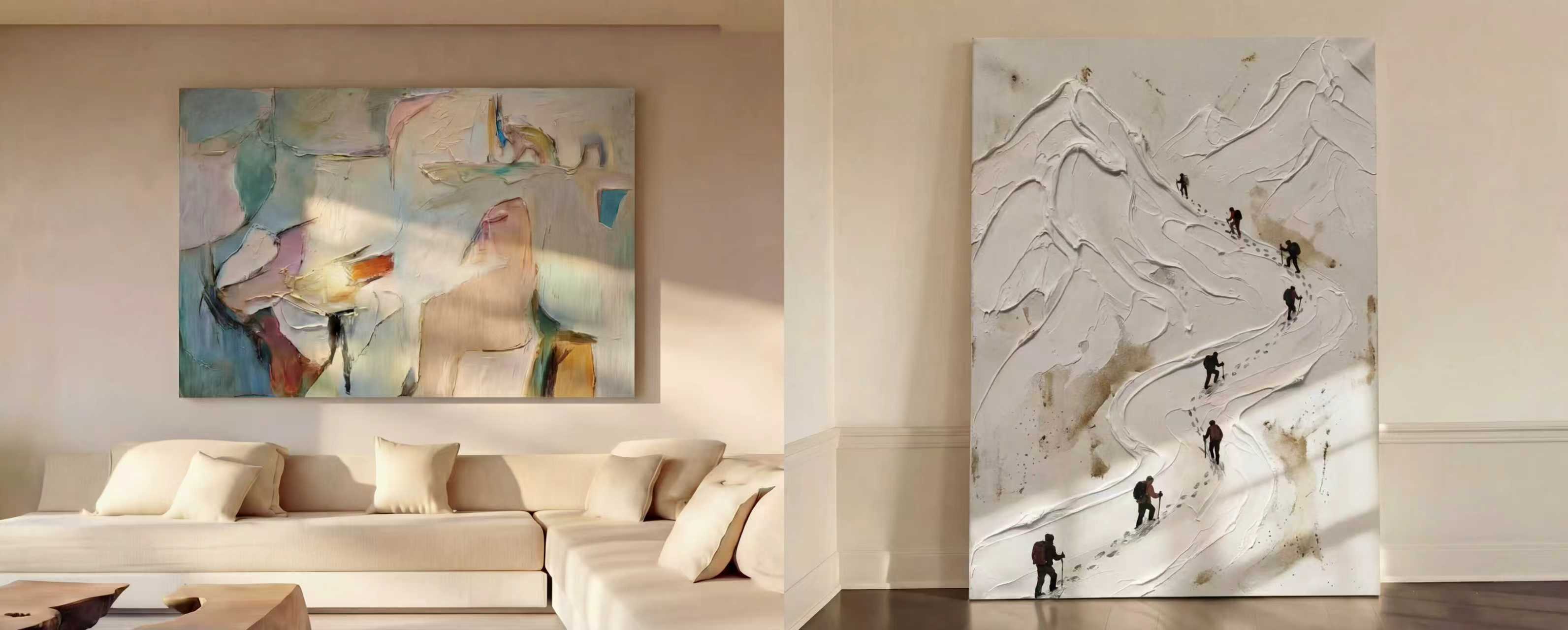
How High to Hang a Picture Above a Sofa — and Why Most People Get It Wrong
Getting the height right above a sofa comes down to two numbers: the gap between the sofa back and the bottom of the frame, and the overall center-point of the artwork. Nail both and the wall looks intentional. Miss either one and even great art feels off.
Quick read
Six inches of breathing room between sofa and frame is the quiet detail that separates a styled wall from a decorated one.
Browse related artFiguring out how high to hang a picture above a sofa is one of those decisions that sounds minor until you've lived with a piece that floats six inches too high — or practically rests on the cushions. The standard guidance is a gap of 6 to 10 inches between the top of the sofa back and the bottom edge of the frame, with the horizontal center of the artwork landing somewhere between 57 and 60 inches from the floor. That center-point aligns with average standing eye level, which is where the eye naturally settles when it sweeps a room.
These aren't arbitrary numbers. They come from the same principle used in gallery hanging: keep art in a zone where it reads as part of the room, not floating on the ceiling or pinned to the furniture. The sofa is just your anchor point.
The 6-to-10-Inch Rule — and When to Bend It
The 6-to-10-inch gap works for most standard sofas, which sit 30 to 36 inches tall at the back. If your sofa is lower — say, a low-profile sectional at around 28 inches — you can drop toward the 6-inch end of that range or even go slightly tighter. If it's a tall, high-backed piece closer to 38 inches, push toward 10 inches so the art doesn't feel like it's sitting on top of the frame.
There's one scenario where you can ignore the rule entirely: gallery walls. When you're hanging a cluster of frames, treat the overall composition as a single unit and apply the 6-to-10-inch gap to the bottom of that group, not to each individual piece.
Proportion Matters as Much as Height
Height placement and art proportion are two separate problems, and both have to be solved. A picture hung at the perfect height can still look wrong if it's the wrong width for the sofa.
- Width target: Aim for artwork that spans roughly two-thirds of your sofa's length. On a 90-inch sofa, that's about 60 inches of visual width — which could be one large piece, a diptych, or a tight grouping of three frames.
- Single large piece: Easiest to hang, strongest visual impact. Works especially well with abstract or minimal compositions.
- Two panels: Leave 2 to 4 inches between them. Treat the pair as one unit when measuring height.
- Three or more frames: Map out the arrangement on the floor first. Keep consistent spacing — 2 to 3 inches between frames — and find the center of the group before you mark the wall.
Under-scaled art is the more common mistake. A single 16×20 frame above an 84-inch sofa looks like a sticky note on a billboard. Go bigger than feels comfortable — the room almost always rewards it.
How High to Hang a Picture Above a Sofa: A Quick Decision Checklist
Before you put a nail in the wall, run through these:
- Is the bottom of the frame 6 to 10 inches above the sofa back? (Measure, don't eyeball.)
- Does the horizontal center of the piece fall between 57 and 60 inches from the floor?
- Is the artwork at least two-thirds the width of the sofa?
- Have you accounted for any ceiling features — a low beam, a sloped ceiling — that would force the art down or change its visual center?
- Is there a lamp or floor plant nearby that might visually compete with the piece at its chosen height?
If you're hanging in a room with 8-foot ceilings, these proportions almost always hold. With 9- or 10-foot ceilings, you have a little more room to breathe, but resist the temptation to go higher — the sofa is still your anchor, not the ceiling midpoint.
Low vs. Too High: What Each One Does to the Room
Hung too low, art looks like it grew out of the sofa. It merges with the furniture visually and loses its presence as a wall element. It can also create an uncomfortable sense of closeness — particularly noticeable if someone sitting on the sofa feels like the frame is right behind their head.
Hung too high, the piece disconnects from the room entirely. It starts competing with ceiling height and reads more like a ventilation cover than intentional décor. The wall below the art looks bare, and the sofa below looks abandoned.
The sweet spot — that 6-to-10-inch gap, centered at eye level — creates a visual conversation between the furniture and the wall. The sofa and the art feel like they belong to the same room, not two separate decisions.
Mistakes to Avoid
Hanging by feel alone. Most people hang art too high. It's a documented tendency, probably because holding a frame up and eyeballing it naturally tilts toward the comfortable upper-arm height, which is usually several inches above where it should land. Use a tape measure every time.
Ignoring the sofa height. The 57-to-60-inch eye-level rule applies to open wall space. Above a sofa, the sofa height is your real reference. A 34-inch sofa plus 8 inches puts your bottom frame edge at 42 inches — and that's where you start, not at 57 inches.
Choosing art that's too small. Mentioned above, but worth repeating: err large. A piece that feels slightly oversized in the store will almost always feel right on the wall.
Forgetting to check for light interference. Natural light from a nearby window can wash out a canvas or create glare on glass-covered prints depending on time of day. Check the wall at different times before committing.
What to Hang Above a Couch: A Few Practical Formats
The placement decision is tied to the format. Here's how common formats behave:
- Single large canvas: Clean, confident, minimal effort. Best for rooms that already have a lot of visual texture elsewhere.
- Horizontal diptych: Gives you width flexibility. Great for wide sectionals where a single piece would need to be enormous.
- Vertical pair: Less common but interesting above a sofa with low arms — draws the eye upward without adding horizontal bulk.
- Gallery wall: Adds energy and personality but requires planning. Map it on paper or use painter's tape on the wall before touching a hammer.
Abstract works tend to perform particularly well above sofas — they fill space without competing with the furniture's lines, and they let color do the work of connecting the piece to the room's palette. If you're still deciding on a direction, abstract wall art is a reliable place to start browsing by scale and mood.
FAQ
What is the ideal height to hang art above a sofa?
The bottom edge of the frame should sit 6 to 10 inches above the sofa back, with the center of the artwork at roughly 57 to 60 inches from the floor.
What size art should go above a sofa?
A piece or grouping that spans about two-thirds of the sofa's length is the most commonly cited proportion — wide enough to feel intentional, not so wide it overwhelms the wall.
Can I hang two pictures above a sofa?
Yes. Treat the pair as a single unit, space them 2 to 4 inches apart, and apply the height rules to the group's overall bottom edge and center point.
What if my sofa is very tall or very low?
Adjust the gap accordingly. Lower sofas can tolerate a slightly tighter gap (closer to 5 to 6 inches); taller sofas may need 10 inches or more so the art doesn't look stacked on top of the frame.
Should I center the art over the sofa or over the whole wall?
Center it over the sofa, not the wall — unless the sofa is perfectly centered on the wall itself. The sofa is the visual anchor; the art should respond to it.
When you're ready to find something scaled for the space, explore wall art for above the sofa at mipiece — organized by size so you can match proportions without guessing.