
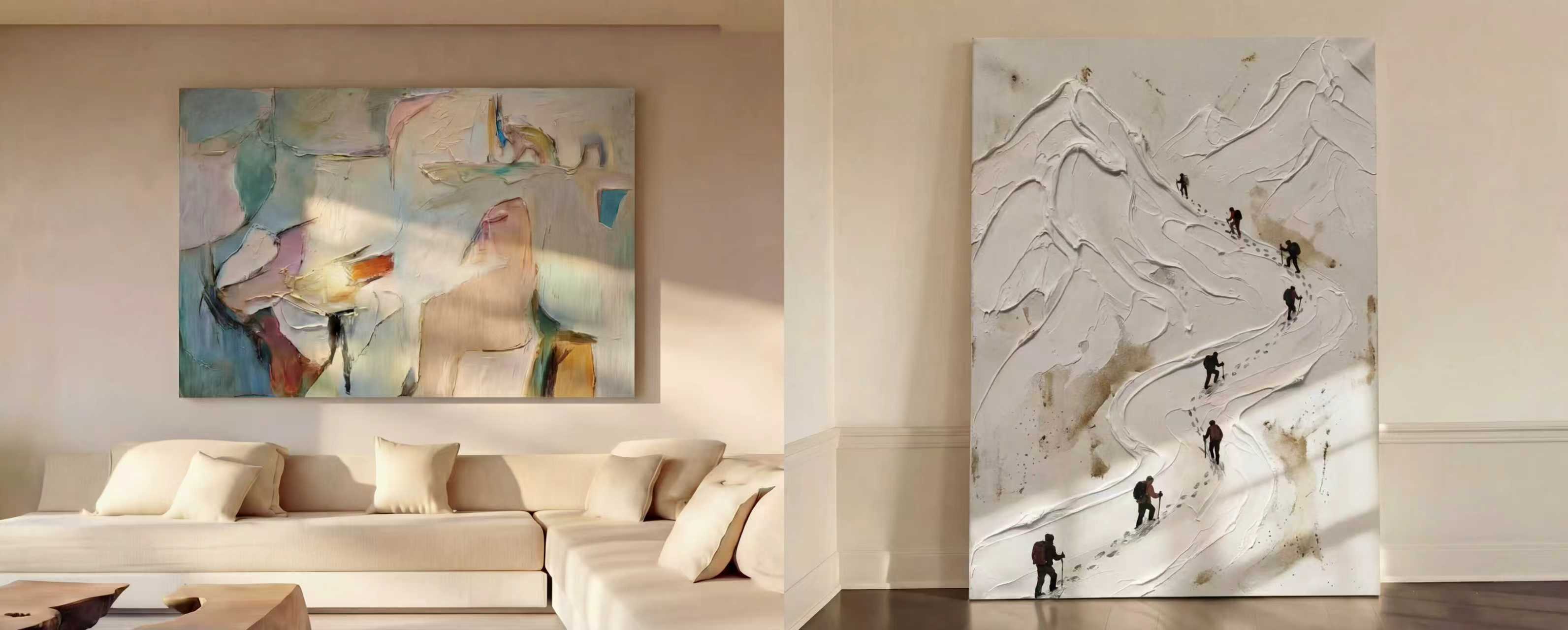
How to Choose Wabi Sabi Wall Art for a Real Home
Wabi sabi wall art leans into natural imperfection, quiet color, and organic form. The right piece feels calm rather than decorated. This guide walks through the specific criteria — texture, tone, scale, placement, and common tradeoffs — so you can buy with confidence instead of guesswork.
Quick read
The best wabi sabi art doesn't announce itself. It settles in, and you notice it more over time.
Browse related artWabi sabi wall art is one of those categories where the wrong purchase is easy to make. The aesthetic looks deceptively simple — neutral tones, loose marks, natural surfaces — but there's a meaningful difference between art that embodies the philosophy and art that just looks beige. Knowing how to choose wabi sabi wall art comes down to a handful of specific criteria, not a vague feeling.
The short version: prioritize texture, restrained color, some form of asymmetry or visible process, and appropriate scale. Everything else follows from those four. Here's how to think through each one.
What Wabi Sabi Wall Art Actually Is
Wabi sabi is a Japanese aesthetic rooted in finding beauty in transience and imperfection. In art, that translates to work that looks handmade, slightly worn, or deliberately unresolved. Think brushstroke marks that don't fill the entire canvas. Edges that blur. Surfaces that seem to have absorbed time rather than resisted it.
This is different from minimalism, though the two overlap. Minimalism tends toward precision and control. Wabi sabi allows for irregularity. A perfectly centered grid print is minimalist. A single ink wash with an uneven horizon line is wabi sabi. The distinction matters when you're shopping, because the label gets applied loosely.
The Four Buying Criteria That Matter
1. Texture — Real or Implied
Texture is the most reliable signal. Authentic wabi sabi art tends to have visible surface variation: the tooth of cold-press paper, the slight ridging of a brushstroke, the grain of linen canvas, or the unevenness of a hand-applied medium. When you're buying prints rather than originals, look for works that were made with textural media and captured that quality in the image — you should be able to see the materiality even in a flat reproduction.
Smooth, flat digital illustrations rarely land in this aesthetic, even if the color palette is correct.
2. Color Restraint
Wabi sabi palettes are almost always drawn from natural materials: warm grays, clay, undyed linen, weathered wood, soft sage, stone white, and the occasional muted terracotta. The key word is muted. Saturation is typically low. If a piece in the wabi sabi section has high-contrast colors or bright tones, trust your eye over the label.
That said, restraint doesn't mean boring. A single warm ochre brushstroke on an off-white ground can carry enormous presence — it just does it quietly.
3. Asymmetry and Visible Process
Perfect symmetry signals craft mastery. Wabi sabi signals something slightly different: the mark of a hand, the trace of a decision, the evidence that something was made rather than produced. Look for compositions where the weight is slightly off-center, where marks thin out toward an edge, or where empty space dominates one side of the frame. These aren't mistakes — they're the point.
4. Scale Relative to Your Wall
This is where a lot of purchases go wrong. Wabi sabi art depends heavily on negative space — both within the artwork itself and around it on the wall. A piece that's too small gets lost and loses its contemplative quality entirely. A piece that fills every inch of wall leaves no room for the work to breathe.
A reasonable starting point: your art should occupy roughly 60 to 75 percent of the usable wall width, with clear margins above furniture and to the sides. For wabi sabi specifically, err toward the lower end of that range and let the wall participate in the composition.
Room-by-Room Guidance
Living room: A large-format horizontal piece above a sofa — organic abstract, ink on paper, or a loose landscape — works particularly well here. Keep framing simple: natural wood, raw metal, or no frame at all with clean stretched canvas.
Bedroom: Scale down slightly and lean toward softer, cooler neutrals. A vertical piece flanking the bed or a small study above a nightstand reads more intimate. Avoid anything with sharp or busy mark-making — it competes with rest.
Home office or entryway: A single strong vertical piece, or a very spare diptych with clear space between panels, anchors without overwhelming a smaller wall. Entryways especially benefit from art that makes one clear statement rather than a gallery arrangement.
If you're browsing options, the organic modern collection includes pieces that translate well across these room contexts.
Framing and Hanging: Don't Undo the Work
The right art in the wrong frame is a real problem with this aesthetic. Heavy ornate frames, high-gloss finishes, and stark black profiles all pull against the wabi sabi quality. Natural wood frames in light oak, ash, or raw walnut tend to extend the material story of the work itself. White frames can work if they're matte and thin. Floating frames — where the artwork sits away from the mat — can look particularly good with works on paper.
For hanging height, center the piece at roughly eye level (typically 57 to 60 inches to the center of the artwork). Resist the urge to hang art too high, which is one of the most common and most correctable mistakes in any interior.
Mistakes to Avoid
- Buying by palette alone. A muted color scheme doesn't make something wabi sabi. Look for texture, process, and imperfection alongside the tones.
- Over-grouping. Gallery walls can work in a wabi sabi interior, but they require real restraint — fewer pieces, more space between them. When in doubt, one large piece outperforms five small ones in this aesthetic.
- Ignoring the frame. The frame is part of the object. A beautiful piece in a wrong frame will consistently disappoint.
- Scaling too small. Timid sizing is the single most common mistake. Measure your wall before you buy, not after.
- Chasing trends too literally. Wabi sabi as a search term has attracted a lot of product that uses the vocabulary without the philosophy. If something looks mass-produced and perfectly uniform, it probably doesn't belong in this category regardless of how it's labeled.
How to Choose Wabi Sabi Wall Art: A Quick Decision Checklist
Run any candidate piece through these questions before buying:
- Does it have visible texture, or evidence of a handmade process?
- Is the color palette genuinely muted — or just neutral on a bright screen?
- Is there asymmetry, empty space, or compositional tension?
- Have I measured the wall and confirmed the scale works?
- Does my framing choice complement or undercut the work?
If you can answer yes to the first four and have a plan for the fifth, you're in good shape.
FAQs
What makes art qualify as wabi sabi?
Wabi sabi art typically reflects imperfection, natural materials, handmade qualities, and restrained color. The aesthetic values the trace of process — a visible brushstroke, an uneven edge, empty space used deliberately — over polish or technical perfection.
Can prints work for a wabi sabi interior, or do I need originals?
Prints work well as long as the source artwork was made with textural, process-visible media. A high-quality print of an ink wash or a mixed-media abstract can carry the right feeling. What doesn't translate is trying to replicate the aesthetic through flat digital illustration.
How large should wabi sabi wall art be?
Larger than most people default to. Aim for a piece that covers roughly 60 to 70 percent of the wall width, and leave enough margin around it for the surrounding wall to function as negative space. This scale amplifies the contemplative quality that defines the style.
What colors are most appropriate for wabi sabi wall art?
Warm neutrals, muted earth tones, stone whites, soft grays, and occasional understated greens or terracottas. Low saturation throughout. The goal is color that feels like it came from a natural material rather than a paint swatch.
Does wabi sabi art work in modern or contemporary interiors?
Yes — often very well. The organic textures and restrained palettes of wabi sabi art provide warmth and tactility that purely contemporary interiors can lack. The pairing works especially well in spaces with clean-lined furniture, concrete or plaster walls, and natural material accents like wood and linen.
Ready to find the right piece? Browse the full selection at Shop wabi-sabi art and use the criteria above to narrow your choices with confidence.