
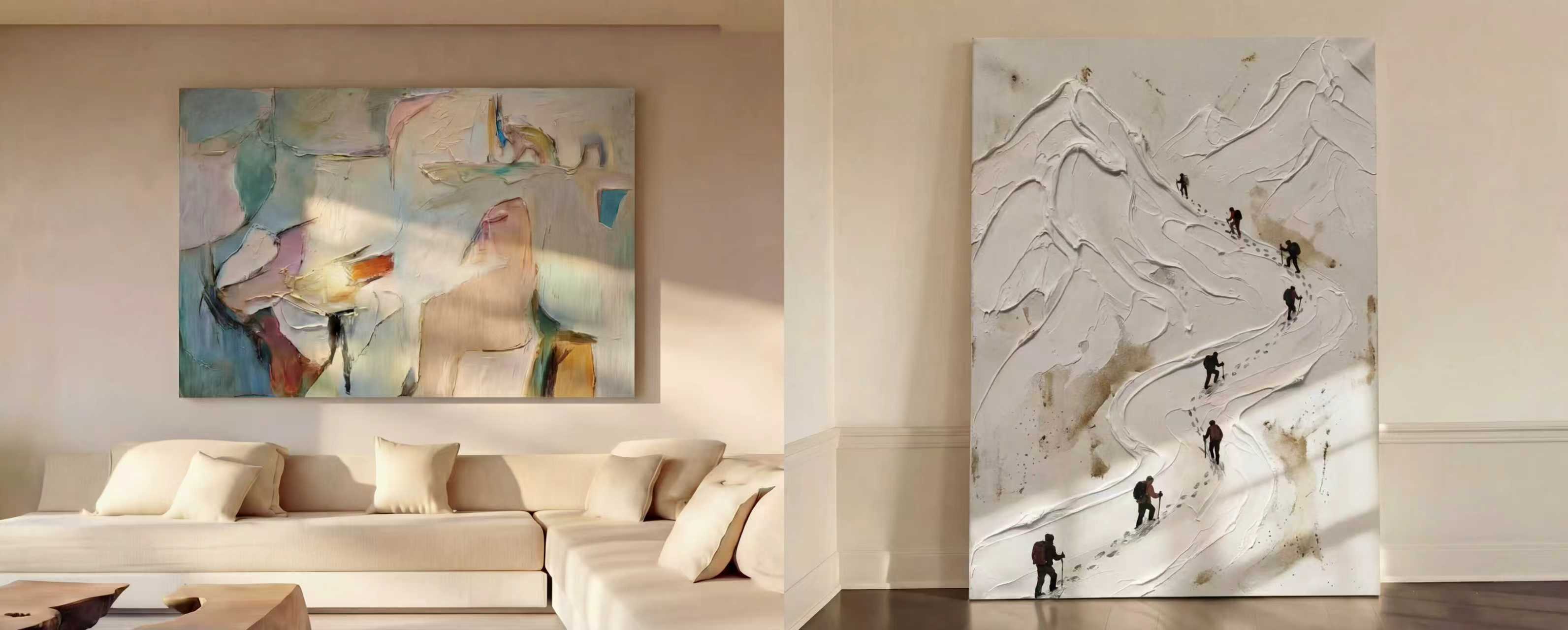
Large Vertical Wall Art for the Living Room: When It Works Best
Not every living room wall calls for a wide horizontal piece. Narrow gaps between windows, double-height walls, and awkward corners are exactly where large vertical wall art earns its place. This guide covers when to go vertical, how to size it correctly, and the placement mistakes worth avoiding.
Quick read
Vertical art is not a fallback — in the right room, it is the most intentional choice you can make.
Browse related artMost wall art buying advice defaults to horizontal: long sofa, wide piece above it, done. That formula works, but it ignores a significant portion of living room walls. Narrow stretches between windows, entryway-adjacent walls, double-height ceilings, and underused corners all respond better to large vertical wall art for the living room than to anything wide and low-slung.
The vertical format pulls the eye upward. That single gesture can make an eight-foot ceiling feel taller, a cramped corner feel considered, and a narrow wall feel like it was always meant to be a feature — not a problem to work around.
Where Vertical Art Actually Belongs
The most natural home for a tall piece is any wall where width is the limiting factor. Think of the sliver of drywall between two windows, the wall beside a fireplace that is only thirty inches wide, or the stretch of wall flanking a doorway. Horizontal art crammed into these spots looks forced. A single vertical canvas, hung at the right height, fills the space with intention.
Double-height living rooms are the other obvious candidate. When a wall climbs twelve, fourteen, or sixteen feet, a standard-sized horizontal piece floats in the middle of all that space and looks abandoned. A large vertical piece — something in the range of 24 by 48 inches or taller — gives the eye a path to travel and makes the scale feel purposeful rather than accidental.
Sizing Large Vertical Wall Art for the Living Room
There is no universal rule, but there are useful proportions. For a narrow wall between 24 and 36 inches wide, a canvas that fills roughly 60 to 75 percent of the available width tends to look balanced. Going wider risks feeling squeezed; going narrower loses impact.
Height is where vertical art has real range. On a standard ceiling, a piece between 36 and 48 inches tall hits the sweet spot — significant enough to register as a statement, proportionate enough to stay grounded. In rooms with ceilings above ten feet, you have room to go taller: 48 to 72 inches is not excessive if the wall supports it.
- Narrow wall (under 36 inches wide): 18–24 inches wide, 36–48 inches tall
- Standard ceiling (8–9 feet): Center the piece so the visual midpoint sits roughly 57–60 inches from the floor
- Double-height ceiling (10+ feet): Consider going 48–72 inches tall, or grouping two vertical pieces with a tight gap
- Corner anchoring: Position the piece on the dominant face of the corner, leaving 6–8 inches from the adjacent wall
Corner Anchoring: An Underused Technique
Corners are the most neglected real estate in a living room. Most people push a plant into the corner and move on. But a large vertical piece hung on one face of a corner — with furniture pulled slightly away from the wall — creates a vignette that reads as intentional design rather than furniture overflow.
The key is placement on the dominant face. Identify which wall your eye naturally travels to when you enter the room, and hang the piece there. Keep the art centered on that wall segment, not centered on the entire corner. A reading chair or narrow console in front of it completes the moment without blocking it.
Abstract compositions work particularly well here because they do not demand a specific viewing distance or a perfectly symmetrical setting. If you want to explore that direction, mipiece's abstract art collection has vertical formats that suit both narrow walls and corner placements.
Vertical vs. Horizontal: Reading the Room
The sofa wall is almost always a horizontal play. Wide furniture anchors wide art, and fighting that logic rarely pays off. But the rest of the living room is more flexible than most people realize.
A fireplace flanked by two tall vertical pieces — one on each side — creates symmetry without the boxy feeling of a single centered horizontal canvas. An entry wall that opens into the living room is another strong candidate for vertical format: it sets the tone before a guest even enters the main space.
If your living room has an architectural detail like a narrow built-in niche or a recessed panel, a vertical canvas that fits cleanly inside it is more refined than anything hung in front of it. Let the architecture do part of the work.
Surface Depth and the Case for Textured Art
Scale is not only about dimensions. A large vertical piece in a flat matte print can disappear against a textured wall or in a room with heavy upholstery. Adding physical depth — through canvas texture, layered mediums, or relief elements — gives the piece presence from multiple angles and across different lighting conditions.
In living rooms with directional natural light, a piece with surface variation catches the light differently throughout the day, which keeps it from feeling static. 3D textured wall art handles this particularly well in rooms where the art needs to hold its own against strong afternoon sun or warm evening lamp light.
Mistakes Worth Avoiding
Hanging too high is the most common error with vertical art. People assume tall pieces belong near the ceiling. They do not. The visual center of the piece should sit at or just below eye level — approximately 57 to 60 inches from the floor — regardless of how tall the canvas is. The art should meet the viewer, not hover above them.
- Do not hang vertical art directly above a sofa unless the piece is narrow enough that it does not visually compete with the furniture's width. A tall, narrow canvas above a wide sofa looks unstable.
- Do not rely on one small piece to fill a large vertical space. If the wall demands scale, commit to it. A piece that is too small for its wall reads as an afterthought.
- Avoid centering vertical art on a wall that has strong horizontal furniture running along it. The competing directions fight each other. Either move the furniture or choose a different wall.
- Do not skip wall anchoring. A tall canvas has a higher center of gravity. Use two hanging points or a proper cleat for anything over 24 inches tall.
Frequently Asked Questions
What size vertical art works best in a small living room?
In a small living room, one vertical piece in the 24 by 36 inch range is usually enough. Going larger in a tight space risks overwhelming the room, but going too small makes the art look accidental. One well-sized piece is always stronger than several undersized ones scattered around the room.
Can I hang large vertical wall art in a living room with low ceilings?
Yes — and it can actually help. A tall vertical piece draws the eye upward, which creates the illusion of height. Keep the piece proportional to the wall width, and hang it so the center sits at standard eye level rather than pushing it toward the ceiling.
How far from the corner should I hang vertical wall art?
Leave at least six to eight inches between the edge of the canvas and the adjacent wall. This gives the piece breathing room and keeps it from looking like it was hung there because nowhere else was available.
Should vertical wall art match the furniture below it?
It does not need to match, but it should relate. Look for a shared color, tone, or material quality rather than a literal match. A dark walnut console under a piece with deep ochre or charcoal tones creates cohesion without being decorative in an obvious way.
Is one large vertical piece better than a gallery wall in a narrow space?
Usually, yes. Gallery walls require width to breathe properly. A narrow wall that gets a gallery treatment tends to feel cluttered. One confident vertical piece is cleaner and more impactful in a tight space.
Ready to find the right scale and format for your wall? Browse large vertical wall art and find something that fits the room rather than just filling it.