
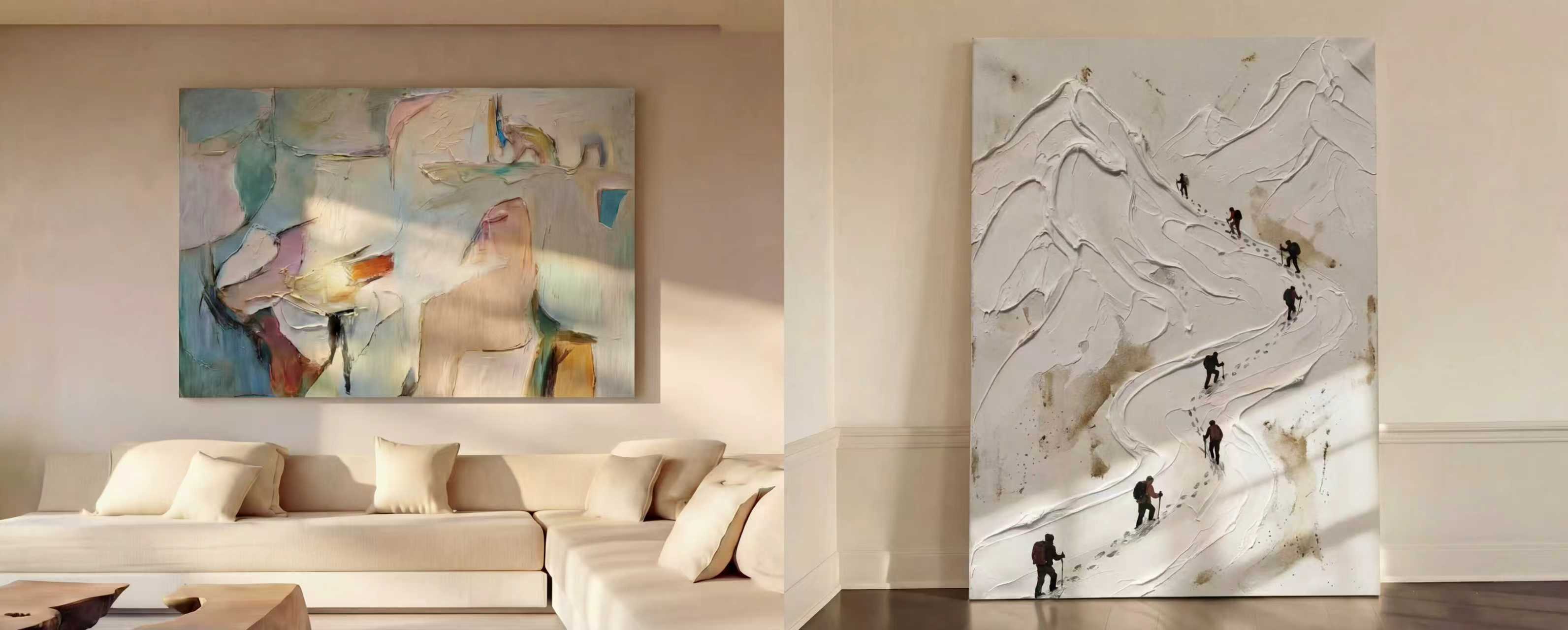
Modern Wabi Sabi Interior Design and the Art That Fits It
Wabi sabi is a Japanese aesthetic rooted in finding beauty in things that are worn, uneven, or incomplete. In modern interiors, it shows up as muted palettes, raw materials, and a deliberate resistance to visual clutter. The wall art that belongs in these rooms isn't polished or symmetrical—it carries texture, organic form, and a sense of something made by hand or shaped by nature.
Modern wabi sabi interior design isn't a trend with a mood board and a shopping list. It's closer to a point of view—one that treats worn edges, quiet neutrals, and organic irregularity as genuinely beautiful rather than flaws to fix. Wall art plays a specific role in that philosophy: it should add presence without demanding attention, texture without noise.
If you've been drawn to rooms that feel calm, grounded, and somehow timeless, this guide will help you understand what makes them work—and how to choose art that belongs there rather than just fills the wall.
What Wabi Sabi Actually Means for a Modern Room
The phrase comes from two Japanese concepts: wabi, roughly meaning rustic simplicity, and sabi, the beauty that comes with age and wear. Together, they form an aesthetic that values the unfinished, the handmade, and the quietly imperfect over the smooth and the new.
In a contemporary American home, this translates to linen instead of polyester, raw plaster instead of high-gloss paint, and furniture with visible grain or patina. Rooms feel intentional but never fussy. There's usually a lot of breathing room—both physically and visually.
What this means for wall art specifically: prints that mimic mass production or rely on bold graphic impact tend to read as wrong in these spaces. The art that fits carries something quieter. An ink wash with uneven edges. A botanical study rendered in charcoal. An abstract piece that looks like it was made by a person, not a software preset.
Room by Room: Where Wabi Sabi Art Lands Best
Above the sofa
This is typically the highest-stakes wall in a living room, and the temptation is to fill it with something large and striking. In a wabi sabi interior, that impulse is worth resisting. One medium-to-large piece with a muted, earthy palette—think sand, charcoal, warm taupe, or faded sage—will anchor the seating area without overwhelming the room's quieter elements. An abstract landscape with visible brushwork or a piece with organic, irregular shapes tends to work better here than a clean geometric print.
Scale still matters: art that's too small above a long sofa looks timid. Aim for a width that covers roughly two-thirds of the sofa's length, but let it hang at a comfortable eye level rather than pushing it flush to the ceiling.
The bedroom wall
Above a bed is one of the most personal placements in any home. In wabi sabi rooms, that wall often holds a single piece—or nothing at all. When art is used, it tends to be subtle: a delicate ink composition, a soft abstract in cream and warm gray, or something with a natural motif like dried botanicals or water-worn stone. The point is to create a sense of rest, not visual stimulation. Frames, if used at all, are usually thin and natural—pale wood or simple black—never ornate.
Entryways and hallways
These transitional spaces are underestimated. In a wabi sabi home, a hallway isn't just a corridor—it's the first breath of the interior. A single vertical piece with organic texture, or a small grouping of two or three closely related works, sets the tone before a visitor reaches any other room. Here, art with visible texture—paper grain, soft brushstrokes, uneven hand-lettering—rewards close viewing in a way that a glossy print does not.
The dining room
Dining walls in wabi sabi interiors tend toward the understated. One well-chosen piece across from the table, or a pair of smaller works flanking a window, suits the spirit better than a gallery wall crammed with mismatched frames. Art with a botanical or natural-world quality—abstracted plant forms, earthy landscapes, organic mark-making—reinforces the grounded, sensory quality that good meals already carry.
What Defines the Essence of Organic Modern Art in This Context
Wabi sabi and organic modern are distinct but closely related. Organic modern tends to be slightly warmer and more curated than strict wabi sabi—it allows for more comfort and polish while still favoring natural materials and flowing, asymmetrical forms. The art that bridges both aesthetics usually shares a few traits:
- Visible texture or mark-making — brushwork, grain, or gestural lines that remind you a human hand was involved
- Muted, earth-rooted color — warm whites, sandy tans, clay, soft sage, slate, and charcoal rather than primaries or bright pastels
- Asymmetry — compositions that don't feel centered or balanced in a conventional way
- Negative space — what's left empty in the piece is as deliberate as what's included
- Natural motifs — botanical forms, water, stone, wood, or abstract interpretations of landscape
If a piece feels loud, shiny, or engineered to impress, it probably won't fit. If it makes you slow down and look more carefully, it probably will.
What Wabi Sabi Wall Art Is Not
This is where a lot of interiors go slightly wrong. A few things worth avoiding:
- Trendy minimalism without warmth — stark white prints with thin black sans-serif text aren't wabi sabi, they're just flat. Wabi sabi needs tactile or tonal depth.
- Over-curated gallery walls — the aesthetic works against symmetrical grids of matching frames. If you want multiple pieces, let the arrangement breathe and feel a little loose.
- Motivational or typographic prints — words on walls, however tastefully set, introduce a different kind of energy than what wabi sabi invites.
- Overly literal nature imagery — a photographic print of a forest is nature, but it isn't necessarily wabi sabi. The aesthetic is more about evoking the feeling of the natural world than illustrating it.
- Too many pieces — one strong work in a room almost always outperforms five mediocre ones. Restraint is the practice.
How to Choose a Piece You Won't Regret
Start with the wall, not the art. What's the light like? Is the wall large or narrow? What's already in the room—the furniture, the textiles, the floor? Wabi sabi art should feel like it grew out of those decisions, not arrived separately from them.
Then consider the room's dominant undertone. Warm rooms—cream, tan, terracotta, soft wood—tend to carry art with warm neutrals and organic ink tones well. Cooler rooms with more gray, slate, or linen lean toward charcoal, dusty sage, and muted blue-green. You don't need to match exactly, but the art shouldn't fight the room's temperature.
Finally, consider what the piece asks of you. Wabi sabi art rewards presence. If a print looks complete the moment you glance at it and offers nothing more, it probably isn't doing the job. Look for work that has something to unfold—a subtle gradient, an edge that trails off, a texture that changes in different light.
If you're looking to start exploring, mipiece has a focused edit of wabi sabi and organic wall art that approaches this aesthetic without forcing it.
Frequently Asked Questions
What makes wall art feel wabi sabi rather than just minimalist?
Minimalism tends to prize clarity and reduction. Wabi sabi goes further—it values imperfection, organic irregularity, and the sense that time or nature has touched something. Wall art that's simply sparse isn't wabi sabi. Wall art with visible texture, earthy tone, and a slight feeling of incompleteness comes closer.
Can wabi sabi art work in a room that isn't fully wabi sabi in style?
Yes. Art with organic, earthy qualities can work in transitional, Scandinavian, or even soft-industrial interiors. The key is that the piece doesn't fight the room's material palette. If the surrounding space is very glossy or very colorful, the contrast will undercut the art's quieter qualities.
What frame works best with wabi sabi wall art?
Simple natural wood frames—light oak, pale birch, or unfinished wood—suit the aesthetic best. Thin black metal frames can work in rooms with more modern bones. Heavy ornate frames or bright white gallery frames tend to pull the energy in the wrong direction.
How large should wabi sabi art be in a living room?
There's no single rule, but one substantial piece often reads better than a cluster of small ones. Above a standard sofa, something in the 30–40 inch wide range typically holds the wall well without overpowering the room. The more breathing room you can give the piece on the wall, the more impact it tends to have.
Is wabi sabi wall art always abstract?
Not necessarily. Botanical illustration, gestural landscapes, and figure work can all carry the right qualities if they have texture, organic form, and a restrained palette. Abstract work simply tends to be a natural fit because it doesn't impose a specific narrative—it leaves room for interpretation, which aligns with the wabi sabi spirit.