
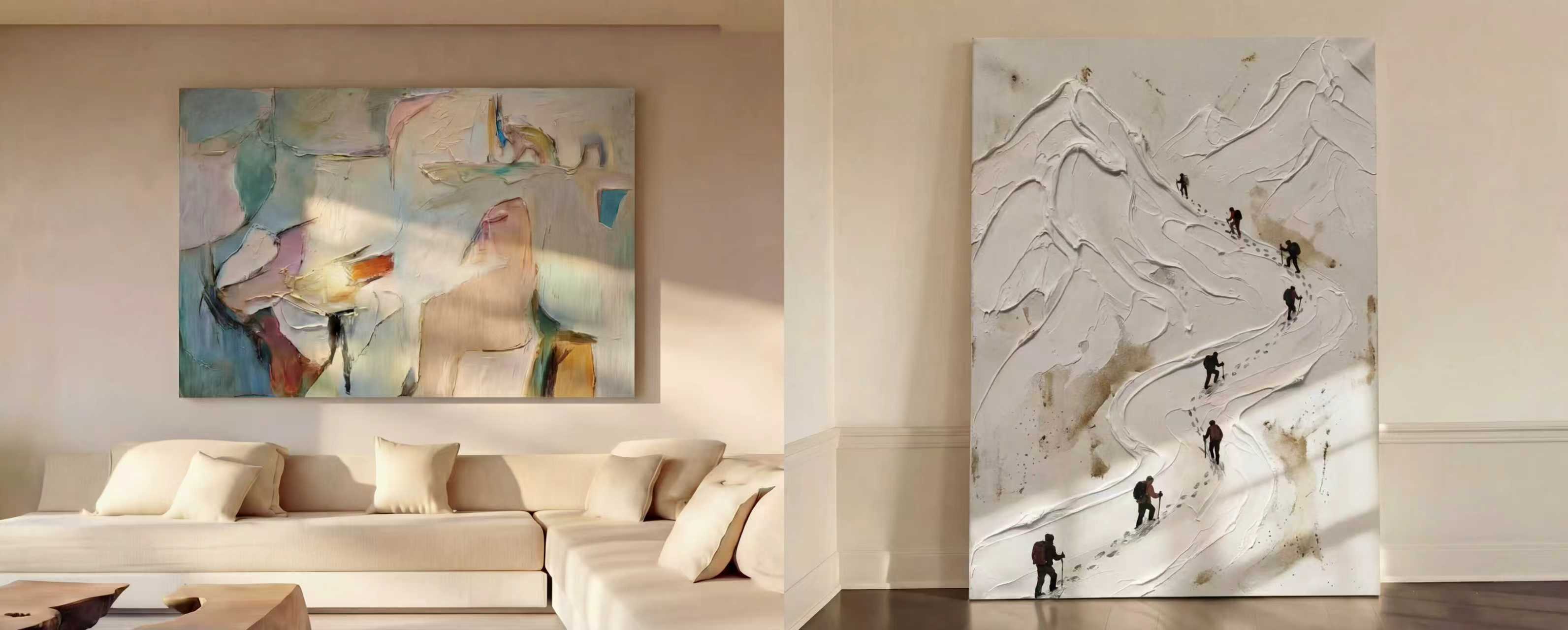
Original Painting vs Print: Which One Makes More Sense for Your Space?
The original painting vs print debate doesn't have one right answer. It depends on how much wall you're working with, what you want the piece to do emotionally, and how honest you want to be with your budget. This guide breaks down the real tradeoffs so you can make a confident call.
Quick read
Authenticity and affordability rarely live in the same frame — knowing which one matters more in your room is the whole decision.
Browse related artThe question comes up every time someone gets serious about decorating a wall that actually means something. Original painting or print? Both can look stunning. Both can look cheap if you choose wrong. The difference isn't just about price — it's about what you're buying for, and whether the answer changes room by room.
Here's the honest breakdown: originals offer texture, singularity, and a certain weight that reproductions can't fully replicate. Prints offer consistency, scale flexibility, and a price point that lets you take risks. Neither is automatically better. Let's work through the actual decision criteria.
What You're Really Paying for With an Original Painting
An original painting is, by definition, a one-of-one object. Someone made physical decisions — palette knife pressure, layering order, brush drag — that can never be exactly repeated. That irreproducibility is part of what you're purchasing.
Beyond the romantic idea of uniqueness, there are practical differences worth noting:
- Texture and surface dimension. Impasto technique, layered mediums, and canvas grain create depth that photographs don't capture and prints can't replicate without significant post-processing.
- Provenance and resale potential. Originals from documented artists can appreciate. Prints, with rare exceptions, do not.
- Conversation weight. An original tends to anchor a room differently — visitors notice it, ask about it, remember it.
The tradeoff is straightforward: originals cost more, sometimes significantly more, and the quality range is enormous. A poorly executed original is not automatically better than a well-produced print.
Where Prints Win — and They Do Win in Several Scenarios
A high-quality giclée print on archival paper or canvas can hold extraordinary color fidelity and last decades when properly stored and framed. For buyers decorating rental apartments, staging homes, or building a gallery wall with five or six pieces, prints make obvious financial sense.
Prints also solve a scale problem that originals rarely can. Need a 60-inch-wide piece for a dining room accent wall? A custom-sized print is a realistic option. A painting that size from an emerging artist will cost multiples more and may take months to commission.
Some specific cases where prints are the stronger choice:
- You want multiples of the same image across different rooms
- You're furnishing a short-term or transitional space
- You're building a large gallery wall on a fixed budget
- The image itself — a photograph, a graphic composition — doesn't depend on physical texture for its impact
The Original Painting vs Print Decision: A Practical Checklist
Before you spend anything, run through these questions honestly.
1. What is the piece's visual job in this room?
If the wall art is a focal point — above a bed, centered on a living room wall behind a sofa — an original earns its premium more readily. If it's part of a larger composition, a print holds its own just fine.
2. How much texture matters to you?
Texture is the thing photographs and screens can never communicate. If you've stood in front of a painting and felt pulled in by its surface, you already know texture matters to you. If you've bought prints before and never felt anything was missing, you likely don't need an original to be satisfied.
3. What's your honest budget ceiling?
Set a real number before you start browsing. Original paintings at quality galleries start higher than most people expect. If that ceiling is below what good originals realistically cost in your preferred style, don't stretch — a well-chosen print in a good frame will outperform a compromised original every time.
4. Is this a forever home or a transitional space?
Originals reward stability. If you're moving in two years, the risk calculation changes. Prints travel well and can be reframed for new spaces.
5. Do you care about supporting an individual artist?
Buying an original means buying directly from someone's practice. That matters to some buyers in a real way. If it matters to you, it's worth factoring in as a non-financial value.
Mistakes to Avoid on Both Sides
People consistently make the same errors in this decision, regardless of which direction they lean.
- Buying a cheap original to feel like you're getting authenticity. A mass-produced "original" painting — the kind sold in bulk at import furniture shops — offers neither the investment value nor the artistic integrity that makes originals worth their premium. If you can't verify who made it and why, approach it as you would any decorative object.
- Buying a print without considering the frame. A print in a poorly chosen or flimsy frame loses most of its visual credibility. Budget accordingly. A $90 print in a $150 custom frame outperforms a $90 print in a $20 poster frame by a visible margin.
- Ignoring scale. This applies to both. A small original on a large wall is a missed opportunity. A print stretched beyond its native resolution looks soft and unconvincing. Always check print dimensions against your wall before ordering.
- Assuming prints look cheap. A well-produced giclée on museum-quality canvas, properly framed and lit, can read as substantial and considered. The assumption that prints signal budget-consciousness says more about framing choices than print quality.
Where to Find Quality Contemporary Art for Sale
If you're looking at originals, reputable options include independent artist studios, vetted online platforms that represent working artists, regional art fairs, and gallery shows. Always ask about the artist's practice, the medium, and what documentation comes with the work.
For prints, the quality range is wide. Look for archival inks, specified paper or canvas weights, and clear information about edition size. Open-edition prints are fine for decorating; limited editions carry slightly more collectible weight but shouldn't be confused with originals.
For buyers who want the visual richness of texture and dimension without commissioning a full original, 3D textured wall art occupies a genuinely interesting middle ground — offering physical surface depth through specialized production methods. It's not an original painting, and it doesn't claim to be, but it closes some of the sensory gap that flat prints leave open.
Frequently Asked Questions
Is an original painting always worth more than a print?
Not automatically. An original by an unknown artist with no documentation may hold less market value than a signed limited-edition print by a well-known name. Value depends on the artist, provenance, condition, and demand — not the format alone.
Can you tell the difference between a high-quality print and an original on a wall?
At distance, often no. Up close, texture and surface variation become apparent on originals. Prints on textured canvas can approximate this somewhat, but the physical depth of an original is still distinct to a trained eye.
How do I know if a print is archival quality?
Look for giclée printing specifications, archival or acid-free paper or canvas, and pigment-based (not dye-based) inks. Sellers who don't list this information should be asked directly.
Does framing affect how an original vs print looks on the wall?
Significantly. Framing choices — depth, material, matting — affect the perceived weight and formality of any piece. A gallery-wrap canvas original with no frame reads differently than the same painting behind glass in a painted wood frame. Prints gain credibility with intentional framing.
What's a reasonable budget for a quality original painting?
This varies widely by artist, size, and market. Emerging artists may price originals from a few hundred dollars upward; established gallery artists will price them much higher. Set a ceiling based on what the piece needs to do in your home, not what you hope to spend.
If you're ready to explore wall art that brings genuine visual presence without requiring an original-painting budget, browse original-feel wall art at mipiece and see what works for your space.