
Stillness and Motion: Why This Weeping Portrait Stops a Room Cold
This hand-painted canvas by Fir Gallery divides its composition into two opposing halves — a still, pale face on the left and dense swirling hair on the right — to produce artwork that reads dramatically from across a room but stays livable up close. It suits neutral and soft-modern interiors especially well, and holds its own without needing nearby color support.
Quick read
Two halves, one unresolved tension — that's exactly what makes it work.
Product reference
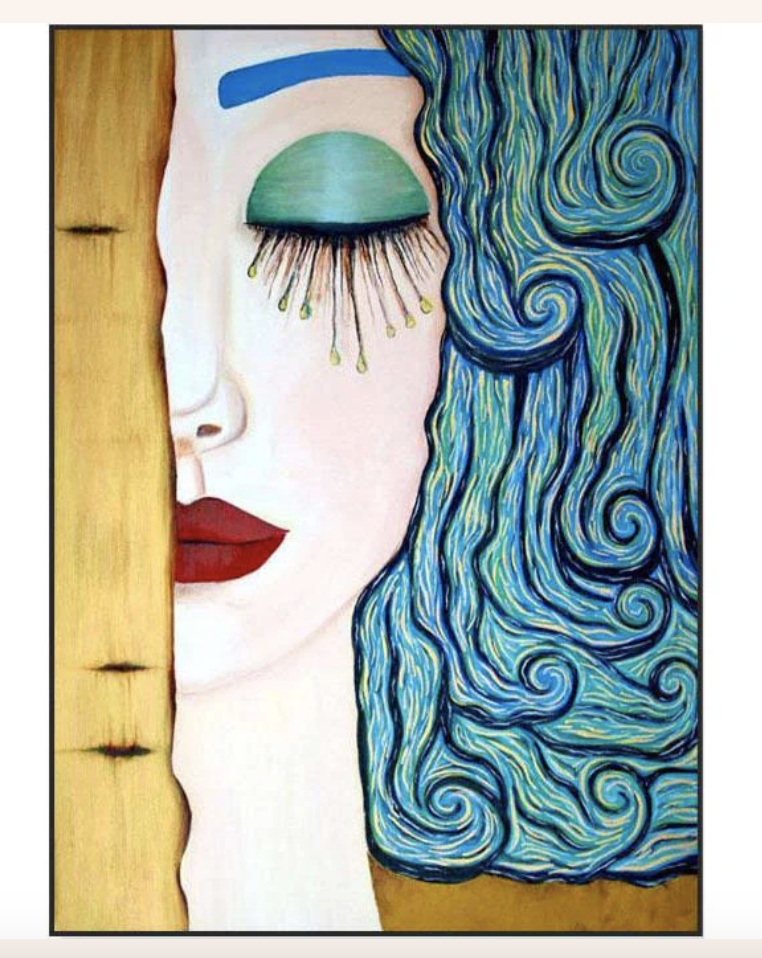
The composition announces itself quickly. A pale, close-cropped face occupies the left half of the canvas — closed eye, a domed green lid, long radiating lashes with small tear droplets suspended at the tips, and deep red lips below. The right half belongs entirely to hair: dense interlocking spirals in cobalt, teal, and pale gold that move with the kind of restless energy associated with Van Gogh's post-impressionist brushwork. A narrow strip of raw warm wood interrupts the left edge, grounding the whole image with a quiet organic note.
What holds the piece together — and what makes it worth looking at past the first thirty seconds — is that those two halves never quite resolve. The stillness of the face and the motion of the hair coexist in genuine tension. Neither side overtakes the other. That's harder to pull off than it sounds, and it's the main reason this canvas reads as art rather than decoration.
How It Reads in a Room
At medium scale, this piece has enough visual weight to anchor a wall without dominating the whole room. The blue-tonal range — cobalt running into teal, with pale gold threading through — is strong enough to read from across a living room but calm enough to avoid feeling aggressive against cream, warm white, or soft gray walls.
Daylight brings out the texture of the hand-painted surface and the layered spiral work in the hair. Under warmer lamp light in the evening, the cobalt deepens and the face grows quieter — the composition actually shifts in mood between morning and night, which is more than most canvas art manages.
Where It Works Best
Above a neutral linen sofa in a living room is probably the most natural fit. The horizontal scale of a sofa gives the canvas room to breathe, and the blue range pulls the eye without unsettling a soft, collected palette. Keep surrounding accessories restrained — light oak shelving, matte frames, simple textiles — and the painting does the heavy lifting on its own.
In a bedroom behind the headboard, the half-face composition reads as contemplative rather than confrontational. It's expressive without being intrusive, which matters in a room meant for rest. A reading lamp positioned nearby will warm the face and let the swirling hair catch the light differently depending on the angle.
A home office wall facing the desk is a less obvious choice that actually works well. The piece has a strong visual structure without being loud — it gives the eye somewhere interesting to land without pulling focus away from work the way busier abstract art sometimes does.
What to Pair It With
Furniture in warm white linen or soft teal upholstery aligns naturally with the canvas's color story without creating too much visual competition. Light oak wood nearby — shelving, a side table, a bed frame — picks up the warm gold strip on the left edge. Matte charcoal frames on nearby smaller pieces add contrast without fighting the blue range.
Bohemian interiors, soft modern rooms, and spaces with Art Deco leanings all accommodate this piece well. It's less at home in stark minimalist environments where its emotional weight can feel slightly at odds with the surroundings.
Realistic Expectations
This is a figurative piece, which means it carries a human presence. Some buyers underestimate how differently figurative art reads from abstract wall art — even a partial face introduces a psychological note that pure pattern or color-field work doesn't. That's not a flaw, but it's worth sitting with before purchasing. The closed eye and tear droplets keep the emotional register melancholy-adjacent rather than neutral, so rooms built around comfort and calm respond to it better than high-energy entertaining spaces.
The hand-painted surface also means slight texture variation is part of the piece, not a defect. The spiral work in the hair in particular shows brushwork up close that printed reproductions can't replicate.
Product Details
- Type: Hand-painted canvas wall art
- Size category: Medium
- Style: Abstract figurative, pop-art influenced, illustration-adjacent
- Subject: Figure — partial female face with swirling hair
- Color range: Cobalt, teal, pale gold, cream, deep red, warm wood
- Finish: Hand-painted surface with visible brushwork texture
- Best rooms: Living room, bedroom, home office
- Interior style fit: Bohemian, soft modern, Art Deco
- Recommended placement: Above a sofa or headboard, centered at eye level; on a feature wall with clear space around it; between narrow shelving units in a home office
- Furniture pairings: Warm white linen, light oak wood, soft teal upholstery
If you're building a room around a single piece with genuine staying power, Swirling Blue Portrait Weeping is worth the wall space.