
What Defines the Essence of Organic Modern Art in a Home
If you've been drawn to art that looks both spare and warm at the same time, you're probably circling the organic modern aesthetic. This guide breaks down what actually defines the style, separates the myths from what works in real rooms, and helps you figure out whether this kind of wall art belongs in your space.
Quick read
Organic modern art isn't about emptiness — it's about the right kind of presence.
Browse related artThere's a particular kind of wall art that stops people mid-scroll. It's not bold or loud. It doesn't demand attention the way a statement canvas does. But it's also not just a neutral placeholder. It has warmth, weight, and a sense that someone thought carefully about it. That's usually organic modern art — and understanding what defines it makes it much easier to buy well.
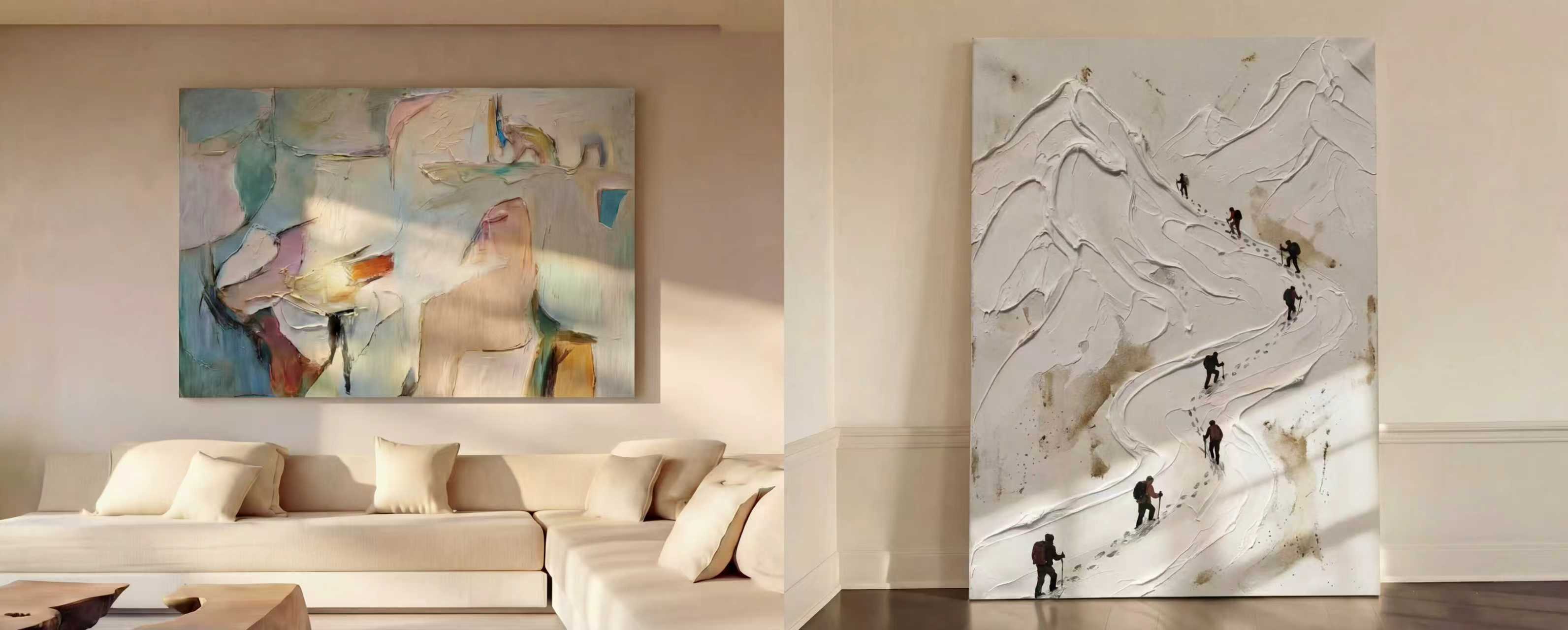
At its core, what defines the essence of organic modern art is the tension between restraint and life. The forms are simplified, sometimes abstract, but they borrow their shapes and colors from the natural world rather than from geometry or urban culture. Think worn stone, dried botanicals, slow water, coastal fog. The palette runs toward sand, clay, sage, warm white, and charcoal — never neon, rarely pure black.
Myth vs. Reality: What Organic Modern Art Actually Is
A lot of shoppers assume organic modern just means beige abstract art. That's understandable — the market is flooded with pieces that use neutral tones without any real intention behind them. But color softness alone doesn't make something organic modern. The distinction matters when you're trying to build a room that actually holds together.
- Myth: Any abstract print in a neutral color qualifies.
Reality: The composition needs to suggest natural form — a horizon, a stone's silhouette, a leaf's curve — even when it's fully abstract. - Myth: Organic modern art has to be minimal to the point of boring.
Reality: Some of the strongest pieces in this style carry real textural density. Layered washes, visible brushwork, and soft marks give the work presence without noise. - Myth: It only works in white or gray rooms.
Reality: Organic modern art often performs better against warm whites, limewash walls, wood paneling, or even a deep terracotta. The softness of the palette is flexible, not fragile. - Myth: Wabi-sabi and organic modern are the same thing.
Reality: They overlap, but they're not identical. Wabi-sabi art leans into imperfection and transience as a philosophy. Organic modern is more of a visual style — it borrows the warmth and humility of wabi-sabi without necessarily carrying its full aesthetic weight.
The Visual Language: Forms, Color, and Composition
Three elements consistently show up in work that earns the organic modern label.
Form
Shapes are rounded, irregular, or suggestive of something found rather than drawn. You might see abstracted coastlines, loose pebble-like clusters, or compositions that echo the cross-section of an agate or a tree ring. Hard angles are rare. Even when the piece is technically geometric, the edges tend to soften.
Color
The palette draws from materials: unbleached linen, dried clay, river stone, pale bone, moss. Warm undertones dominate. Cool grays appear occasionally but are usually offset by something warmer nearby. Saturation stays low, but the tones aren't flat — there's often visible variation within a single field of color, the way natural materials always carry slight inconsistency.
Composition
Space is used deliberately. Negative space isn't empty — it's weight-bearing. A single organic form placed off-center against a lot of open ground can carry more visual authority than a busy canvas. This is where minimalist abstract art meaning becomes relevant: the restraint isn't laziness, it's precision about what deserves attention.
How It Works in Real Rooms
Scale is probably the most common mistake people make when placing organic modern art. Because the style is quiet, there's a tendency to go smaller than the room needs. A 12x16 print in the center of a large wall doesn't create calm — it creates an awkward void. The style actually works best when you commit to the size.
In a living room with a large sofa, a single oversized piece — something in the 40x50 range, or a diptych that spans similar width — anchors the space without competing with the furniture. The art and the room settle into each other.
For bedrooms, the organic modern aesthetic is particularly well-suited above the bed. The softness of the palette translates into something genuinely restful. A horizontal landscape-format piece, loosely abstract, with warm earth tones, will quiet a room better than almost any other style. Avoid anything with strong contrast or sharp graphic lines in this position — it works against the purpose of the space.
In a hallway or entryway, a single vertical piece with a strong but unhurried composition sets the tone for the whole home. This is one of those spots where less really does work harder.
If you're building a gallery wall in this style, keep the frames consistent — natural wood, thin black, or simple white — and let the art carry the variation. Mixing too many frame styles fragments the calm the work is trying to create.
What to Avoid
A few patterns reliably undercut what organic modern art is trying to do in a room.
- Pairing it with very high-contrast decor. Black lacquer furniture, chrome fixtures, and glossy surfaces pull against the style's warmth. The art ends up looking lost or out of place.
- Hanging it too high. Eye level means the center of the piece sits roughly 57–60 inches from the floor. Above a sofa, the bottom edge of the frame should sit about 6–8 inches above the furniture, not floating near the ceiling.
- Choosing prints that are labeled organic modern but are actually just cool-toned geometric abstracts. If the color temperature is cold or the shapes are mechanical, it's a different style category regardless of what the listing says.
- Over-accessorizing around it. Organic modern art benefits from breathing room. A few considered objects — a ceramic vase, a linen throw, something in natural material — support it. A cluttered surface below it competes with it.
Modern Wabi-Sabi Interior Design and the Overlap
It's worth spending a moment on the relationship between organic modern art and modern wabi-sabi interior design, because shoppers often encounter both terms when researching this aesthetic and they're not always distinguished clearly.
Wabi-sabi as a design philosophy values imperfection, asymmetry, and the beauty of things that show time. A handmade bowl with an uneven rim, a wall with slightly inconsistent limewash, a piece of driftwood left in its natural state — these are wabi-sabi instincts. Art that fits a wabi-sabi interior tends to have visible process: the brushstroke, the paper edge, the unpredictable mark.
Organic modern borrows that sensibility but sits in slightly more curated territory. The pieces are still warm and natural in their references, but the composition is more considered, the production more deliberate. You can use organic modern art in a wabi-sabi room and it will feel at home. But the reverse isn't always true — heavily produced, perfectly reproduced prints may undercut a space built around wabi-sabi values.
The practical upshot: if your room skews raw and handmade, look for art with visible texture or process. If your room is cleaner and more controlled, a crisper organic modern print will often serve better than something intentionally rough.
Frequently Asked Questions
What makes wall art organic modern rather than just minimalist?
Minimalist art often works with geometric forms, high contrast, and strict compositional rules. Organic modern art shares the restraint but replaces hard geometry with natural forms and swaps cool or neutral tones for warmer, earthier ones. The key difference is warmth — both visual and tonal.
Does organic modern wall art work in a rental with white walls?
Yes, and often very well. White walls give the warm tones in organic modern art somewhere to land. If the white reads slightly cold, adding a warm-toned frame — natural oak or a soft off-white matte — brings the piece into better balance with the space.
How many pieces should I use in one room?
There's no fixed rule, but organic modern styling generally benefits from restraint. One strong oversized piece usually outperforms a collection of smaller ones in the same zone. If you're grouping pieces, a diptych or triptych in a coordinated palette tends to feel more intentional than a mixed gallery wall.
Can organic modern art work in a kitchen or bathroom?
Absolutely. In a kitchen, a small piece above open shelving or beside a window brings warmth without clutter. In a bathroom, choose prints on quality paper or canvas rather than anything sensitive to humidity, and lean toward softer botanical or abstract forms that reinforce the room's quieter mood.
Is organic modern the same as Japandi?
They share a sensibility — both favor calm, natural materials, and quiet compositions — but Japandi design draws specifically from Japanese and Scandinavian aesthetics and tends toward cooler, more austere palettes. Organic modern runs warmer and is less culturally specific. The two work well together in the same space, but they're not interchangeable labels.
Browse Organic modern wall art to find pieces built around the forms, palettes, and compositions this style is actually defined by.