
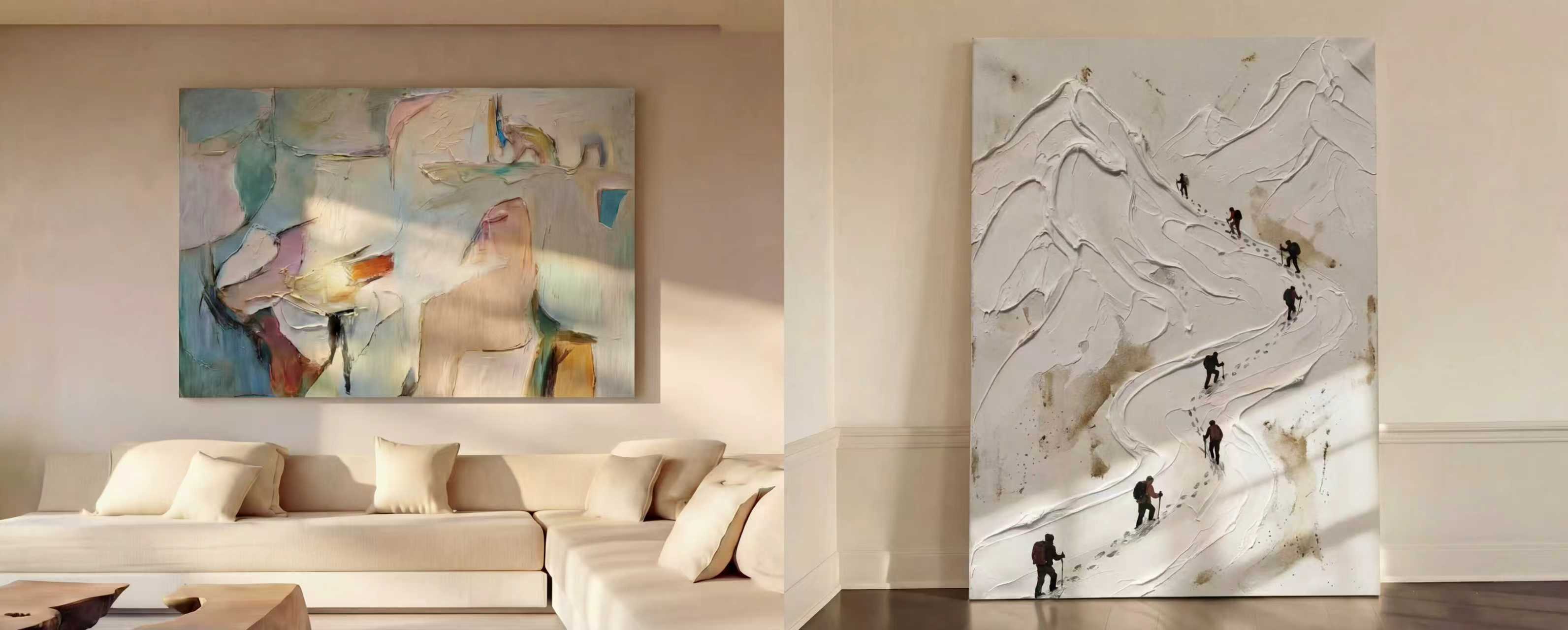
What Is Monochromatic Art, and Why Does It Work So Well in a Room?
Monochromatic art sticks to one color family and plays with its lighter and darker variations instead of mixing multiple hues. Because the eye reads fewer color signals, the piece feels restful, which is why it works especially well above sofas, beds, and in hallways where you want visual breathing room.
So what is monochromatic art? It's artwork built from a single color family, using lighter tints, deeper shades, and mid-tones instead of mixing different hues. Think charcoal to dove gray, or navy to pale sky.
That one-color discipline is why these pieces feel so settled on a wall. With fewer competing colors, the eye relaxes, and the room reads calmer, cleaner, and more intentional, without looking cold.
What Is Monochromatic Art, Really?
A true monochromatic work doesn't mean flat or boring. It means the artist pulled every value from one hue: a blue painting might run from near-black indigo down to almost-white ice, with every step in between. The contrast comes from tone, not from color variety.
This is different from a neutral piece, which can mix beige, gray, cream, and brown. Monochromatic is stricter. One family, many volumes.
Why It Calms a Room
Color tells the brain to do something. Lots of colors, lots of signals. A single-hue piece gives the eye one clear note to rest on, which is why designers lean on it for bedrooms, reading corners, and rooms that already have a lot going on in the furniture or textiles.
It also plays well with pattern. If your rug is busy or your sofa has a print, a monochromatic canvas above it won't fight for attention.
Room Scenarios: Where Monochromatic Art Lands Best
Above the sofa
A wide charcoal-to-gray abstract over a linen or cream sofa anchors the whole living room without introducing a new color story. Aim for art that spans roughly two-thirds the width of the sofa, hung about 6 to 10 inches above the back cushions.
Over the bed
Bedrooms benefit most from single-hue work. A soft blue wash or a muted sage piece above the headboard signals wind-down the moment you walk in. Keep the frame simple, thin black, natural oak, or frameless.
In the entry
Entryways are small and often chaotic, with shoes, keys, mail, coats. A vertical monochromatic print, black ink on off-white or deep green on cream, gives the space a single point of focus as you walk in.
Down a hallway
Hallways are perfect for a series. Three or four small works in the same color family, hung at even spacing, turn a transitional space into something worth walking through. Stick to one hue across all frames to keep the rhythm intact.
Dining room
Above a dining console or sideboard, a large moody monochromatic piece, deep plum, espresso, or ink blue, sets a dinner-party mood without demanding the room commit to that color everywhere else.
How It Connects to Minimalism and Abstract Work
Monochromatic art overlaps heavily with minimalist design, but they aren't the same thing. Minimalism is about restraint in composition and content. Monochromatic is about restraint in color. A piece can be both, or just one.
You'll also see this approach across abstract art, where artists use tonal layering to suggest mood, weather, or motion without any recognizable subject. Flower symbolism in abstract art, for example, often comes through in single-hue petal forms, where the color itself carries the meaning (white for quiet, red for heat, blue for distance).
Choosing the Right Hue for Your Room
Start with what's already in the space. Not the wall paint, the soft goods: sofa, rug, bedding, curtains. Pick a color family that either echoes those tones or sits one step off them.
- Warm rooms (terracotta, oak, caramel leather): try rust, sand, or warm charcoal.
- Cool rooms (white walls, gray sofa, linen): try navy, slate, or soft black.
- Green-leaning rooms (plants, sage accents): try forest-to-moss gradients.
- High-contrast rooms (black and white): stick to pure grayscale.
Common Mistakes to Avoid
A few things quietly undermine monochromatic work:
- Going too small. A single-hue piece relies on presence. A 12x16 over a large sofa will look like a postage stamp.
- Mixing undertones. A cool blue-gray piece next to warm beige walls can feel off. Match the temperature.
- Over-framing. Heavy ornate frames fight the quiet of the art. Keep frames thin or skip them.
- Clustering competing colors around it. If you hang a navy monochromatic piece, don't surround it with four other accent colors on the same wall.
A Quick Note on Geometric Monochromatic Work
The definition of geometric art is work built from clean shapes, lines, grids, and repeated forms. When you combine that with a single color family, you get pieces that feel architectural rather than painterly, great for offices, entryways, and modern dining rooms where you want structure without color noise.
FAQs
Is black and white considered monochromatic?
Technically grayscale, but it's usually grouped with monochromatic work because it follows the same logic: one tonal family, many values.
Can I mix two monochromatic pieces in the same room?
Yes, as long as the hues are compatible. Two separate single-hue works in related families (say, navy and charcoal) can coexist beautifully.
Does monochromatic art make a room feel smaller?No, it often does the opposite. With less color contrast on the walls, the eye travels more smoothly, which tends to make spaces feel larger and more open.What color works in almost any room?
Warm charcoal or soft black. They read as neutral but still offer real tonal depth, so the art has presence without dictating a color scheme.
How big should a monochromatic piece be over a sofa or bed?
Plan for roughly two-thirds the width of the furniture below it. Monochromatic art leans on scale, under-sizing it is the fastest way to lose its effect.
If a quieter wall sounds like what your space needs, browse our Monochromatic and minimalist wall art collection for pieces built around exactly this idea.