
What Is Wabi Sabi Wall Art? A Plain-English Guide
Wabi sabi wall art translates a centuries-old Japanese philosophy into something you can actually hang on a wall. It favors natural materials, subtle irregularity, and a restrained palette over polished or decorative finishes. This guide explains what defines the style, how it differs from plain minimalism, and how to choose pieces that work in a real room.
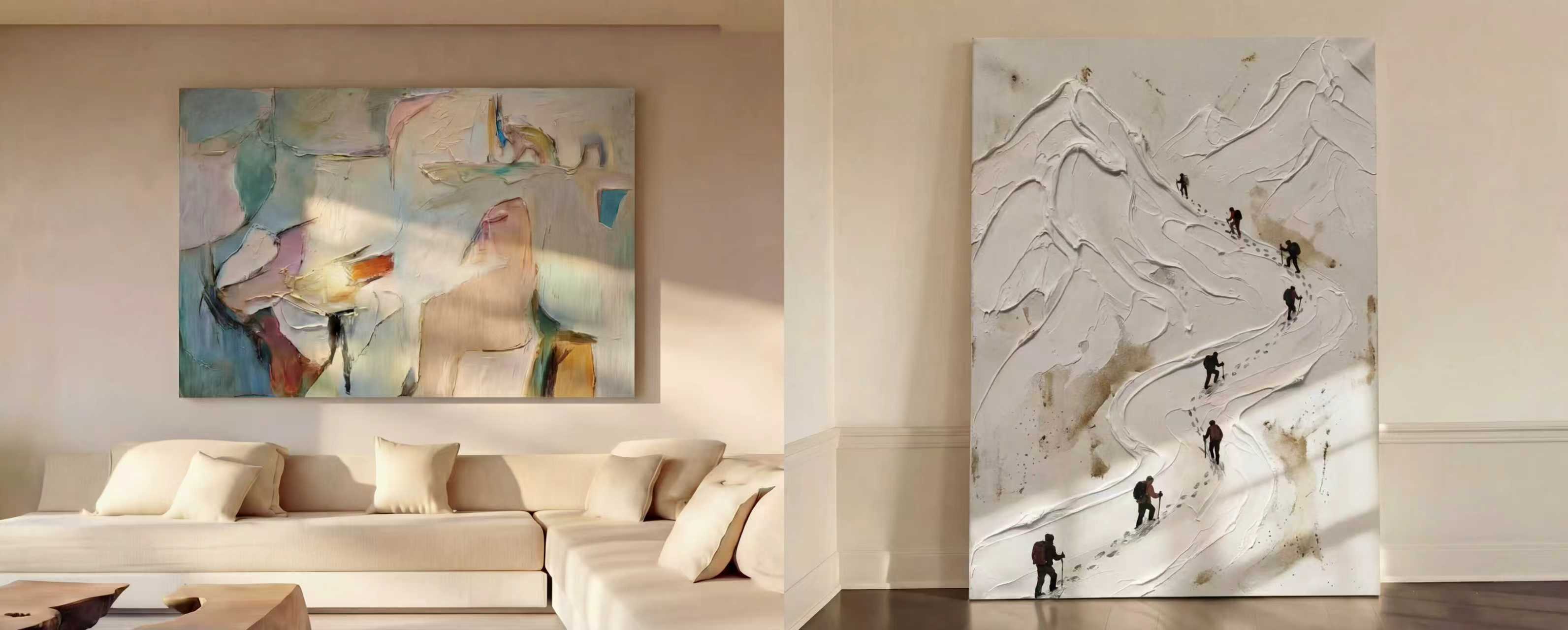
Wabi sabi wall art is rooted in a Japanese aesthetic philosophy that treats imperfection, transience, and simplicity as sources of beauty rather than flaws to correct. On a wall, that translates to pieces with uneven textures, organic shapes, weathered surfaces, and palettes pulled straight from nature—stone, soil, dry grass, overcast sky. Nothing is overly finished. Nothing is trying to impress you.
That's a deliberate departure from most mainstream wall art, which tends toward either bold graphic impact or slick decorative perfection. Wabi sabi goes the other direction: quieter, slower, more tactile. Once you understand what you're looking at, it's surprisingly easy to spot—and to live with.
The Philosophy Behind the Aesthetic
The term itself combines two ideas. Wabi originally referred to the melancholy of solitude, the sparse beauty of living simply. Sabi speaks to the passage of time—patina, wear, the kind of character that accumulates rather than gets designed in. Together they describe an appreciation for things that are aged, irregular, unadorned, and impermanent.
In practice, this isn't about making things look broken or neglected. It's about resisting the urge to over-refine. A piece of wall art in this tradition might show visible brushwork, a slightly asymmetrical composition, or a texture that reads differently depending on the light. The "flaw" is the feature.
What Wabi Sabi Wall Art Actually Looks Like
If you're used to scanning wall art galleries online, wabi sabi pieces have a few consistent visual markers:
- Palette: Warm neutrals, stone grays, clay, off-white, charcoal, deep moss. Rarely anything bright or saturated.
- Texture: Often tactile-looking—layered plaster effects, sand-grain surfaces, linen-like grounds, or visible mark-making. Three-dimensional relief work fits naturally here.
- Composition: Asymmetrical, spare, or deliberately off-center. Negative space is treated as part of the design, not empty area to fill.
- Subject matter: Abstract forms, organic shapes, loose botanical references, elemental motifs like water, stone, or light.
The overall effect is calm without being cold, minimal without being sterile. That's the distinction that matters.
How It Differs from Generic Minimalist Wall Art
This is worth clarifying because the two styles get conflated constantly. Minimalist wall art reduces—clean lines, flat planes, controlled geometry, precise color. It's often cool-toned and intentionally impersonal. Wabi sabi reduces too, but it leans warm and organic. It welcomes irregularity. It's interested in materials and process in a way that pure minimalism isn't.
A minimalist print might be a single thin line on white paper. A wabi sabi equivalent might be an abstract brushstroke in raw umber on a textured ground—same restraint, completely different feeling. One reads as designed. The other reads as made.
If your space already trends toward organic modern design—natural wood, woven textiles, unglazed ceramics—wabi sabi wall art will feel like the obvious complement rather than a style stretch.
Choosing the Right Piece for Your Room
Scale matters more here than in busier art styles. Because these pieces rely on restraint, putting something too small on a large wall dilutes the effect. A single substantial piece—or a very considered two-piece arrangement—usually outperforms a gallery wall approach in wabi sabi interiors.
A few practical notes:
- Living rooms: One large-format textured or abstract piece above a sofa works well. Stick to a palette that echoes your existing neutrals rather than contrasting sharply.
- Bedrooms: Smaller pieces at eye level when seated or lying down. The intimacy suits the philosophy. Avoid anything with strong visual energy—the goal is rest.
- Entryways: A single vertical piece with strong texture creates a quiet first impression without demanding attention.
- Home offices: Wabi sabi art tends to be genuinely calming in work environments. One piece is enough; this isn't a style that benefits from accumulation.
If you're drawn to dimensional work, 3D textured wall art is a natural fit—the physicality of raised surfaces connects directly to the material honesty the aesthetic values.
Common Mistakes to Avoid
The biggest one: confusing "earthy color palette" with the actual aesthetic. You can paint a wall greige and hang mass-produced art and still have nothing to do with wabi sabi. The philosophy lives in the quality and character of the piece itself—the sense that a human hand was involved, that time or process left a mark.
A few others worth naming:
- Over-curating the arrangement. If every piece is perfectly aligned and symmetrically spaced, the visual result works against the philosophy. Some asymmetry is appropriate.
- Mixing it with high-gloss or very polished finishes. Wabi sabi art tends to recede next to shiny surfaces. It wants matte, rough, natural neighbors.
- Buying too many pieces at once. This style rewards restraint. One right piece beats five adequate ones.
- Ignoring scale. A small wabi sabi print on a large wall can look like an afterthought. Size up when in doubt.
What Is Wabi Sabi Wall Art: A Quick Reference
For anyone still calibrating their eye, here's a simple frame: if a piece looks like it was made slowly, by hand, from natural materials, with no interest in being showy—it's probably wabi sabi-adjacent. If it looks designed, printed, or manufactured to a tight spec, it probably isn't, regardless of the color palette.
The aesthetic rewards patience. It often reads better in person than in product photos, because texture and subtle tonal variation are hard to capture on screen. When possible, look for pieces where the artist or maker's process is part of the description.
Frequently Asked Questions
Is wabi sabi the same as japandi style?
Related but distinct. Japandi blends Japanese minimalism with Scandinavian design principles—it's more geometric and controlled. Wabi sabi is specifically about embracing imperfection and organic irregularity. Japandi rooms often include wabi sabi elements, but the terms aren't interchangeable.
What colors define wabi sabi wall art?
Muted, nature-derived tones: warm whites, raw linen, clay, charcoal, stone gray, deep greens, dusty terracotta. High contrast and saturated colors work against the aesthetic.
Can wabi sabi wall art work in a modern or contemporary home?
Yes, often very well. The organic texture and warmth of wabi sabi pieces provide a counterpoint to harder modern architecture. One or two pieces in an otherwise clean, contemporary space can add significant depth without disrupting the overall feel.
How large should wabi sabi wall art be?
Err on the side of larger rather than smaller. Because the style relies on texture and quiet visual weight, undersized pieces tend to disappear. For a standard sofa wall, a piece at least 36 inches wide reads more confidently than something scaled down.
Does framing matter for wabi sabi art?
It can. Thin natural wood, raw oak, or no frame at all tends to suit the aesthetic better than ornate or metallic frames. If the piece itself has physical texture or dimension, a deep-set or floated presentation often works better than a traditional frame.
Browse the full collection of Wabi-sabi wall art at mipiece to find pieces that bring this aesthetic into your space.