
What to Hang Above a Couch: Wall Art Ideas That Actually Work
The wall above a couch is the most visible surface in most living rooms, and the most commonly mishandled. This guide walks through the three main approaches — one large piece, a diptych or triptych, and a gallery wall — with honest tradeoffs for each, plus sizing rules, height guidance, and the mistakes that make otherwise good art look wrong.
Quick read
Get the scale right first. Everything else — style, color, arrangement — is secondary.
Browse related artThe wall above your couch is the first thing people see when they walk into your living room. It's also, statistically, the spot where most people hang something slightly too small, slightly too high, and slightly off-center. Getting it right isn't complicated, but it does require a few deliberate choices before anything goes up.
Here's a practical breakdown of what to hang above a couch — covering the three main layout approaches, how to size and position whatever you choose, and the decisions that separate a finished-looking room from one that still feels unresolved.
Start With the Two-Thirds Rule
Before picking a style or subject, settle the proportion question. A common guideline in interior design is that wall art above a sofa should span about two-thirds of the sofa's width. So if your couch is 84 inches wide, you're aiming for roughly 56 inches of visual width — whether that's a single canvas, two panels side by side, or a cluster of smaller frames.
Why does this matter so much? Art that's narrower than half the sofa's width reads as an afterthought. Art that's wider than the sofa creates tension rather than balance. The two-thirds range gives you flexibility while keeping the composition anchored.
Height is the other variable. The bottom edge of your art (or the lowest frame in a gallery arrangement) should sit 6 to 10 inches above the sofa back. Any lower and it feels cramped. Much higher and the art floats, disconnected from the furniture beneath it.
Option 1: One Large Statement Piece
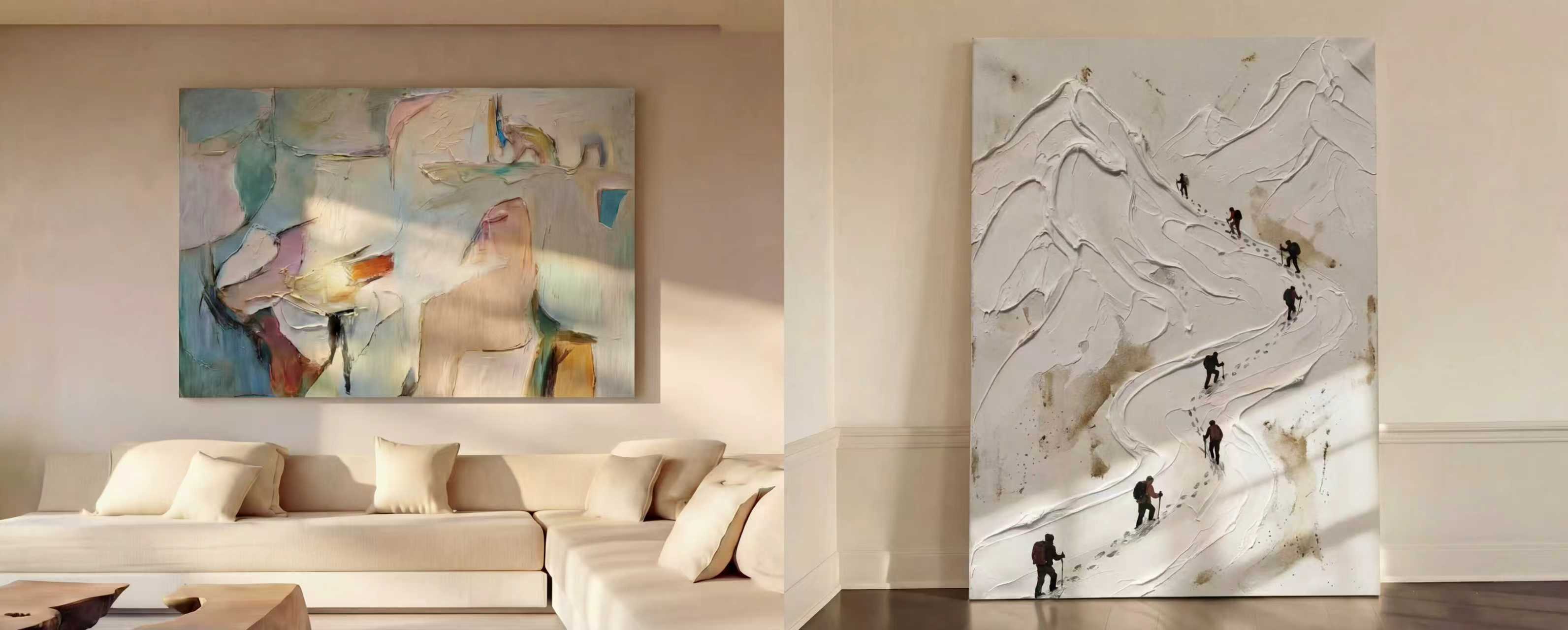
A single oversized canvas is the cleanest choice. It works especially well in rooms with otherwise busy surfaces — bookshelves, a fireplace, an open kitchen — because it gives the eye a clear resting point.
Best for: sofas 72 inches or wider, rooms with high ceilings, minimalist or mid-century interiors.
Tradeoff: Large-format pieces are a harder commitment. If you move, redecorate, or simply change your mind, a 60-inch canvas isn't easy to repurpose elsewhere. Buy something you genuinely want to live with, not just something that fills the space.
Abstract work tends to age well in this format — it doesn't date the way a trend-specific print might. If you're drawn to that direction, mipiece's abstract art collection has large-format options worth considering.
Option 2: Diptych or Triptych
Two or three panels hung as a set give you similar visual impact to a single large piece, with a bit more flexibility in sizing and shipping. A diptych (two panels) split across 48 to 60 inches reads as cohesive as long as the gap between panels stays consistent — typically 2 to 3 inches.
Best for: mid-size sofas (66–80 inches), people who want some visual rhythm without the complexity of a gallery wall.
Tradeoff: Multi-panel sets require more careful leveling. Even a quarter-inch difference in height between panels is noticeable on a long blank wall. Use a level. Seriously.
Triptychs work particularly well when the subject or composition flows across all three panels — a landscape that continues edge to edge, or an abstract with a color story that shifts gradually. Three unrelated prints hung close together isn't a triptych; it's the beginning of a gallery wall done tentatively.
Option 3: Gallery Wall Above the Couch
A gallery wall offers the most flexibility and the highest margin for error. Done well, it feels curated and personal. Done poorly, it looks like a yard sale.
Best for: eclectic interiors, renters who prefer smaller and less expensive pieces, people who enjoy rotating art seasonally.
Tradeoff: Gallery walls take planning. The most reliable approach is to lay your frames out on the floor first, photograph the arrangement, and use that as your hanging guide. Resist the impulse to just start hammering.
A few things that hold a gallery wall together visually: consistent frame finish (all black, all natural wood, all white), a shared color that runs through most of the prints, and a clear anchor — usually the largest piece, slightly left or right of center. If every frame is a different size and finish, the wall reads as chaotic rather than collected.
Matching Art Style to Room Style
Proportion gets the art on the wall correctly. Style gets it right for the room.
- Minimal or Scandinavian rooms: Clean-lined work with limited color — black-and-white photography, simple geometric abstracts, or quiet nature-inspired prints. Minimalist wall art is an easy place to start.
- Warm, earthy interiors: Organic textures, muted palettes, and imperfect forms feel at home here. Wabi-sabi-influenced work — imperfect shapes, natural tones — tends to read well against linen sofas and warm wood floors.
- Eclectic or maximalist rooms: You have more latitude, but a strong color anchor still helps. Pull one dominant color from your sofa or rug and let it show up somewhere in the art.
- Modern or industrial spaces: Bold abstract work, graphic black-and-white pieces, or photography with strong contrast all translate well against concrete, exposed brick, or dark walls.
Mistakes Worth Avoiding
A few patterns come up repeatedly when art doesn't quite work above a couch:
- Hanging it too high. The most common mistake. Measure from the top of the sofa back, not from the ceiling.
- Going too small. A 20-inch print above an 84-inch sofa won't anchor the space — it'll look like a placeholder.
- Matching too literally. Art that matches your throw pillows exactly tends to feel coordinated rather than designed. Let there be some creative distance between the art and the furniture.
- Ignoring the room's light. Art hung opposite a strong light source will glare if it's behind glass. Either choose matte glazing or position it where natural light comes from the side.
- Treating the wall as isolated. The art above your couch should relate to the rest of the room — the rug, the lamp, the coffee table — not just to the sofa.
Quick Decision Checklist
Before you buy, run through these:
- Have you measured your sofa width and calculated two-thirds of that number?
- Do you know the ceiling height and how much vertical space you're working with?
- Are you committed to one large piece, or do you want flexibility to rearrange?
- Does the palette in the art connect to something already in the room?
- Have you considered the frame finish relative to other hardware in the space (light fixtures, cabinet pulls, curtain rods)?
Five questions. If you can answer them before you start browsing, you'll buy with more confidence and fewer returns.
Frequently Asked Questions
How wide should art be above a couch?
Aim for art that spans roughly two-thirds of your sofa's total width. For a standard 84-inch sofa, that's approximately 56 inches of visual width — achievable with one large piece or a multi-panel arrangement.
How high should I hang a picture above a sofa?
Position the bottom edge of the frame (or the lowest frame in a grouping) 6 to 10 inches above the sofa back. The center of the artwork should land near eye level when standing — typically 57 to 60 inches from the floor.
Is one large piece better than a gallery wall above a couch?
It depends on the room and your preference. A single large piece is lower maintenance and cleaner visually. A gallery wall offers more flexibility and personality but requires more planning to look intentional rather than crowded.
What kind of art works best in a living room?
There's no universal answer, but abstract work, landscape photography, and graphic prints tend to be versatile across styles. The more important factor is scale and palette — art that fits the wall proportionally and connects to the room's existing colors will almost always look right.
Can I hang a mirror above a couch instead of art?
Yes — a large mirror follows the same proportion rules as art and has the added benefit of reflecting light. The tradeoff is that it won't anchor the room with color or subject matter the way a painting or print does. In darker rooms, a mirror is often the smarter choice.
When you're ready to browse, Living room wall art from mipiece is a practical place to start — especially if you're looking for large-format or multi-panel options.