
Best Plaster for Canvas Art and What Buyers Should Know
If you're shopping for plaster-textured canvas art rather than mixing your own, the material under the paint matters more than most listings admit. Modeling paste and acrylic plaster blends stay flexible on stretched canvas, while heavy gypsum mixes are prone to hairline cracks and warping. This guide separates the myths from what actually holds up on a wall.
Quick read
Texture is the easy part. Longevity is where most plaster art quietly fails.
Browse related artIf you're shopping rather than making, the best plaster for canvas art is almost always a lightweight modeling paste or an acrylic-based plaster blend. Those formulas stay flexible on stretched canvas, resist hairline cracks, and don't pull the frame out of square as they cure.
Traditional gypsum or plaster of Paris looks dramatic in studio photos, but on a flexing canvas it tends to chip, sag, or split along the stretcher bars within a few seasons. The myth is that heavier plaster equals better art. The reality is the opposite.
What buyers usually assume vs. what actually holds up
Three assumptions show up over and over in product reviews. They're worth challenging before you spend on a textured piece.
Myth 1: Thicker plaster means higher quality
Thicker isn't sturdier. A canvas is a flexible substrate stretched over wood, and it moves with humidity. Thick gypsum layers can't move with it, so they crack. Acrylic modeling pastes are engineered to flex, which is why most serious texture-led canvas art uses them even when the relief looks two or three centimeters deep.
Myth 2: All plaster art is fragile
Quality textured canvas is surprisingly durable. The plaster body is bonded to gesso, sealed with acrylic medium, and often topped with a matte or satin varnish. That sandwich resists dust, light handling, and normal temperature swings. Fragility usually comes from shortcuts: unsealed surfaces, raw gypsum, or texture applied too thickly in a single pass.
Myth 3: Heavy = expensive = better
Weight is one of the easiest things to misread. A 36-inch canvas loaded with traditional plaster can exceed 20 pounds, which puts stress on the stretcher and demands heavy hanging hardware. The same piece in modern plaster blends might weigh half as much and hang on a standard anchor. Lighter doesn't mean cheaper construction. It usually means better engineering.
What makes plaster art painting so unique
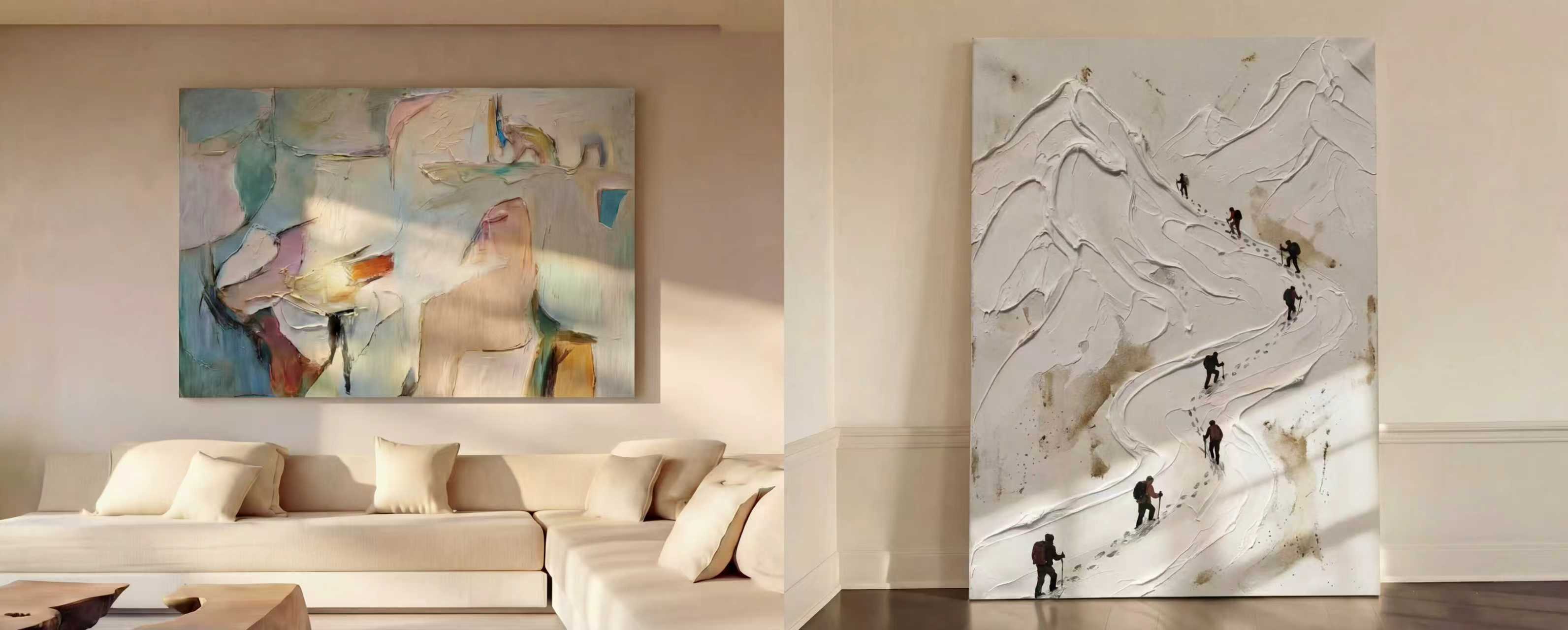
Plaster turns a painting into something you read with your eyes and with raking light. As the sun moves across a room, the relief casts new shadows, so the piece looks different at 9 a.m. than it does at 6 p.m. Flat prints can't do that. Neither can most oil paintings.
This is also why plaster works so well in minimalist rooms. A neutral palette with deep texture gives the wall presence without adding visual clutter. You get sculpture-like depth without committing to an actual sculpture.
What is texture art painting, in buyer terms
Texture art painting is any work where the surface itself carries part of the meaning. Brushstrokes, palette-knife ridges, sand, fiber, and plaster all qualify. For canvas art, plaster is the most popular route because it gives sharp peaks, soft drifts, and carved lines in the same piece.
From a shopping standpoint, what matters is:
- Relief depth: shallow (under 1 cm) reads as subtle from across the room; deep (2 cm+) reads as sculptural even at a distance
- Finish: matte plaster looks chalky and architectural; sealed plaster has a slight sheen and hides fingerprints better
- Color treatment: tinted plaster keeps the relief monochrome; painted-over plaster lets you see contrast in the carved areas
Room-by-room guidance
Living room
Scale up. A single large textured canvas above the sofa reads better than a gallery wall of smaller plaster pieces, which can start to feel busy. Aim for a width that's about two-thirds of the sofa.
Bedroom
Soft relief, neutral tones. Plaster art over a bed should feel calm. Avoid sharp peaks directly above pillows for obvious reasons, and choose horizontal compositions that echo the bed's footprint.
Entry and hallway
This is where deep relief earns its keep. Side lighting from a sconce or a window will animate the surface every time someone walks past. A vertical plaster piece in a narrow entry can feel like a small architectural detail.
Dining room
Watch for kitchen humidity and cooking residue. A sealed, varnished plaster surface is much easier to dust than a raw one. If your dining area opens to the kitchen, lean toward pieces with a protective topcoat.
Mistakes to avoid when buying plaster canvas art
- Ignoring the back of the canvas. A reinforced stretcher and cross-bracing matter more on textured pieces because of the added weight
- Using picture-hook hardware rated for prints. Plaster art often needs a heavier anchor or a French cleat
- Hanging in direct, sustained sunlight. UV can yellow acrylic mediums over years
- Cleaning with a damp cloth. A soft, dry brush is almost always the right tool
- Buying based on a flat photo. Ask for a raking-light or angled image so you can actually see the relief
Care and upkeep, kept simple
Dust gently every few weeks with a soft natural-bristle brush. Skip sprays, polishes, and microfiber cloths, which can snag on peaks. If you move, transport plaster canvases face-up and well-padded, never stacked. Avoid hanging above active heat sources or radiators where the plaster body can dry out unevenly.
FAQ
Does plaster on canvas crack over time?
Quality acrylic-based plaster on a properly braced canvas should not crack under normal indoor conditions. Cracks usually trace back to traditional gypsum mixes or to thick layers applied without a flexible binder.
How heavy is a typical plaster canvas?
It varies, but a well-made 30 to 40 inch piece using modern plaster blends often weighs 6 to 12 pounds. Older-style gypsum pieces of the same size can weigh nearly double.
Can I hang plaster art in a bathroom?
Powder rooms are usually fine. Full bathrooms with regular shower steam are riskier, since repeated humidity swings stress any textured surface.
Is plaster art the same as 3D wall art?
Plaster is one type of 3D or textured wall art. Other types include carved wood, metal relief, and fiber works. Plaster on canvas is the most common entry point because it pairs sculptural depth with paintable surfaces.
What finish looks best in modern interiors?
Matte or low-sheen plaster in off-white, bone, sand, or charcoal tends to read as contemporary. High-gloss plaster reads more decorative and can fight with minimalist rooms.
Once you know what to look for in the material itself, picking a piece gets a lot easier. Browse our 3D textured wall art to see how flexible plaster, careful finishing, and considered scale come together on a real canvas.