
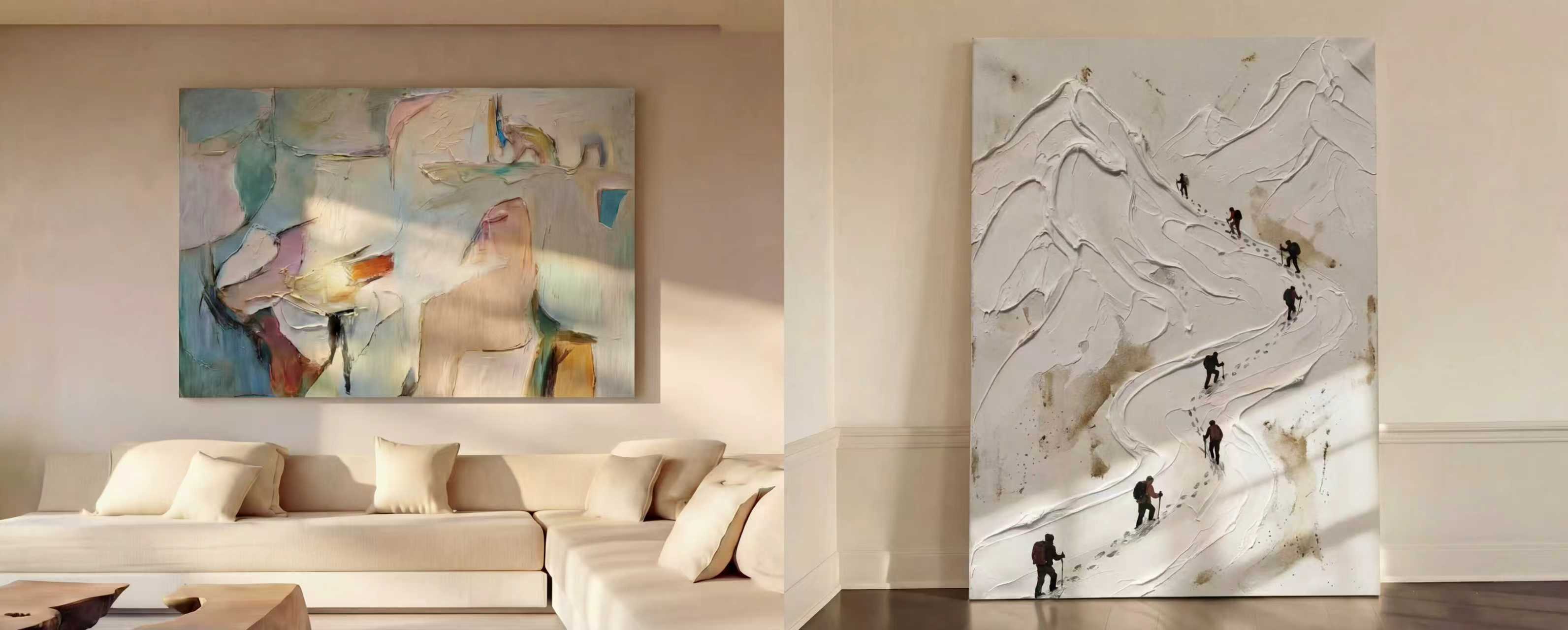
How to Arrange a Painting on the Wall So It Feels Intentional
Arranging a painting well is less about rules and more about sightlines, anchors, and restraint. Match the art to the furniture below it, size it to the visual weight of the room, and resist the urge to fill every blank inch. The result looks deliberate without looking staged.
The short version: treat the painting as part of the furniture grouping, not a wall decoration. Hang its center around 57 to 60 inches from the floor, keep it anchored to a sofa, bed, console, or mantel, and let the piece occupy roughly two-thirds the width of whatever sits beneath it.
That's the working answer to how to arrange a painting on the wall. The rest of this guide is about the things people get wrong, and why the usual advice quietly sabotages a lot of rooms.
Myth 1: A Big Wall Needs a Big Painting
Reality: a big wall needs a piece scaled to the furniture, not the wall. A wide blank wall behind a narrow console will look strange with an oversized canvas because the eye reads the console as the anchor. Measure the furniture below, then size the art to about 60 to 75 percent of that width.
If there is no furniture, the wall itself becomes the anchor. In that case, fill roughly half to two-thirds of the wall's width with either one large piece or a grouping that reads as one shape from across the room.
Myth 2: Eye Level Means Your Eye Level
Reality: gallery eye level is a convention, around 57 to 60 inches to the center of the piece. It works because it averages the sightlines of people standing and sitting. If you hang to your own eye level, the art will float too high above a seated guest, which is why so many living rooms feel slightly off without anyone knowing why.
Two exceptions:
- Above a sofa or headboard, leave only 6 to 10 inches between the top of the furniture and the bottom of the frame. The painting should feel connected to what's below it.
- In a dining room, drop the center slightly. People are seated longer, so the sightline is lower.
Myth 3: A Gallery Wall Solves a Blank Wall
Reality: a bad gallery wall is worse than a blank one. Gallery walls work when the pieces share something, either a color story, a frame style, a subject, or a consistent matting. They fail when they become a scrapbook of unrelated prints.
For gallery wall above couch ideas, try this structure:
- Pick an anchor piece, usually the largest, and place it slightly off-center.
- Build outward with smaller works, keeping 2 to 3 inches of breathing room between frames.
- Keep the overall cluster within the width of the sofa, not wider.
- Limit the palette to three tones that already appear in the room.
Lay the arrangement on the floor first. Photograph it. Adjust. Only then go to the wall.
Myth 4: Art Has to Match the Room
Reality: matching is where rooms go to look like hotel lobbies. The better question is how to match art in a room through contrast and repetition, not through color-matching a throw pillow.
Two things to repeat:
- One color from the art should echo somewhere else in the room, even subtly, like a lamp base, a book spine, or a rug thread.
- One mood. A quiet, washed-out landscape fights a room full of saturated color. A bold abstract gets lost in a room of beiges.
Contrast does the heavy lifting. A moody painting in a bright room looks intentional. A beige painting in a beige room looks forgotten. If you're leaning toward calmer pieces, our minimalist collection is a good place to study how restraint carries a wall.
Myth 5: Centering on the Wall Always Looks Right
Reality: center to the furniture, not the wall. A sofa pushed slightly left of center on a wall should still have its painting centered over the sofa. Your eye groups the art with the furniture, and a painting floating in the wall's true center will look untethered from the arrangement below.
The same applies to beds, consoles, and fireplaces. The furniture is the anchor. The wall is the background.
Common Placement Mistakes
- Hanging too high. The single most common error. If in doubt, lower it an inch.
- Undersized art over a large sofa. A 16x20 over an 84-inch sofa looks like a postage stamp. Go bigger or go grouped.
- Ignoring the light. A painting hung directly opposite a bright window will glare all afternoon. Offset it or choose matte finishes.
- Too many focal points. One wall, one main event. If the TV is on the wall, the art supports it rather than competes.
- Forgetting the sightline from the doorway. Stand in every entry to the room. What do you see first? That's your hero spot.
Room-by-Room Quick Notes
Living room: anchor to the sofa, leave 6 to 10 inches above it, and keep the piece 60 to 75 percent of the sofa's width.
Bedroom: above the headboard, treat the art and the bed as one block. Horizontal pieces tend to calm the room more than verticals.
Dining room: lower the center slightly and favor quieter pieces, since people face each other, not the wall.
Entry or hallway: narrow walls reward vertical art. Keep the bottom edge at least 8 inches above any console.
Home office: place art in your peripheral vision, not directly behind the screen, so it reads during breaks instead of competing with your monitor.
FAQ
How high should I hang a painting above a sofa?
Leave 6 to 10 inches between the top of the sofa and the bottom of the frame. The center of the art usually lands around 58 inches from the floor.
What if my wall is very tall with no furniture below?
Treat the wall as the anchor. Use one large piece or a vertical grouping that fills about half the wall's width, centered around standing eye level.
Can I mix painting styles on the same wall?
Yes, if they share a palette, a frame style, or a consistent mood. Mixing all three usually fails.
Should art always be centered on the wall?
No. Center it on the furniture below. That's the visual anchor your eye actually uses.
How do I know if a painting is too small for the space?
Step back 10 feet. If the art looks like an afterthought against the furniture, it's undersized. Go up a size or cluster it with companions.
When you're ready to find the piece itself, browse wall art for every room and start with the wall that matters most.