
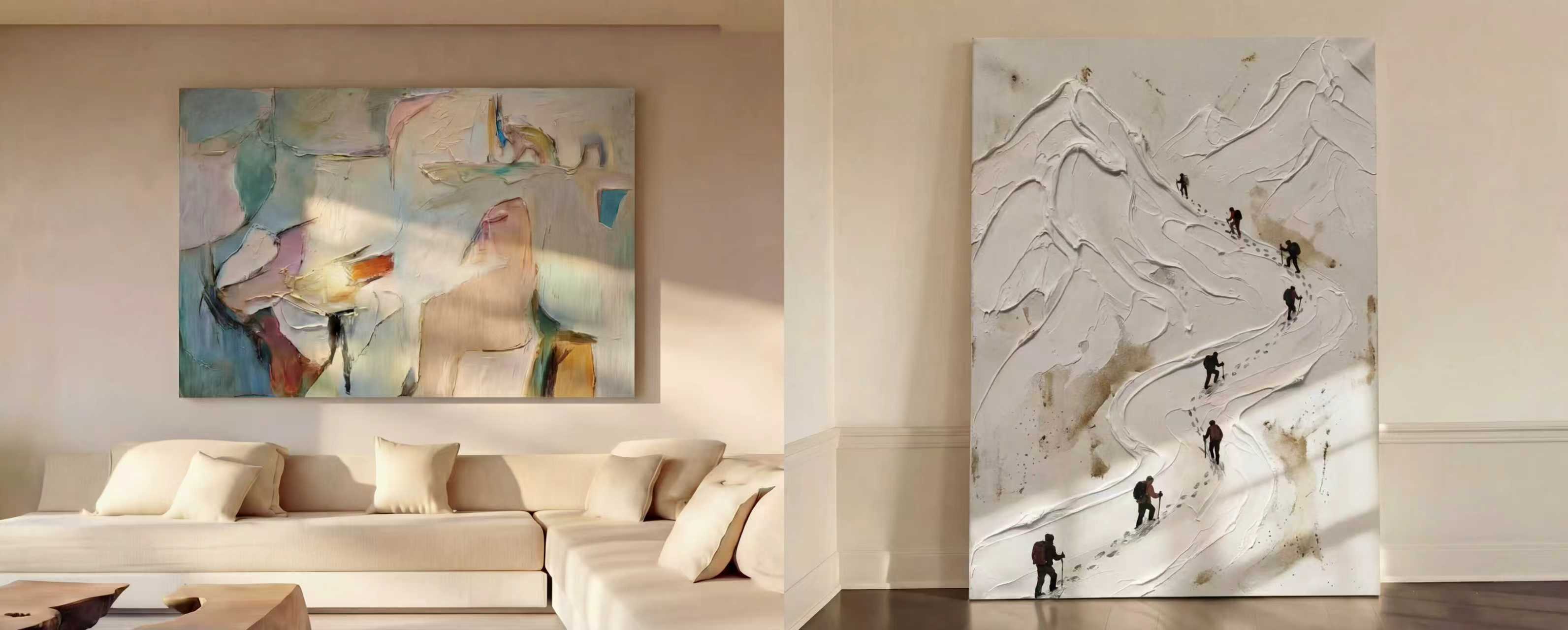
What Is Texture Art Painting? A Buyer's Guide to Choosing the Right One
Unlike standard canvas prints, texture art paintings carry dimension. They cast real shadow, respond to changing light throughout the day, and bring a handcrafted quality to any wall. This guide explains how they work, what separates visual texture from physical texture, what to look for before buying, and where they fit best in a home.
Quick read
Texture isn't decoration — it's the difference between a wall that's filled and a wall that's alive.
Browse related artTexture art painting is exactly what it sounds like — and also more than it sounds like. At the most basic level, it refers to artwork where the surface isn't flat. Paint, plaster, sand, gesso, or mixed media are built up in layers, creating raised marks, peaks, grooves, and reliefs that you can actually see casting shadows across the canvas. The result is a piece that shifts in appearance as light moves across it during the day — something a printed image simply cannot do.
That physical quality is why texture-led shoppers tend to feel a strong pull toward this category. There's a realness to it. You're not hanging a reproduction; you're hanging an object with presence.
Visual Texture vs Physical Texture — Know the Difference Before You Buy
This distinction matters more than most buying guides acknowledge. Visual texture is an illusion — brushstrokes, patterns, or photographic techniques that suggest depth without actually creating it. A high-quality canvas print of an oil painting can look textured from across the room. Up close, the surface is smooth.
Physical texture (also called tactile texture) is three-dimensional. You could run your finger across the surface and feel ridges, crests, or gritty layers. This is what defines genuine texture art painting — and what drives its higher price point compared to flat prints.
- Visual texture: canvas prints, lithographs, high-res reproductions, some giclées
- Physical texture: hand-applied plaster art, palette knife paintings, sand-mixed acrylics, impasto work, layered wabi-sabi pieces
When you're shopping, look for terms like hand-textured, plaster relief, impasto, or mixed media with raised surface. If the listing doesn't mention how the texture was applied, ask — or zoom into any detail photography to see whether the surface actually has dimension.
What Makes Plaster Art Painting So Unique
Plaster art sits at the high end of the texture painting category for good reason. Plaster is applied by hand — often with a palette knife or trowel — then shaped, layered, and sealed. The result looks architectural as much as artistic. Surfaces can be smooth and flowing in some areas, rough and granular in others, within a single piece.
What makes plaster art painting so unique compared to other textured formats is how dramatically it responds to directional light. In a room with a window to the side, the piece looks entirely different at noon versus late afternoon. That's not a flaw — it's the appeal. The art never fully settles. It keeps revealing itself.
Plaster work also tends to pair naturally with organic, neutral, or wabi-sabi interiors — raw linen, warm whites, natural wood, undyed textiles. If your room leans minimalist or Japandi, plaster art fits without competing.
A Buyer's Checklist: What to Evaluate Before Purchasing
Buying textured art online requires a little more scrutiny than buying a flat print. Here's a practical checklist to run through:
- Surface detail photography: Does the product listing include close-up shots that show actual raised surfaces? If the only images are straight-on flat shots, be cautious.
- Medium description: What materials are used? Acrylic with sand additive, modeling paste, gesso relief, and plaster each behave differently over time and suit different aesthetics.
- Scale relative to your wall: Heavily textured pieces often read best at larger sizes — typically 24×24 inches or above. A small heavily textured piece on a large wall can look like an afterthought.
- Framing or no framing: Many texture paintings are sold as gallery-wrapped canvas, which suits the sculptural quality of the work. A thin frame can sometimes undercut the raw effect.
- Color range in different lights: Neutral tones — warm whites, greiges, taupes, earthy ochres — are the most versatile for textured work. Highly saturated colors can compete with the texture itself.
- Placement lighting: Do you have a light source — natural or artificial — that will rake across the surface? Without directional light, even strong physical texture can flatten out on the wall.
Where Texture Art Paintings Work Best in the Home
Not every room benefits equally. Here's how to think about placement:
Living rooms: A large textured canvas above a sofa or console table is one of the most effective placements. The piece anchors the seating area and gives guests something to notice even when no one is consciously looking at it.
Primary bedrooms: A textured piece above the headboard adds depth without visual noise. Neutral plaster tones work especially well here because they're calming rather than demanding.
Home offices and studies: A single statement texture piece behind a desk adds creative energy without the distraction of color or pattern. It signals taste without shouting.
Entryways: Often overlooked, but a hallway with side lighting is actually ideal for textured art. The raking light across the surface creates an immediate impression as soon as someone walks in.
For a starting point on room-ready options, the wabi-sabi wall art collection offers textured pieces that work particularly well in organic, pared-back interiors.
Mistakes to Avoid
A few missteps come up repeatedly when shoppers are new to this category:
- Buying too small: Textured work loses impact at smaller sizes. If your budget is limited, a single well-scaled piece beats a cluster of small ones.
- Placing it against a visually busy wall: Bold wallpaper, busy tile, or a highly patterned backdrop competes with the texture rather than letting it breathe. Textured art wants a calm backdrop.
- Expecting it to look the same in all lighting: This is a feature, not a problem — but if you're installing in a room with no directional light source, check that the piece still reads well under flat overhead lighting before committing.
- Confusing visual texture with physical texture in listings: Always zoom into product photography and read material descriptions carefully. A "textured-looking" print and a hand-applied plaster painting are not the same purchase.
- Ignoring the wall color: Very dark walls can absorb texture detail. Very white walls can overexpose it. Mid-tone warm neutrals tend to let textured art show its full range.
Frequently Asked Questions
What is texture art painting made from?
It depends on the technique. Common materials include acrylic paint mixed with sand or modeling paste, gesso relief, plaster compounds applied by palette knife, and mixed media incorporating fabric, paper, or natural materials. Each creates a different surface feel and visual effect.
Is textured canvas art more expensive than regular prints?
Generally, yes. Physical texture requires hands-on application rather than mechanical printing, which means more labor and often higher-quality materials. The price reflects that craft, though the range across the market is wide.
How do I hang textured wall art safely?
Most gallery-wrapped textured canvases are hung the same way as standard canvas — using D-rings or a wire mount on the back. For heavier plaster work, use wall anchors rated for the weight. Check the product specs before using standard picture hooks.
Will textured art look good in a modern or minimalist home?
Often better than busier art, actually. Texture adds visual interest without introducing color or pattern. A neutral plaster or wabi-sabi piece sits quietly in a minimalist room while still giving the wall something worth looking at.
Can textured paintings be damaged easily?
The surface is more vulnerable to direct impact than a flat print, but in normal wall-hanging conditions they're durable. Avoid placing them in high-humidity rooms without a protective sealant, and dust gently with a soft dry brush rather than wiping with cloth.
Ready to see what physical texture actually looks like on a wall? Browse the full range of Textured wall art at mipiece and find the piece your room has been waiting for.