
How to Choose Art for Your Home Without Guessing
Choosing art for your home feels harder than it should be. The truth is, most people shop backward—they fall for a print online, hang it, and wonder why it doesn't land. This guide flips that. You'll learn how to read a room first, then find the piece that belongs in it.
Knowing how to choose art for your home is less about taste and more about reading a room correctly. Most buying regrets trace back to one of three things: the wrong scale, a color that clashes with the light, or a piece that competes with the furniture instead of supporting it. Get those three things right and almost any style works.
The sections below break this down room by room, so you're not navigating abstract advice—you're looking at your actual sofa, your actual wall, and making a confident call.
Start With the Room's Mood, Not the Art's Style
Before you browse a single collection, ask what the room is already doing emotionally. A dining room that hosts loud dinner parties needs something different from a bedroom designed for winding down. That emotional register—energetic, calm, dramatic, quiet—should drive your first filter.
Warm rooms with amber lighting, terracotta tones, or natural wood furniture tend to absorb cool, high-contrast prints in ways that feel disconnected. The piece ends up looking like it was placed there rather than chosen. Conversely, a room with cool gray walls and polished concrete floors can handle a bold abstract or a graphic black-and-white photograph without visual tension.
Style labels like "modern," "bohemian," or "traditional" are useful shortcuts, but they're not rules. What matters is whether the art's color temperature and emotional energy align with the room's existing character.
Scale Is the Most Common Mistake
A piece that's too small above a sofa is probably the single most frequent wall art error in residential spaces. It reads as an afterthought rather than an anchor. As a rough starting point, aim for art that covers roughly two-thirds of the width of the furniture it hangs above—not the full wall, not a narrow strip.
- Sofa walls: A standard 84-inch sofa typically calls for a single piece or grouped arrangement spanning at least 54 to 60 inches wide. If you're working with a single canvas, something in the 40-by-50-inch range or larger usually holds the wall properly.
- Bed headboards: Art above a bed should feel grounded, not floating. Center it over the bed frame, not just the headboard, and keep the bottom edge roughly 6 to 8 inches above the headboard height.
- Hallways: Narrow corridors favor vertical formats or a staggered horizontal series. A single oversized vertical print can make a short hallway feel taller.
- Entry walls: The entry sets tone for everything that follows. A medium-to-large statement piece works better here than a small gallery cluster—guests don't have time to read a gallery wall while removing their shoes.
- Dining rooms: Hanging height matters more here than almost anywhere else. Eye level when seated is lower than you think—around 55 to 60 inches from the floor to the artwork's center.
How to Match Art in a Room You Already Have
Matching art to an existing room is about finding a bridge, not a mirror. You don't need to repeat every color in the art—you need to pick up at least one or two tones that already live in the space and carry them into the piece.
Look at your largest textile first. If your sofa is a dusty blue-green, an abstract that pulls from that same cool family—even if it's mostly cream and charcoal—will feel cohesive. If your rug carries ochre or rust, a warm-toned botanical or an earth-palette landscape will reinforce that foundation rather than fight it.
Wood tones matter too. Darker walnut furniture tends to pair well with art that has some warmth or depth—rich ink tones, deep greens, amber accents. Light oak or white furniture is more forgiving and handles both cool and warm palettes comfortably.
One underused technique: pull your dominant paint color and look for art that uses that color as a midtone rather than a primary. The result feels intentional without being matchy.
Room-by-Room Scenarios
Living Room
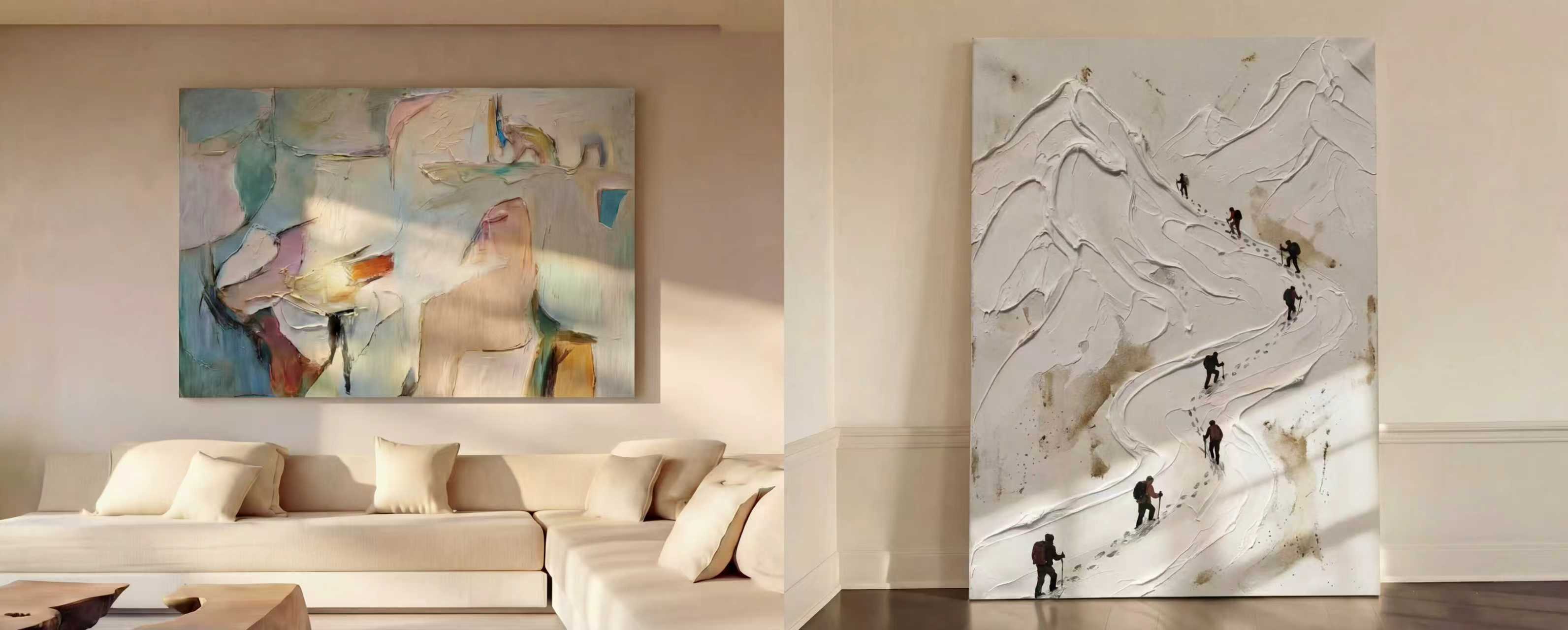
The sofa wall is the most important real estate in the room. A large-scale abstract in muted tones—think organic shapes in warm off-whites, sage, and clay—works across almost any furniture style without demanding attention. If the room already has strong pattern in the rug or upholstery, opt for something quieter in the art. If the room is neutral throughout, the art can carry more visual weight. Explore organic modern wall art for living rooms that want warmth without clutter.
Bedroom
Bedrooms benefit from art that slows you down. Soft gradients, landscape horizons, or minimal line work in muted palettes tend to support rest better than high-contrast graphic prints. Avoid anything with sharp angles or aggressive color contrasts directly above the bed—it creates a visual tension that reads as restless rather than restful.
Dining Room
Dining rooms can handle more drama than people expect. A deep-toned still life, a moody abstract, or a large-format nature print at seated eye level creates atmosphere for meals and conversation. Just watch the frame finish—brass and warm gold frames feel appropriate around the table in ways that chrome or stark black sometimes don't.
Entryway and Hallway
The entry has one job: make a first impression. Keep it to one strong piece rather than overwhelming a small space with a cluster. In hallways, a repeating series—same frame, different prints—provides rhythm without chaos. Minimalist wall art works particularly well in narrow hallways where visual noise compounds quickly.
What to Avoid
- Hanging everything at the same height throughout the house. Gallery walls, stairwells, and dining rooms all have different sightlines. Treat each space on its own terms.
- Buying art that's too small for the wall. When in doubt, go larger. A piece that's slightly oversized reads as confident; one that's too small reads as undecided.
- Matching art color too literally to the room. If your walls are sage green and you buy a print that's also mostly sage green, the art disappears. You want harmony, not camouflage.
- Ignoring the frame. A beautiful print in the wrong frame loses most of its impact. Consider the frame finish as part of the overall furniture palette, not an afterthought.
- Skipping the tape test. Before you order, cut paper to the exact dimensions of the piece and tape it to the wall. It takes five minutes and saves significant regret.
Frequently Asked Questions
How do I know what size art to buy for my wall?
Measure the furniture below or beside the wall space first. Art above a sofa should span roughly two-thirds of the sofa's width. For open walls, cut paper to the candidate size and tape it up before ordering—this step alone eliminates most sizing mistakes.
Should wall art match my furniture or my wall color?
Neither, exactly. Look for art that picks up one or two tones already present in the room's largest elements—the rug, sofa fabric, or dominant paint color—rather than trying to match anything precisely.
How high should I hang wall art?
The standard guideline is to center the artwork at roughly 57 to 60 inches from the floor, which approximates average eye level. In dining rooms, adjust lower to account for seated sightlines. Above furniture, leave 6 to 10 inches between the top of the piece and the bottom of the art.
Can I mix different art styles in the same home?
Yes, as long as you create some connective tissue between rooms—a consistent frame finish, a shared color temperature, or a recurring subject matter. Total stylistic variety from room to room can work if each space feels complete on its own terms.
What's the best art for a small room or hallway?
Vertical formats open up ceiling height, making small rooms feel taller. In hallways, a single strong vertical print or a linear series in matching frames creates flow without visual congestion. Avoid busy, high-contrast patterns in very tight spaces—they compound the sense of constriction.
Ready to find something that actually fits the space you have? Shop all wall art at mipiece and filter by size, mood, and room type to narrow it down fast.