
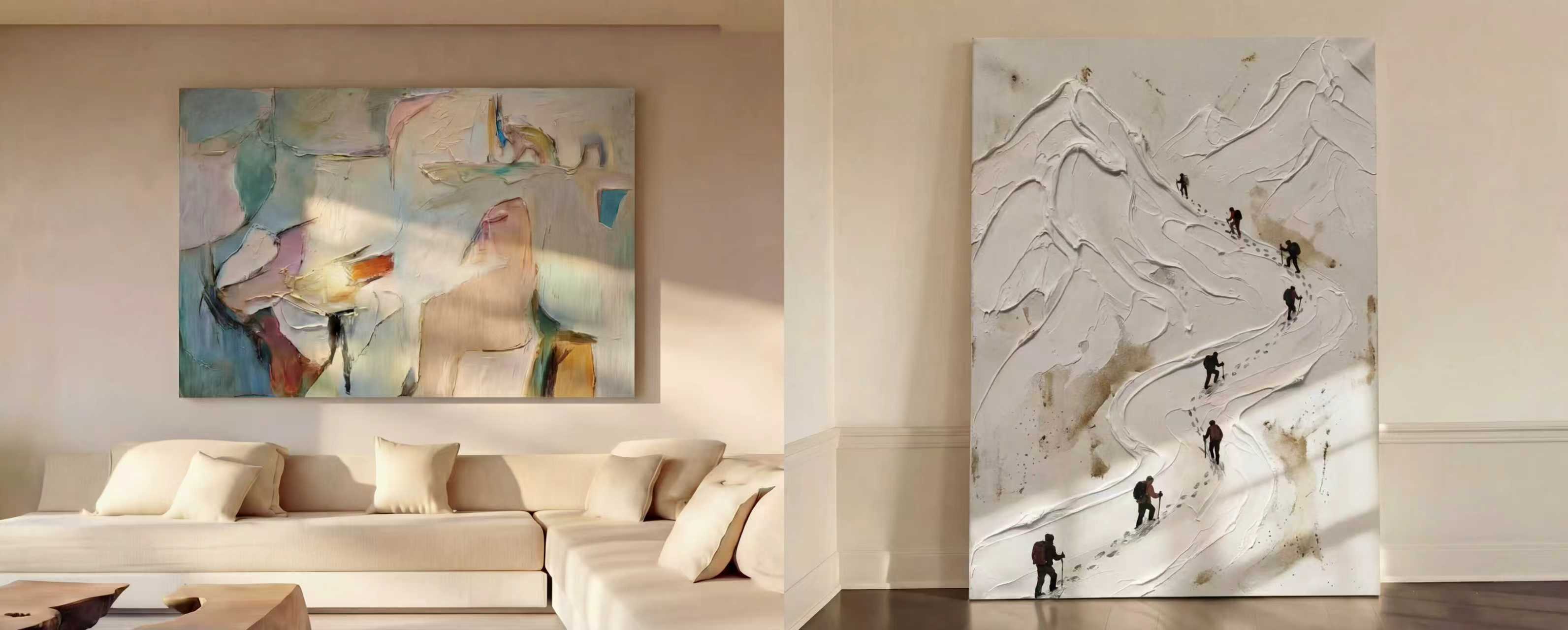
How to Match Art in a Room Without Matching Everything
Matching art to a room doesn't mean coordinating every frame, color, and subject into a tidy set. The most visually satisfying interiors usually have art that shares a mood or a single color note with the room — not art that mirrors the sofa or the rug exactly. This guide walks through how to find that balance, what overcooking it looks like, and how to choose pieces that feel intentional without feeling staged.
Quick read
A room with art that almost matches is almost always more interesting than one where everything does.
Browse related artKnowing how to match art in a room is less about finding the "right" piece and more about understanding what kind of relationship you want that piece to have with everything else. Should it echo the wall color? Contrast the furniture? Anchor a corner that feels unresolved? Each scenario calls for a different approach — and the worst outcomes usually come from trying to solve all three at once.
The short version: repeat one element — a color, a value range, a mood — and let everything else breathe. That's the whole principle. Everything below is just that idea applied to real rooms.
Color Repetition vs. Color Matching
These are not the same thing, and the difference matters more than most buying guides admit.
Color matching means pulling the exact hue from your wall, your sofa, or your rug into the artwork. It sounds logical. It usually looks flat. When a piece of art shares its dominant color with the largest surface in the room, both compete — and neither wins.
Color repetition means finding art that carries a color already present somewhere in the room, but not the dominant one. A warm terracotta in a throw pillow, a honey tone in a wood shelf, an olive tint in a plant — these are the colors worth repeating in art. They create coherence without the stiffness of an obvious match.
A practical example: in a living room with cream walls, a charcoal sofa, and warm oak floors, you don't want art that's cream, charcoal, or oak-brown. You want art that pulls out something quieter — maybe a dusty sage, a warm sand, or a muted rust that already lives in the space in small doses. That repetition reads as intentional without being obvious.
When Contrast Works Better Than Harmony
Not every room needs art that agrees with it. Some rooms are too tonally uniform — everything warm, everything muted, everything safe — and a single piece of contrast does more than a whole gallery wall of harmonious prints.
A spare, neutral room benefits from art with visual weight: a deep inky abstract, a piece with strong compositional lines, or something with a color that doesn't appear anywhere else in the room. The contrast gives the eye somewhere to go. Without it, the room can feel unresolved in a way that's hard to name but immediately felt.
The rule of thumb: use contrast when the room already has strong tonal unity. Use repetition when the room already has a lot going on. The art should do the opposite of what the room is already doing too much of.
Scale Is the Variable Most People Get Wrong
Even well-chosen art can fail if the scale is off. A small print centered on a large wall doesn't just look small — it makes the wall look like it swallowed something. And a large, dominant piece over a small console can feel aggressive in a way that overwhelms everything around it.
- Above a sofa: Art should span roughly two-thirds the width of the sofa. Not the full width, not half.
- On an empty wall: Go larger than feels comfortable. Most people undersize wall art and then wonder why the room feels unfinished.
- In a hallway or narrow space: Vertical pieces or a tight horizontal grouping. Avoid wide horizontal work — it compresses the perceived width of the space.
- Above a bed: Center it optically, not just mathematically. Leave eight to twelve inches between the top of the headboard and the bottom of the frame.
Scale interacts with matching, too. A large-scale abstract in a room with delicate furniture needs to share at least one color or tonal quality with the room to avoid feeling like it was moved in from a different space entirely.
How to Match Art in a Room Without Overmatching It
Overmatching is the more common mistake, and it's worth naming directly. It happens when someone buys a set of three prints in the same palette, hangs them evenly spaced at the same height, and wonders why the room looks like a hotel corridor.
The problem isn't the individual pieces — it's the uniformity. When everything matches too precisely, the art stops reading as chosen and starts reading as purchased-as-a-unit. It loses the quality that makes original or artist-driven work feel alive.
Some specific things to avoid:
- Buying a matching set just because it's sold as one
- Repeating the same frame finish across every piece in a room
- Spacing multiple pieces with ruler-level precision on every wall
- Choosing art solely because it contains the same colors as your existing decor
A more interesting approach: mix one larger anchor piece with one or two smaller works in a nearby corner or shelf. Let the frames vary slightly — one natural wood, one matte black. Let the subjects differ while the palette loosely connects. That variety is what makes a room look considered rather than assembled.
Choosing Art by Room Mood, Not Just Room Color
Color is the most obvious variable, but mood is often more durable. A room can change its textiles, its paint, its furniture — but if the art carries the right mood, it tends to survive those changes.
Think about what the room is supposed to feel like, then look for art that amplifies that feeling. A bedroom meant to feel quiet and restorative calls for work with low visual complexity — soft tonal gradients, sparse compositions, organic shapes. A home office meant to feel focused and grounded might want something with stronger geometry or a more structured feel.
For rooms that lean toward natural materials and an unhurried atmosphere — think linen, rattan, live-edge wood — art in the wabi-sabi style tends to belong without effort. The imperfection in the work mirrors the imperfection in the materials.
For rooms that are cleaner and more edited, minimalist wall art often integrates better than something with high visual complexity, even if the colors would technically work.
A Few Questions Worth Asking Before You Buy
Before committing to a piece, run it against these:
- Does this art share at least one color or value with the room — without duplicating the dominant one?
- Is the scale large enough to hold its own, or am I undersizing to play it safe?
- Does this feel like something I chose, or something I matched?
- Will this still feel right if I change the rug or repaint the walls?
That last question is underrated. Art that works because of mood rather than exact color coordination tends to stay relevant through more changes to the room around it.
FAQ
Does wall art need to match the room's color palette?
Not exactly. Art works best when it repeats a secondary or accent color from the room rather than mirroring the dominant one. Exact matches tend to flatten the visual result.
How do I choose art for a room with a lot of pattern and texture?
Lean toward simpler, less busy compositions. High-pattern rooms benefit from art with strong visual clarity — a single subject, a clean abstract, or something with a lot of negative space.
Is it okay to mix art styles in the same room?
Yes, as long as there's a throughline — shared palette, shared scale, or shared tonal mood. The mix itself isn't the problem; a total absence of any connecting thread is.
What's the most common mistake people make when hanging art?
Hanging it too high and choosing pieces that are too small for the wall. Both are very common and both make rooms feel less resolved than they could be.
How many pieces of art should a room have?
There's no fixed number. One large, well-chosen piece can anchor an entire room more effectively than six smaller ones that don't quite connect. Start with less and add only when the room calls for it.
If you're building out a room with a natural, unhurried feel, browse Organic modern wall art — pieces that tend to sit easily in rooms without announcing themselves.