
The Weight of Rust: Inside Abstract Rust Copper Formations
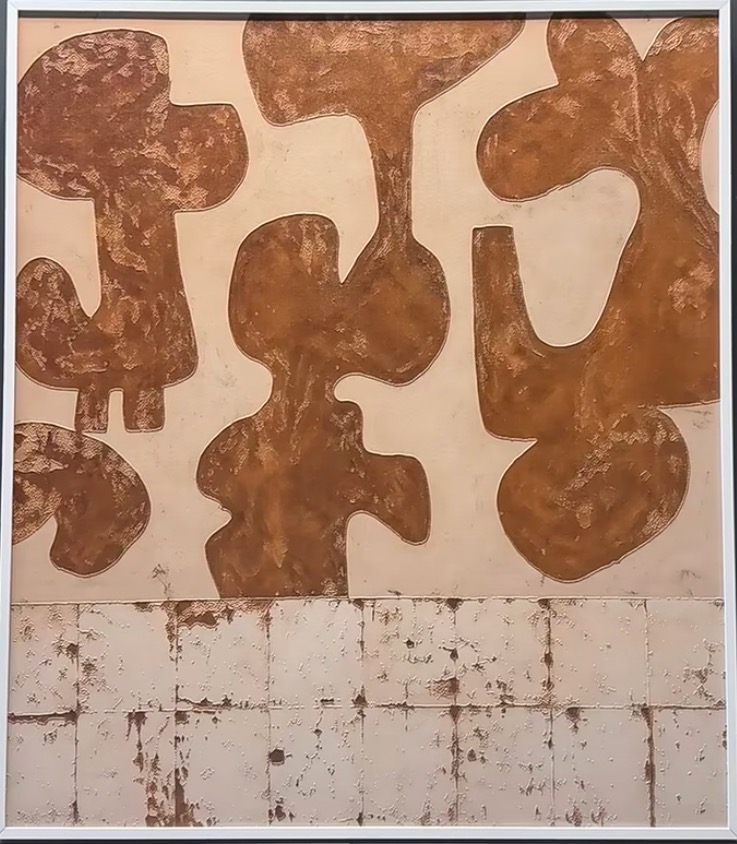
Abstract Rust Copper Formations is a hand-painted canvas that reads as sculptural rather than illustrative. Rounded, biomorphic forms in rust and bronze rise over a pale ivory ground, with a raised, plaster-like surface that shifts under changing light. A tiled lower band anchors the composition, making it a strong fit for Wabi Sabi, rustic modern, and industrial-leaning rooms.
Quick read
Earthbound, tactile, and quietly architectural — a piece that behaves more like a relief than a painting.
Product reference
At first glance, Abstract Rust Copper Formations doesn't look painted so much as excavated. Rounded, biomorphic shapes in rust, bronze, and oxidized copper rise across a pale ivory ground, their edges weathered and irregular. The surface carries a raised, plaster-like relief that catches light unevenly, pooling shadow in the folds and warming up as daylight shifts across the room.
Below the organic forms, the same palette settles into a gridded, tile-like base — a quiet, geometric counterweight to the fluid shapes above. The result is a composition with real vertical rhythm and a grounded, sedimentary feel.
What kind of wall art this actually is
This is textured abstract canvas art, hand-painted, with a built-up surface that reads closer to sculpture than to a flat print. The copper tones aren't printed color — they're layered pigment on raised relief, which is why the piece changes character depending on whether it's lit by morning light, a warm floor lamp, or an overhead fixture.
If you've been comparing rust and copper wall art online and finding most options look thin or overly digital, the difference here is physical. There's weight to it.
How it reads in a room
The mood is calm but substantial. It isn't a loud, graphic statement, and it isn't a soft, airy abstract either. It sits in between — expressive in shape, restrained in palette. In a warm neutral living room, the copper and rust extend the existing tones rather than fighting them. In a dining room, it holds an end wall with enough presence to give diners something to look at without pulling focus from the table.
Foyers with limited daylight are a quietly good match. The raised texture does something interesting with low, directional light, picking up shadow in a way that flatter artwork can't.
Who it's for
This piece suits buyers leaning into Wabi Sabi, rustic modern, or industrial interiors — rooms where imperfection, patina, and material honesty already belong. It pairs naturally with walnut or oak furniture, aged leather seating, unpolished stone, and concrete accents.
It's less at home in high-gloss, cool-toned, or ultra-minimalist spaces where the warmth and texture would feel out of context. If your palette runs cool gray and chrome, this isn't the piece to bridge it.
Realistic expectations
A few honest notes worth setting:
- The texture is a feature, not a flaw. Expect visible relief, uneven surface, and natural variation.
- It behaves as a focal point. Treat it as the anchor of a wall, not a supporting layer in a gallery arrangement.
- Color reads warmer under incandescent and lamplight, and slightly more muted in cool daylight.
- Because it's hand-painted, no two pieces are identical in every detail of texture.
A quick styling scenario
Picture a low, oatmeal-linen sofa against a warm white wall. A walnut coffee table, a slubby wool throw, a ceramic lamp with a parchment shade. The canvas hangs centered above the sofa, bottom edge roughly 8 to 10 inches above the backrest. In the evening, the lamp throws a raking light across the surface, and the copper shapes deepen into shadow at the edges. The room feels heavier, more rooted — the same furniture, with a new center of gravity.
Product details
- Type: Hand-painted canvas wall art with built-up, plaster-like relief
- Style: Abstract, organic modern, Wabi Sabi
- Palette: Rust, copper, bronze, warm ivory
- Surface: Heavy, granular texture with raised 3D forms; matte finish
- Composition: Three loose vertical columns of biomorphic shapes above a tiled, gridded base
- Best rooms: Living room (above a low sofa), dining room (end wall opposite the table), foyer (above a console), bedroom, home office
- Pairs with: Walnut and oak furniture, aged leather, unpolished stone, concrete
- Framing: Available framed or unframed depending on variant
For buyers weighing this against a flat printed abstract or a softer neutral canvas, the tradeoff is clear: more presence, more texture, more commitment to a warm, grounded direction. See the full piece at Abstract Rust Copper Formations.