
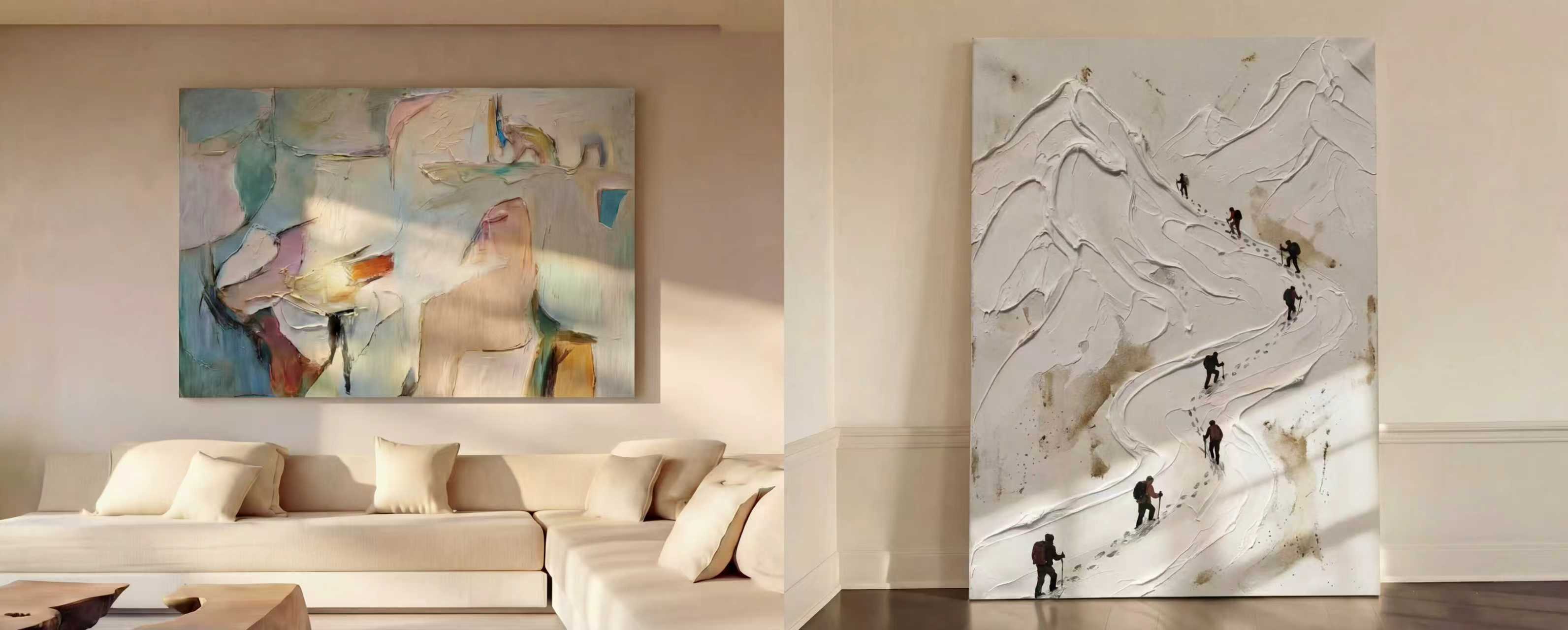
Minimalist Abstract Art Meaning, Without the Pretentiousness
Minimalist abstract art removes everything that isn't necessary. No recognizable objects, no narrative clutter — just deliberate marks, open space, and the tension between the two. Understanding what that means in practice helps you choose pieces that genuinely work in a room rather than ones that just look vaguely expensive.
Minimalist abstract art strips a composition down to its load-bearing elements: a single brushstroke, a field of muted color, two shapes in deliberate tension. There's no scene to decode, no portrait to read. The meaning lives in the restraint itself — in what the artist chose to leave out as much as what stayed.
That might sound like a gallery-wall justification for hanging an expensive beige rectangle. It isn't. Understanding minimalist abstract art meaning is genuinely useful when you're deciding what to put on your walls, because it tells you exactly what the work is and isn't supposed to do.
What Minimalist Abstract Art Actually Is
The term collapses two movements into one phrase. Abstraction, broadly, means the image doesn't represent a specific real-world object. Minimalism means the formal elements — color palette, composition, mark-making — are reduced to as few as necessary to hold visual interest.
Put them together and you get work that often looks deceptively simple. A horizontal wash of warm gray. A single irregular circle on raw linen. Overlapping arcs in two tones of charcoal. The simplicity is intentional and, when it's done well, demanding — because there's nowhere to hide weak composition.
This is different from art that's just sparse. A lonely piece of clip art isn't minimalist abstract art. The restraint has to feel chosen, and the remaining elements have to carry weight.
Negative Space Is Doing the Work
One concept worth understanding before you buy anything: negative space isn't empty. In a minimalist composition, the unoccupied areas of the canvas define the marks just as much as the marks define the space. A thin vertical line on a large white field reads completely differently depending on where that line sits — centered, slightly left, near the bottom edge.
When you're shopping for minimalist abstract work, look at the space around the subject, not just the subject. A piece where the negative space feels accidental or cramped will look restless on the wall. A piece where it feels considered will settle a room.
Minimalist Abstract vs. Organic Modern — They're Not the Same
These two styles often get grouped together in interior design content, and they do share some territory: muted palettes, natural tones, an avoidance of literal imagery. But the difference matters when you're choosing art for a specific room.
- Minimalist abstract tends toward geometry, precision, and high contrast between mark and ground — even when the palette is soft.
- Organic modern art leans into irregular forms, textures that suggest nature (stone, water, branch), and a looser, more gestural quality. The restraint is still there, but the feeling is warmer and less architectural.
A Japandi-style living room with clean-lined furniture often suits true minimalist abstract work. A room with linen sofas, rounded edges, and wood accents usually responds better to organic modern pieces. Neither is superior — they just serve different rooms.
How to Incorporate Black Minimalist Art Without Killing the Light
Black minimalist art is one of the most searched-for categories in wall art, and it's easy to understand why: high contrast, strong definition, works with almost any neutral palette. But it's also the category most likely to go wrong.
A few practical notes:
- Scale matters more here than anywhere. A small black-on-white piece in a large room disappears. A large one in a small room can read as oppressive rather than dramatic.
- Frame choice changes everything. The same black abstract print in a thin natural wood frame versus a wide matte black frame are almost different pieces. The black frame amplifies the graphic quality; the wood frame softens it.
- Placement affects weight. Hanging black minimalist art low on a wall brings visual mass down toward the floor — grounding but sometimes heavy. Higher placement, with more wall visible below, lightens the effect considerably.
- Balance with texture. If the walls, furniture, and floor are all smooth and neutral, black abstract art will feel stark. Add a textured throw, a ceramic vase, something with physical depth — the art integrates better.
When Minimalist Abstract Art Is the Wrong Choice
This style earns its reputation in the right rooms. In the wrong ones, it just looks cold or unfinished.
Skip minimalist abstract if your space already has strong pattern — geometric tile, a bold wallpaper, a heavily patterned rug. The art won't compete well, and the combination becomes busy in a way that defeats the whole point of minimalist work.
Also reconsider if the room has a lot of warm, rustic character — exposed brick, reclaimed wood, vintage furniture. Crisp minimalist abstract pieces can feel imported from a different design vocabulary altogether. Organic modern or gestural abstract work usually lands better there.
And be honest about the wall itself. A large, well-lit wall with good sightlines is where minimalist art performs. A narrow hallway, a wall broken up by windows, or a poorly lit corner will all fight against the composition rather than let it breathe.
Scale and Placement: The Practical Short Version
For a standard living room wall (roughly 8–10 feet wide), a single piece between 36 and 48 inches wide typically holds without shrinking. For a bedroom above a queen or king bed, aim for a width between two-thirds and three-quarters of the headboard width. For a dining room, consider hanging slightly higher than you think is right — art above a seated eyeline reads better than art you're looking down at from a standing position.
One more thing: don't default to center-hung just because it's safe. Minimalist abstract work sometimes benefits from being positioned slightly off-center, especially if the furniture arrangement below isn't perfectly symmetrical.
Frequently Asked Questions
What is the meaning behind minimalist abstract art?
It's art that communicates through reduction — using as few formal elements as possible to create visual tension, calm, or focus. The meaning isn't hidden in a symbol; it lives in the relationship between marks and space.
Is minimalist abstract art the same as modern art?
Not exactly. Modern art is a broad historical category. Minimalist abstract art is a style that emerged from it — specifically from movements like Abstract Expressionism and Minimalism in the mid-20th century — but the style continues in contemporary work today.
How do I know if minimalist abstract art will work in my room?
Look at the dominant shapes and textures in the room first. If the space is architectural and clean-lined, minimalist abstract work will feel at home. If the room is layered with pattern or has strong rustic character, consider organic modern work instead.
Should minimalist art have a frame?
It depends on the piece and the wall. Gallery-wrapped canvas prints often work without a frame — the clean edge is part of the composition. Prints on paper almost always benefit from framing, both for protection and to define the boundary of the image.
How is organic modern art different from minimalist abstract art?
Organic modern art borrows from nature — irregular forms, earthy tones, textures that suggest natural materials. Minimalist abstract art tends to be more architectural and precise, even when the palette is soft. Both use restraint, but they create very different emotional registers.
Ready to find something that works for your space? Browse Minimalist wall art at mipiece and see what holds the room.