
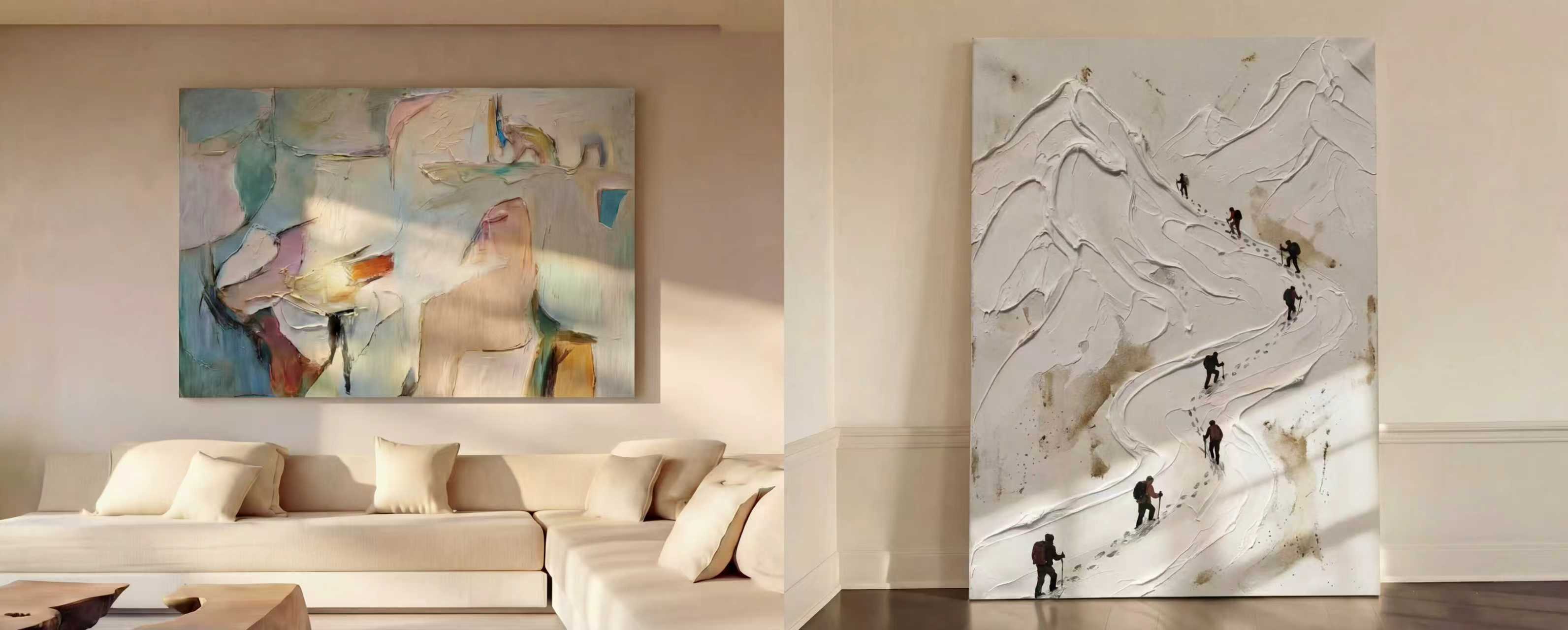
The Quiet Profile: A Line Portrait That Holds a Room Without Raising Its Voice
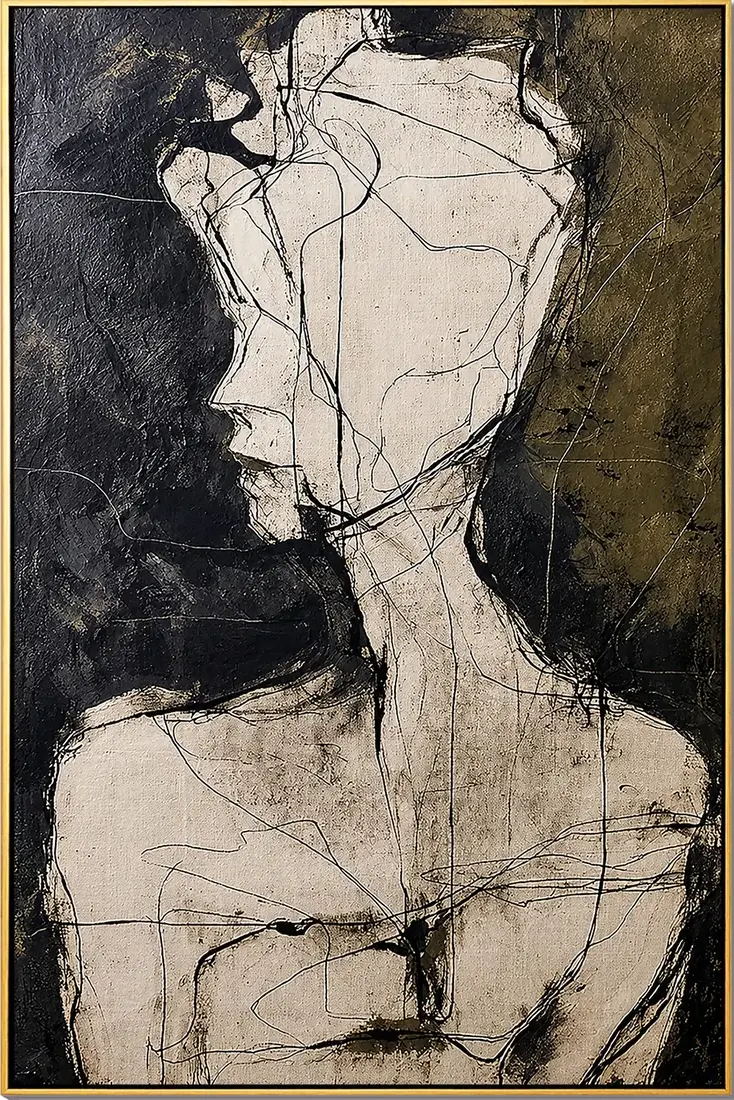
This is a hand-painted minimalist line portrait built around a profile figure, restless contour lines, and a two-tone ground of deep charcoal and muted olive gold. It behaves like a quiet focal point — graphic enough to anchor a wall, restrained enough to sit comfortably above a sofa, bed, or console without pulling the room off balance.
Quick read
A still profile held beneath restless linework, grounded in charcoal and olive gold.
Product reference
At first glance, this piece reads as a hand-drawn figure caught mid-pause. A profile emerges in warm ivory against a canvas split between deep charcoal and muted olive gold. Loose black and white lines trail across the shoulders and face — some following the anatomy, others drifting off the form entirely. It feels less like a portrait and more like a sketch that decided to become a painting.
The surface matters here. The canvas carries visible grain, uneven pigment, and the small irregularities of something made by hand. Up close, you see the brush. From across the room, you see the silhouette. That range is a big part of why it works on a wall.
What Kind of Wall Art This Actually Is
The Minimalist Line Portrait Quiet Profile is a hand-painted canvas in the abstract figure tradition — closer to a contour study than a realist portrait. It sits in the same visual family as modern line art and neutral-toned figure paintings, but the palette pushes it somewhere more grounded. The charcoal side gives it weight. The ochre side gives it warmth. The ivory figure keeps the center calm.
It behaves like a focal point without demanding to be one. That's a useful distinction when you're comparing figurative wall art options and trying to figure out what will actually live well on your wall.
How It Reads in a Room
In daylight, the olive-gold field warms up and the linework recedes slightly, letting the figure feel more present. Under lamplight, the charcoal side deepens, the contrast tightens, and the piece takes on a heavier, more sculptural quality. It shifts through the day rather than sitting flat, which is one of the quiet advantages of hand-painted work over a printed reproduction.
Tonally, it pairs cleanly with walnut, blackened wood, matte black metal, and warm taupe upholstery. It does not want to sit next to bright accent colors or high-gloss finishes. The mood is restrained — think contemporary wabi, minimalist, or a softer take on industrial.
Who It Suits and Who It Doesn't
This piece works for people who lean toward tonal interiors and want a figurative element without going ornate. If your rooms are built on neutrals, natural materials, and a limited palette, it slots in easily. If your space is colorful, maximalist, or heavy on pattern, this piece will feel muted next to it — not a failure, just a mismatch.
One common assumption worth correcting: minimalist line art is often treated as filler. This one isn't. The scale of the figure and the divided ground give it more presence than a typical single-line sketch, so treat it as a statement piece rather than a background layer.
A Real Placement That Works
Picture a living room with a low walnut console, a linen sofa in warm taupe, and a black metal floor lamp off to one side. Hang the portrait centered above the console, roughly eye level when standing. The charcoal ground echoes the lamp, the ochre picks up the wood, and the ivory figure keeps the wall from feeling heavy. Nothing competes. The room settles.
In a bedroom, it reads best on the wall facing the bed, above a low headboard, paired with linen bedding in oat or bone. In a home office, place it on the wall opposite your desk — it gives your eye somewhere quiet to land between tasks, which matters more than people think.
Product Details
- Type: Hand-painted canvas wall art, not a print
- Style: Abstract figure, minimalist line portrait
- Palette: Deep charcoal, muted olive gold, warm ivory, black and white linework
- Surface: Textured canvas with visible grain and uneven pigment
- Best rooms: Living room, bedroom, home office
- Pairs with: Walnut or blackened wood, matte black metal, warm taupe or linen upholstery
- Interior directions: Contemporary wabi-inspired, minimalist, softened industrial
- Placement notes: Above a low console, centered over a neutral sofa, facing the bed, or opposite a desk
How It Compares
Against a pure black-and-white line drawing, this piece feels warmer and more painterly. Against a large-scale abstract in similar tones, it holds more narrative — you read a figure, not just a field. And against a printed portrait, the hand-worked surface gives it a presence that flat reproductions struggle to match.
For a full look at the artwork, sizing, and finish details, see the Minimalist Line Portrait Quiet Profile.