
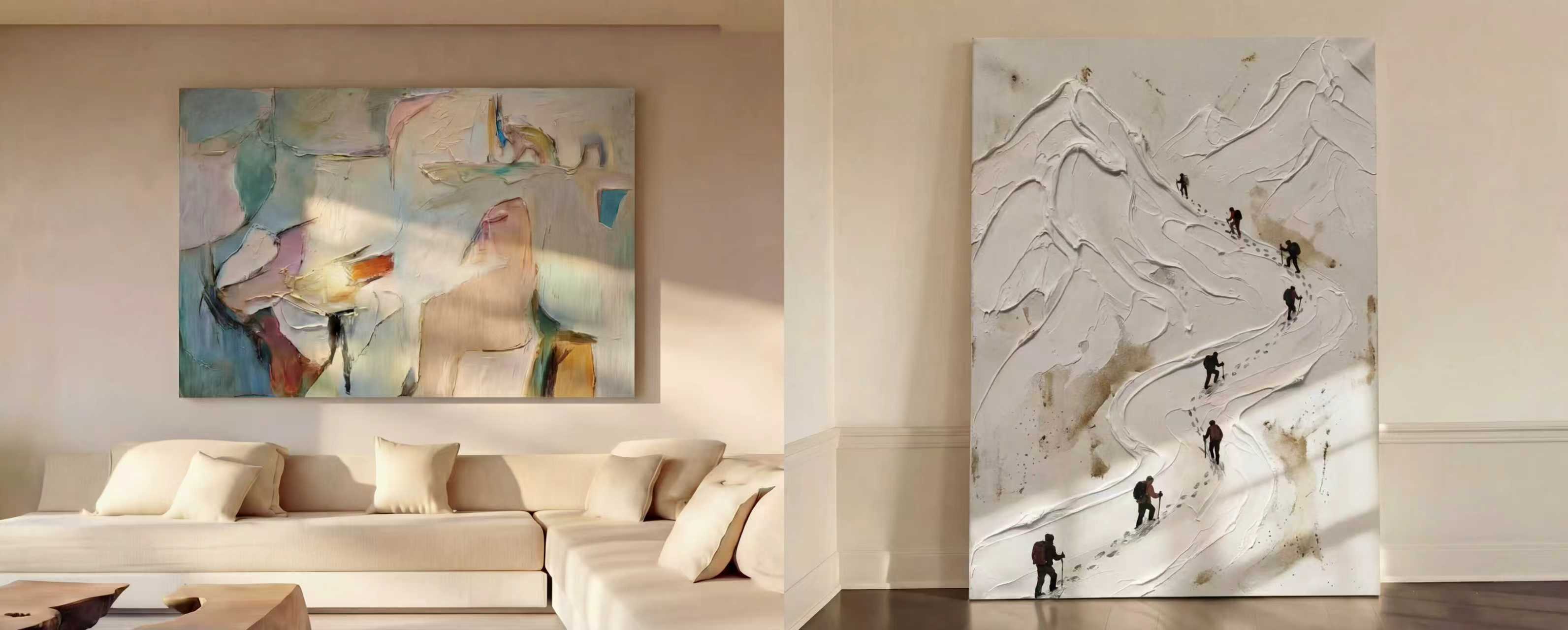
Mixed Media Abstract Reclaimed Junction: A Study in Weathered Texture
Mixed Media Abstract Reclaimed Junction is a hand-painted textured canvas that reads like a fragment of an old wall. Weathered wood, built-up plaster, charcoal shadows, and gold leaf sit in quiet tension, making it a grounded focal piece for living rooms, foyers, and home offices leaning wabi-sabi or warm modern.

Quick read
A quiet meeting of wood, plaster, and gold — held together by contrast, not symmetry.
Product reference
Mixed Media Abstract Reclaimed Junction reads less like a painting and more like a section of an old wall someone carefully lifted and framed. A weathered plank of wood sits embedded in a bed of built-up plaster, its grain broken by streaks of red and small runs of gold leaf. To the left, a rust-toned beam pushes out into charcoal shadow. Above, smoky grey stone dissolves into gilded fragments and quiet white. The composition holds its weight at the center, then loosens toward the edges.
It's a hand-painted, heavily textured canvas — the kind of abstract wall art you notice first for its surface, then for its structure.
What Makes It Visually Distinct
Most abstract canvases rely on color or gesture. This one leads with material. Plaster is laid thick in places and scraped bare in others, so the canvas itself shows through as part of the composition. The wood elements aren't printed effects — they read like reclaimed timber sitting proud of the surface. Gold leaf appears in small, uneven traces rather than as a decorative wash, which keeps the piece grounded instead of glamorous.
The palette stays in a narrow band: warm white, ash grey, ochre, rust, and black. That restraint is what lets the texture speak.
How It Feels in a Room
The overall mood is calm but weighted. It doesn't shout across the room, but it changes the gravity of a wall. In daylight, the ochre and rust warm up and the plaster takes on shadow. Under lamplight, the gold fragments catch and the piece feels quieter, more intimate. It behaves like a wabi-sabi object — imperfect, layered, and slow to fully read.
This is a focal piece, not a supporting one. Hanging something equally textured next to it will create visual noise. Give it a clean wall and let the surface do the work.
Where It Belongs
Above a low console or sideboard in a living room, the material depth reads clearly from six or eight feet away. In a home office, mounted on the wall facing the desk, it adds visual interest without competing with a monitor or bookshelf. A foyer with natural light suits it well — the metallic notes shift through the day, which gives the entry a small, changing detail.
It pairs naturally with reclaimed wood furniture, wrought iron, aged leather, linen upholstery, and walls in warm white, bone, or soft grey. Rooms with exposed brick, concrete, or lime-washed plaster feel like a continuation of the artwork rather than a backdrop for it.
Realistic Expectations
A few things worth knowing before it goes on the wall:
- Because it's hand-painted with built texture, each piece varies slightly in the depth and placement of plaster and leaf.
- The palette is warm-neutral. It won't bridge into cool coastal or high-contrast black-and-white schemes without effort.
- It reads best from a short distance. In a narrow hallway where viewers pass within a foot or two, the surface detail is the reward.
- It's a quiet piece by mood, but visually substantial. Undersizing it above a large sofa will make the wall feel underdressed.
How It Compares
Against a flat printed abstract, this canvas trades reproducibility for physical presence — it casts real shadows. Against a pure wabi-sabi plaster piece, it introduces more structure through the wood elements. Against a bold color-field abstract, it stays neutral, which makes it easier to live with over years rather than seasons.
A Short Styling Scenario
Picture a living room with a low oak console, a stoneware lamp, and a warm white wall. Centered above the console, this piece pulls the palette of the room — wood, ceramic, plaster — up onto the wall. The lamp's evening glow catches the gold traces, and the console's grain visually rhymes with the embedded plank. Nothing else on the wall. It reads as intentional rather than decorated.
Product Details
- Type: Hand-painted mixed media abstract on canvas
- Style: Abstract, 3D textured, wabi-sabi
- Palette: Warm white, ash grey, ochre, rust, black, with gold leaf accents
- Surface: Built plaster texture with embedded wood-look elements; areas of raw canvas left visible
- Best rooms: Living room, dining room, foyer, home office
- Placement: Above a console, sideboard, low credenza, or facing a desk
- Pairs with: Reclaimed wood, wrought iron, aged leather, linen, warm neutral walls
For the full view, sizing, and finish details, see Mixed Media Abstract Reclaimed Junction.