
A Quiet Diptych with a Geological Seam: Inside Shifting Ground
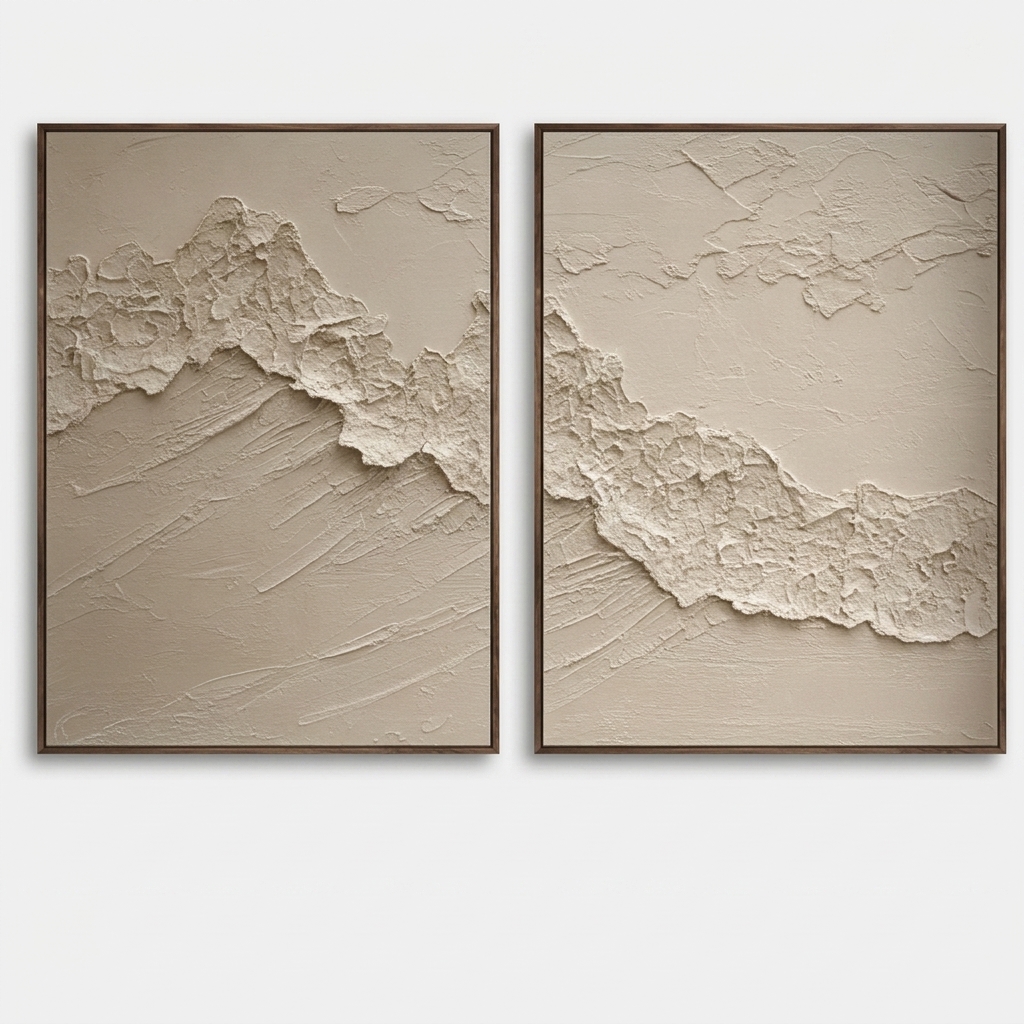
This two-panel wall art piece leans on surface and form rather than color. A raised plaster ridge crosses both canvases from upper left to lower right, creating a slow diagonal that feels geological. The neutral palette keeps things calm, which is why it tends to land well in Japandi, wabi-inspired, and soft modern rooms above sofas, beds, or long consoles.
Quick read
Built, not painted — a quiet ridge of plaster carrying the eye across two panels.
Product reference
Piece: Neutral Textured Abstract Shifting Ground
Format: Hand-painted
Size family: large
View the productShifting Ground opens with a single gesture: a raised ridge of plaster that cuts diagonally across two panels, running from upper left to lower right like one continuous seam. At first glance it reads less like a painting and more like a section of weathered wall — something built up in layers, then left to settle. The palette stays inside a narrow band of sand, bone, and raw linen, so the eye lands on the surface before it registers any color at all.
The left panel sits in a deeper taupe, the right in a cooler ivory. The shift between them is subtle enough that most people read it as distance rather than contrast — as if the same terrain were catching light at two different moments.
How the piece reads in a room
This is textured 3D wall art in the most literal sense. The ridge has real depth, with fractured edges that throw small shadows across the smoother ground below. In daylight, those shadows soften and the piece feels almost matte. Under lamplight, the relief sharpens and the diagonal becomes the most active thing on the wall.
Because so much of the composition is open space, the diptych doesn't crowd a room. It behaves more like a plaster feature wall than a framed painting, which is why it tends to calm a space instead of energizing it.
Who it suits
The piece fits interiors that already lean quiet: Japandi rooms, contemporary wabi-inspired spaces, and soft modern layouts built around light oak, warm linen, and matte plaster walls. If your room relies on tonal layering rather than bold color, this diptych slots in without needing to be balanced against anything loud.
It's less suited to high-contrast, color-forward interiors — mid-century rooms with saturated upholstery, or maximalist walls with heavy pattern. In those settings, the restraint reads as underpowered rather than intentional.
Focal point or supporting piece?
At large scale, hung as a pair, it works as a genuine focal point above a long sofa or behind a bed. The diagonal carries the eye across the seating area instead of anchoring weight in one spot, which is useful on wide walls where a single centered canvas can feel undersized.
Scaled smaller or spaced further apart, the two panels behave more like a quiet backdrop — texture you notice on the second or third look rather than the first.
A short styling scenario
Picture a living room with a low oatmeal-linen sofa, a light oak coffee table, and warm white walls. The diptych goes above the sofa with a modest gap between panels, so the ridge reads as one continuous line. A ceramic table lamp on a nearby console throws raking light across the surface after sunset, and the texture shifts from flat to sculptural. Nothing else on the wall — that's the point.
Common assumptions worth adjusting
- It photographs flatter than it looks in person. The relief is genuinely dimensional, and most product images undersell that.
- Neutral doesn't mean invisible. The scale and texture give it real presence, even without color.
- The two panels are designed to be read together. Splitting them across separate walls breaks the diagonal and loses the effect.
Product details
- Format: Hand-painted diptych (two panels designed to hang as a pair)
- Size tag: Large — built for wide walls above sofas, beds, or long consoles
- Medium: Layered plaster and mixed media on canvas, with raised 3D texture
- Palette: Sand, bone, raw linen, with a subtle taupe-to-ivory shift between panels
- Finish: Matte, tactile, with fractured ridge edges that cast real shadow
- Best rooms: Living room above a long sofa; bedroom behind the headboard; dining room opposite the table at seated eye level
- Pairs with: Light oak wood, warm linen upholstery, matte plaster or warm white walls
- Interior directions: Japandi, contemporary wabi-inspired, soft modern, organic minimalist
For readers who want a large, restrained statement piece where texture carries the visual weight, take a closer look at Neutral Textured Abstract Shifting Ground.