
The Slow Curve: A Textured Diptych That Quiets a Room
This hand-painted diptych pairs two vertical panels into a single arching motion, built from ribbed relief and troweled plaster-style texture. In cream, sand, and soft brown, it settles a room without dominating it — a grounded, wabi-inspired anchor that suits sofas, headboards, and quiet workspaces.
Quick read
Ordered, still, and quietly architectural — a slow line held in warm neutral plaster.
Product reference
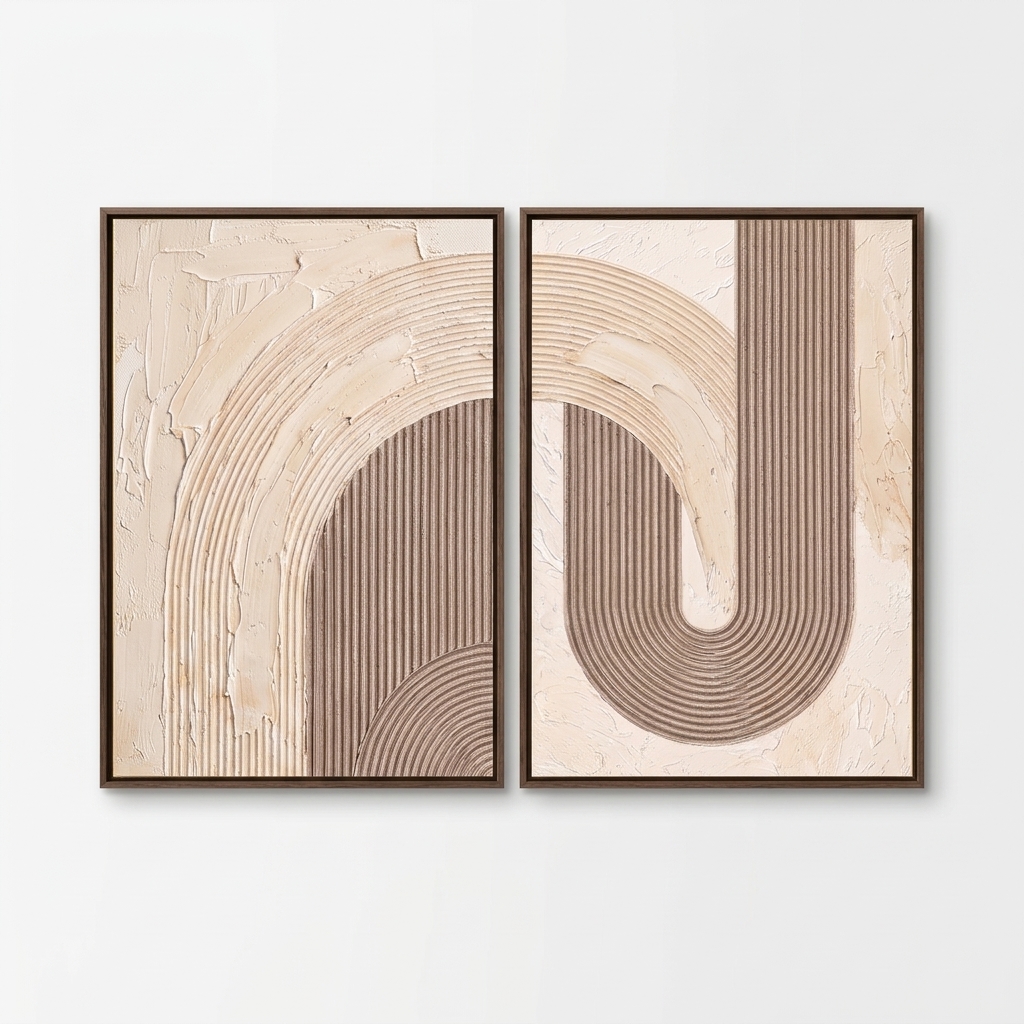
The first thing you notice is the line. Two vertical panels, one arching up from the lower edge, the other looping into a full U — read side by side, they form a single slow curve moving across the wall. The ribbed grooves inside each arch are precise, almost architectural, while the cream ground around them is troweled thick and irregular, closer to plaster than paint. It's a diptych that behaves like one composition, not two matching prints.
What the piece actually looks like
This is a hand-painted textured diptych in a warm neutral palette — cream, sand, and a muted, earthy brown. The curved forms are built in fine parallel ridges that catch light along their edges. The background is worked in heavy strokes, giving the surface a geological, almost weathered quality. The contrast between the ordered curves and the rough field is where the piece earns its presence. Nothing is loud, but nothing feels flat either.
How it reads in a room
In person, the diptych feels grounded rather than decorative. It doesn't sparkle or pop — it holds. In daylight, the plaster texture shows every ridge and trowel mark. Under lamplight, the shadows deepen and the arches take on more relief, which is when the piece starts to feel sculptural. It leans calm and architectural, closer to a wabi-inspired object than a graphic print.
Because the two panels share one continuous line, spacing matters. A narrow gap between frames — around two to four inches — keeps the curve reading as a single gesture. Too much space and the composition breaks apart.
Where it fits
The obvious home is above a low sofa, where the pair gives a deep seating arrangement the visual weight it needs without crowding the ceiling line. Behind a wide headboard, it settles into a bedroom the way a soft plaster wall does — present, not performative. In a home office with a wooden desk and neutral walls, it works as a focal point that won't fight a monitor or bookshelves for attention.
It coordinates naturally with warm white linen, light oak, soft taupe upholstery, and matte plaster or limewash walls. Interior directions it flatters: soft modern, Japandi, contemporary wabi-inspired. It's less at home in high-contrast, high-gloss, or heavily saturated rooms.
Realistic expectations
A few honest notes. This is a textured piece, so surface variation is part of the design — no two hand-painted panels will be identical down to the ridge. The palette skews warm; it will not read cool or gray on a bright white wall. And while the diptych format is generous in scale, it works best when the two panels are hung with intention rather than centered like separate artworks.
Compared to a single large abstract canvas, this set offers more rhythm and more wall coverage for wide furniture. Compared to a framed neutral print, it brings real dimensional texture — closer to a plaster relief than a poster.
A quick styling scenario
Picture a living room with a long oatmeal linen sofa, a light oak coffee table, and a soft wool rug in warm ivory. The wall behind the sofa is matte white, maybe faintly warm. The diptych hangs centered above the seat cushions, framed in walnut, with a small ceramic lamp on a side table casting light across the ridges in the evening. The room reads composed without feeling styled.
Product details
- Format: Diptych — two vertical panels designed to hang as a pair
- Technique: Hand-painted with built-up plaster-style texture and ribbed relief
- Palette: Cream, sand, and muted warm brown
- Frame: Framed canvas, warm wood tone shown
- Size direction: Available in large-scale sizing suited to sofas, headboards, and feature walls
- Best rooms: Living room, bedroom, home office
- Interior fit: Soft modern, Japandi, contemporary wabi-inspired
- Placement tips: Keep a narrow, consistent gap between panels; hang at seated eye level above sofas and beds
For rooms built around warm neutrals and quiet materials, this piece adds structure without noise. See the full artwork here: Neutral Textured Abstract Slow Curve.