
Fading Horizons: A Textured Abstract That Reads Like Terrain
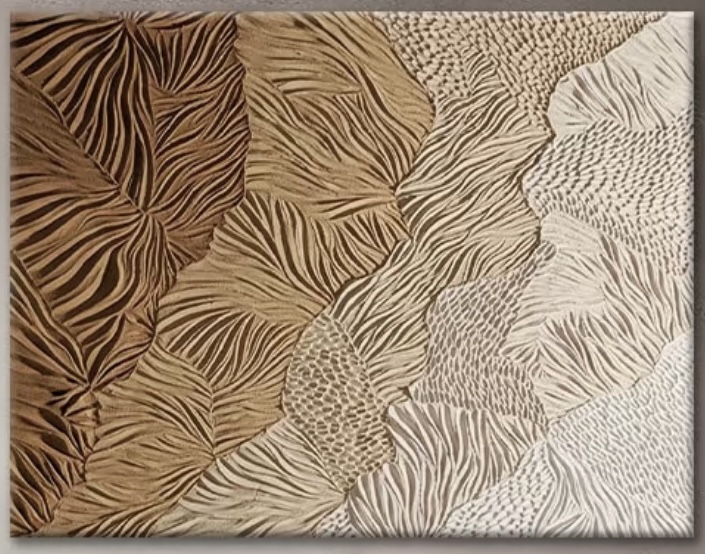
Textured Abstract Gradient Fading Horizons is a horizontal, hand-painted relief canvas built around a slow gradient of umber, ochre, tan, and pale grey. Each color zone carries its own carved rhythm — radiating lines, feathered strokes, pebbled dots — giving the piece a topographic, almost geological presence. It sits well above sectionals, dining tables, and desks in rooms leaning toward wabi-inspired, Japandi, or rustic modern.
Quick read
Less picture, more surface — a carved gradient that behaves like landscape seen from above.
Product reference
The first thing you notice about Textured Abstract Gradient Fading Horizons isn't color — it's surface. The canvas moves left to right through deep umber, ochre, tan, and finally a pale, chalky grey, but each band is carved with its own rhythm. Sharp radiating lines pull into feathered strokes, then break into dense pebbled dots near the lighter edge. It reads less like a painting and more like a relief map, or a set of adjoining fields seen from above.
That's what makes it distinct in use. Most large neutral canvases lean on color washes or loose brushwork to fill a wall. This one leans on material density. Shadow pools inside each groove, so the piece looks noticeably different in morning daylight than it does under a warm lamp at night.
How It Reads in a Room
Fading Horizons is a horizontal, grounded piece — not a floating accent. The gradient gives it directional pull, so the eye naturally travels across the wall rather than settling in the center. In practice, that makes it feel calm rather than loud, even at scale. It's a textured canvas wall art with presence, but it doesn't compete with the furniture underneath it.
In a living room, it holds the wall above a long sectional without crowding cushions or side tables. In a dining room, hung behind the table at seated eye level, it acts like a soft horizon line — grounding the space without demanding conversation. Above a desk facing away from a window, the carved surface gives you something to rest your eyes on between tasks.
Who It's For
This piece suits rooms already moving in a warm, minimal direction — walnut or oak furniture, linen upholstery, plaster or stone wall finishes, muted rugs. If your interior leans Japandi, wabi-inspired, or rustic modern, the palette will slot in without adjustment. It's less at home in high-contrast, cool-toned modern spaces or heavily patterned traditional rooms, where the earth tones can feel disconnected.
Buyers comparing options often weigh this against flat abstract prints or large photographic canvases. The tradeoff is real: a printed piece will always look sharper up close, but it won't carry shadow, depth, or the hand-painted quality this relief has. If you want a wall piece that changes across the day, texture wins.
Realistic Expectations
Because the surface is sculpted rather than smooth, each canvas will have small variations in the depth and direction of the carved lines. That's part of the character, not a flaw. The color gradient is intentionally uneven — pieced, not blended — so the transitions between umber, ochre, tan, and grey are visible as edges, not soft fades.
One common misread: people expect this kind of textured neutral art to disappear into the wall. It won't. It's quiet in palette but assertive in surface. Treat it as a focal point, not filler.
A Quick Styling Scenario
Picture a living room with a long oatmeal linen sectional, a low walnut coffee table, and a wool rug in soft clay tones. The wall behind the sofa is bare plaster. Fading Horizons goes up centered above the sectional, stretching most of its length. In the afternoon, the umber side glows warmer; by evening, lamplight catches the carved grooves and the whole piece deepens. Nothing else on the wall — it doesn't need company.
Product Details
- Type: Hand-painted textured canvas wall art, sculptural relief finish
- Style: Abstract, 3D textured, wabi-sabi leaning
- Palette: Deep umber, ochre, tan, warm grey, pale off-white — earth-tone gradient, left to right
- Surface: Carved rhythms including radiating lines, feathered strokes, and pebbled dot fields; shadow depth varies with light
- Best rooms: Living room above a sectional, dining room behind the table, home office facing the desk, foyer, bedroom over a low headboard
- Pairs with: Walnut and oak furniture, warm linen upholstery, natural stone or plaster wall finishes
- Orientation: Horizontal — best on wide, uninterrupted wall runs
If your room is already leaning warm, minimal, and material-driven, this is the kind of piece that quietly finishes it — see the full canvas in detail at Textured Abstract Gradient Fading Horizons.