
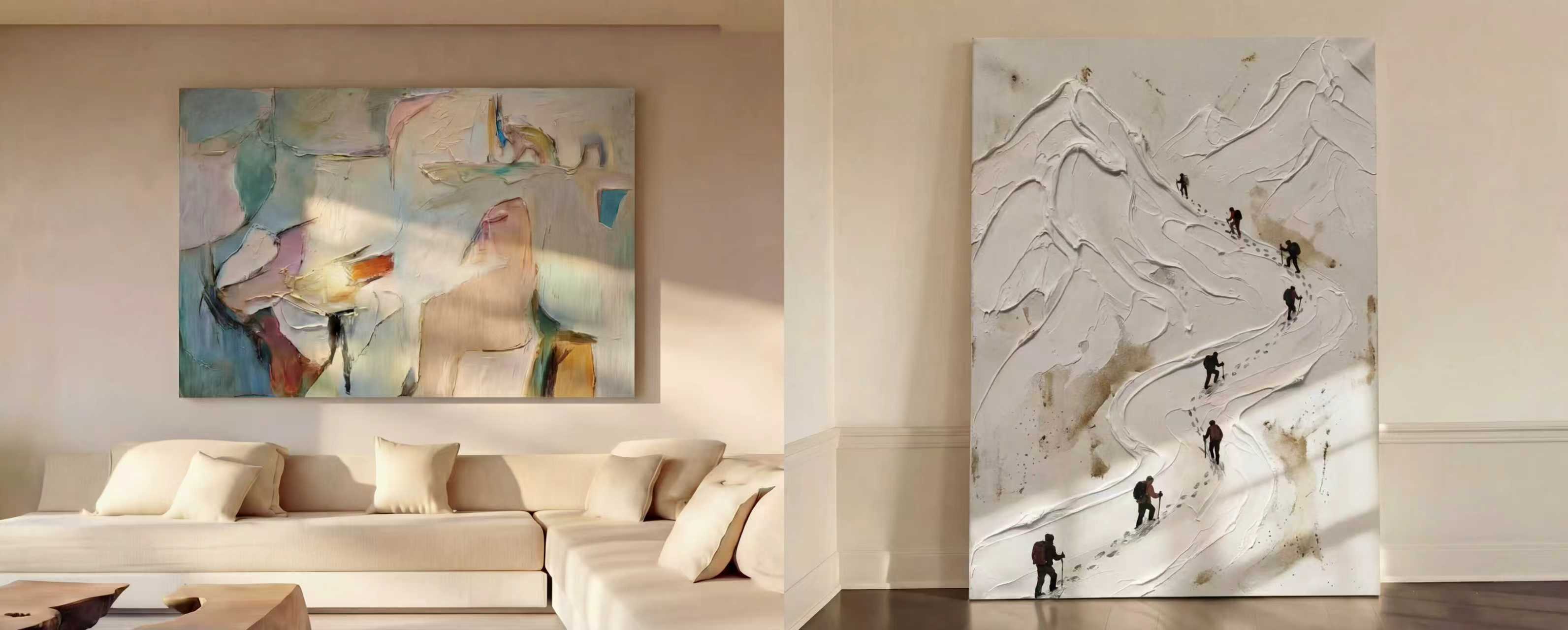
Quiet Horizon: A Textured Abstract That Reads Like Weathered Earth
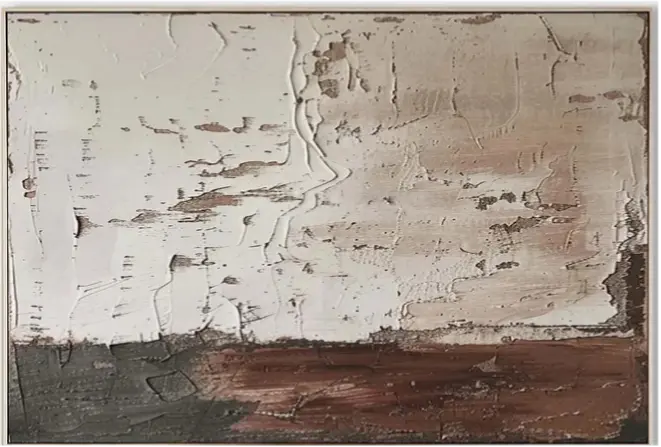
Quiet Horizon is a hand-painted abstract landscape where a heavy, plaster-like cream field meets a low band of umber, rust, and muted olive. The texture does the heavy lifting, catching light unevenly and giving the piece a weathered, tactile presence that suits wabi-inspired, Japandi, and rustic modern rooms.
Quick read
A quiet piece that behaves like a wall finish more than a painting.
Product reference
At first glance, Quiet Horizon looks less like a painting and more like a fragment of a weathered wall someone framed. The upper two-thirds is a dense, cream-and-bone field built up in plaster-like layers, cracked and ridged in ways that catch light unevenly. Below, a firm horizontal line drops into a band of deep umber and rust, with a small wedge of muted olive anchoring one corner. The whole thing reads as a horizon — sky above, mineral ground below — without ever committing to a literal landscape.
It's a hand-painted textured canvas, and that texture is the point. Photographs flatten it; in person, the raised ridges throw shadows that shift with the time of day.
How the piece reads in a room
Quiet Horizon is a calm piece with weight. The cream field keeps it airy from across the room, but the earth-toned band and heavy surface give it a grounded presence you feel when you walk closer. It leans wabi-sabi in mood — imperfect, weathered, patient — without tipping into rustic cliché.
In daylight, the cracks and ridges read soft and chalky. Under a warm lamp at night, the terracotta undertones surface more, and the whole canvas takes on a deeper, more sculptural feel. That shift is part of what makes it worth living with.
Who it's for
This one suits people building rooms around a restrained material palette: walnut or oak wood, linen upholstery, warm whites, soft taupes. If your space already runs quiet — Japandi, contemporary wabi-inspired, rustic modern — the texture becomes the visual event without fighting anything else in the room.
It's less ideal if your walls are already busy with pattern, gallery arrangements, or high-contrast art. Quiet Horizon wants some breathing room around it.
Where it works
- Above a low sofa. The horizontal band lines up naturally with a linear sofa, and the earth tones echo wood and leather.
- Dining room end wall. Facing the table, near natural wood furniture, it reads as a quiet focal point rather than a decorative afterthought.
- Foyer or entry. Above a console table, especially where indirect daylight rakes across the surface, the texture does most of the talking.
- Bedroom or home office. Works over a headboard or behind a desk when you want something calm rather than graphic.
A common misread
People sometimes assume a neutral abstract painting will disappear into a neutral room. This one doesn't. The plaster density and the rust band give it enough contrast to hold a wall on its own — you don't need to prop it up with a gallery cluster or a bold frame. Treating it as a supporting piece usually undersells it. It's a focal piece that happens to be quiet.
How it compares
Against a flat neutral abstract print, Quiet Horizon has real dimensional surface — closer to a mixed-media wall object than a poster. Against a moody, high-contrast abstract, it's softer and easier to live with over time. And compared with a pure wabi-sabi minimalist canvas, it has more warmth, thanks to the rust and olive at the base.
A short styling scenario
Picture a living room with a low, warm-white linen sofa, a walnut coffee table, and a jute rug. The wall behind the sofa is bare and slightly off-white. Center Quiet Horizon so the rust band sits roughly a hand's width above the sofa back. Add a ceramic lamp with a linen shade to one side. That's the whole styling move — the texture handles the rest.
Product details
- Type: Hand-painted textured canvas wall art
- Style: Abstract, wabi-sabi, 3D textured landscape
- Palette: Cream, bone, terracotta, deep umber, rust, muted olive
- Surface: Heavy plaster-like build-up with fissures and raised ridges; rewards close viewing
- Best rooms: Living room, dining room, foyer, bedroom, home office
- Pairs with: Walnut and oak wood tones, warm white linen, soft taupe upholstery
- Interior directions: Contemporary wabi-inspired, Japandi, rustic modern
- Placement notes: Above a low sofa, centered on a main wall, or above a console where indirect light can catch the texture
For anyone weighing a textured landscape wall art piece that adds warmth without visual noise, take a closer look at Textured Abstract Landscape Quiet Horizon.