
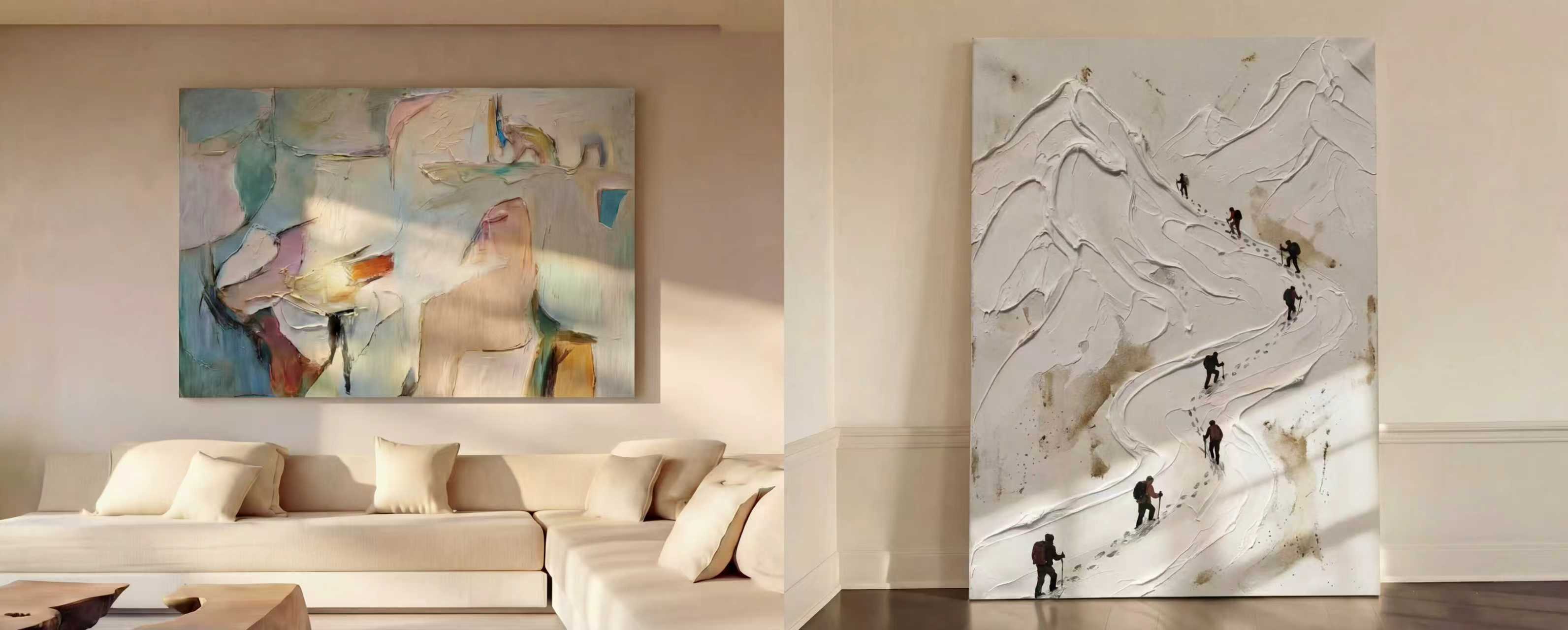
A Quiet Study in Relief: Living With Textured Abstract Sculptural Panels
Textured Abstract Sculptural Panels is a hand-built, sand-toned wall work made of raised rectangular forms in varying heights and widths. It relies on shadow, surface, and material depth instead of color contrast, giving it a calm, architectural presence that suits minimalist, Japandi, and wabi-inspired interiors.

Quick read
A tonal, tactile piece that trades color for shadow and treats the wall itself like part of the composition.
Product reference
At first glance, Textured Abstract Sculptural Panels reads less like a painting and more like a section of plaster wall lifted into its own frame. Rows of raised rectangular forms rise from a warm sand-toned ground, each block cast in slightly different heights and widths. There's no color story to decode. The whole composition works through relief, shadow, and the steady rhythm of vertical bars.
That's what makes it distinct. Instead of asking a room to react to a bold image, it adds surface and depth to a wall that might otherwise feel flat.
How It Actually Reads in a Room
Because the palette holds close to a single tone, the piece behaves differently depending on the light. In morning daylight, the raised forms cast crisp, directional shadows and the surface looks almost architectural. Under warm lamplight in the evening, those same shadows soften, and the piece settles into the wall as a quieter, more textural presence.
It doesn't compete with furniture. It doesn't pull the eye the way a high-contrast abstract canvas would. It works more like a considered material choice, closer in spirit to a limewash wall or a raw linen drape than to a traditional framed print.
Who It Suits
This is wall art for people who lean toward minimalist, Japandi, or wabi-inspired interiors, where tonal palettes and honest materials do most of the visual work. If your room already runs on light oak, warm linen, soft taupe walls, and unfussy silhouettes, the piece slots in without renegotiating anything.
It's less suited to high-contrast, highly saturated rooms. In a space built around bold color or graphic pattern, a tonal beige relief can read as underpowered. It rewards restraint around it.
Realistic Expectations
A few things worth knowing before it arrives:
- The texture is the point. Photographs flatten it. In person, the raised forms have real depth and cast real shadows.
- Because it's hand-painted and hand-built, small variations in block height, edge, and surface are part of the finish, not flaws.
- It's a tonal piece, not a monochrome graphic. Expect subtle warmth, not stark white.
- It performs best on walls that get some directional light during the day.
How It Compares to Other Neutral Wall Art
Against a flat printed beige abstract, this piece has noticeably more physical presence. Against a large statement canvas with strong brushwork, it's quieter and more architectural. And against a woven or fiber wall hanging, it feels more structured and composed, closer to plaster relief than to textile.
If you've been comparing sculptural plaster wall decor, 3D textured canvas, and minimalist neutral prints, this sits firmly in the sculptural camp, with the composure of a minimalist piece.
A Quick Styling Scenario
Picture a living room with a long, low linen sofa in a warm oat tone, a light oak coffee table, and off-white plaster walls. Centered above the sofa, the panels give the wall a subtle vertical cadence that echoes the linearity of the furniture without repeating it. Add a ceramic table lamp to the side, and by evening, the light rakes across the surface and the whole wall gains dimension.
The same piece in a dining room, on the wall facing the table, catches morning light one way and candlelight another. In a home office, hung opposite the desk, it becomes a quiet visual pause between tasks.
Product Details
- Type: Hand-painted, hand-built textured wall art on canvas
- Style: Abstract, minimalist, wabi-sabi, 3D textured
- Palette: Warm sand, soft beige, ivory — tonal, no strong contrast
- Surface: Built-up material forming raised rectangular relief; tactile, dimensional finish
- Best rooms: Living room above a low sofa, dining room on the wall facing the table, home office above a low credenza, foyer, bedroom
- Pairs with: Light oak or walnut wood, linen and bouclé upholstery, plaster or lime-washed walls, ceramic and stone accents
- Feels like: A calm, architectural focal point rather than a decorative accent
For a closer look at scale, texture, and finish, see the full listing for Textured Abstract Sculptural Panels.