
A Single Leaf, Up Close: The Quiet Drama of a Textured Botanical Study
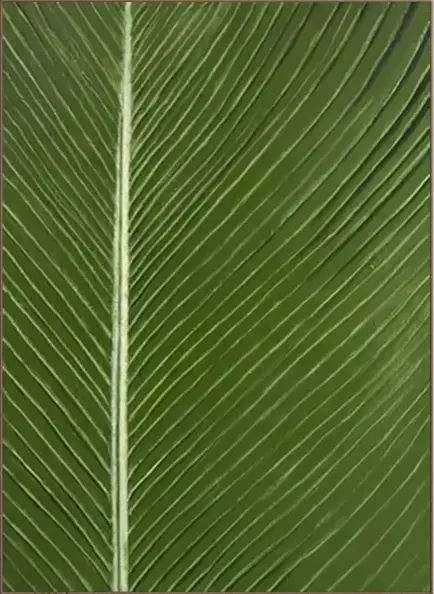
The Textured Botanical Leaf Vein Study is a hand-painted canvas that treats a single leaf as architecture — one tall central spine, parallel ridges branching outward, a tight palette of forest and sage greens. It reads as organic pattern rather than illustration, holding its own above a console, reading chair, or dining banquette without demanding a redesigned room.
Quick read
Close in palette, deliberate in rhythm, quietly sculptural on the wall.
Product reference
The first thing you notice is the vein. A single pale spine runs the full height of the canvas, splitting the leaf into two uneven fields of deep olive and moss. From that line, dozens of fine ridges branch outward at a steady diagonal, each one raised just enough to cast its own thin shadow. The piece reads less like a painting of a leaf and more like a close study of one — the kind of thing you'd notice if you held a frond up to the window and really looked.
That's the character of the Textured Botanical Leaf Vein Study: hand-painted, dimensional, and committed to a very narrow range of greens. There's no sharp contrast, no illustrative detail, no attempt to turn the leaf into a scene. The composition is pattern first, color second, and the texture is what carries the room.
How it reads on the wall
From across the room, the canvas looks calm — a tall vertical field of green with a strong central axis. Step closer and the surface changes. The ridges catch light unevenly along their length, so the piece shifts depending on where you stand and what time of day it is. In morning light near a foyer window, the ribs look crisp and graphic. Under warm lamplight in a living room, the shadows soften and the whole surface feels more velvety.
It's a focal piece, but a quiet one. The repetition is ordered without being symmetrical, which gives it presence without making it loud. Think architectural rather than decorative.
Who it suits
This piece tends to land well with people who like greenery but don't want florals, botanical prints, or anything overtly illustrative. It fits naturally into Japandi, Scandinavian, and wabi-inspired interiors — rooms built around linen, unbleached cotton, warm walnut, and a lot of restraint. If your palette already leans earthy, the deep greens settle in without competing.
It's less at home in high-contrast, highly saturated rooms. Put it next to loud color blocks or glossy black lacquer and the subtle tonal shifts get flattened.
A realistic styling scenario
Picture a narrow entryway with a slim walnut console, a stoneware bowl for keys, and a linen runner on the floor. The leaf study hangs centered above the console, tall enough to draw the eye upward as you walk in. There's nothing else on the wall — no mirror, no sconces fighting for attention. The vertical line of the vein echoes the console's legs, and the greens pick up whatever plant or branch you've set on the shelf. It's the first thing guests look at, and they usually look twice.
In a dining room, the same piece works on the wall across from the table, where diners can rest their eyes on it between courses. Keep it out of direct overhead downlight — side light or ambient light flatters the texture far more.
How it compares to similar wall art
Framed botanical prints give you crisper lines and more literal detail, but they stay flat on the wall. Pressed-leaf shadow boxes bring real texture but tend to feel craft-leaning and small in scale. Large abstract green canvases offer mood and color, but often lack a clear focal structure. This study sits in between — the physical dimension of a textured piece, the recognizable subject of a botanical, and the compositional calm of an abstract.
One thing to set expectations around: because it's hand-painted, the ridges and tonal shifts will vary slightly piece to piece. That's part of the appeal, not a flaw to design around.
Product details
- Type: Hand-painted canvas wall art with raised 3D texture
- Subject: Single oversized leaf with central vein and diagonal ribs
- Palette: Forest green, faded sage, warm ivory along the spine
- Finish: Matte, sculptural surface; light-reactive ridges
- Orientation: Vertical, built for taller wall spaces
- Best rooms: Foyer, living room, dining room
- Pairs with: Walnut or oak furniture, linen upholstery, unbleached textiles
- Placement notes: Centered above a console, low chair, or banquette; avoid harsh overhead spotlights that flatten the texture
If a quiet, dimensional green feels like the right direction for your wall, take a closer look at the Textured Botanical Leaf Vein Study.