
A Quiet Figure, A Loud Texture: Inside Reclined Pause
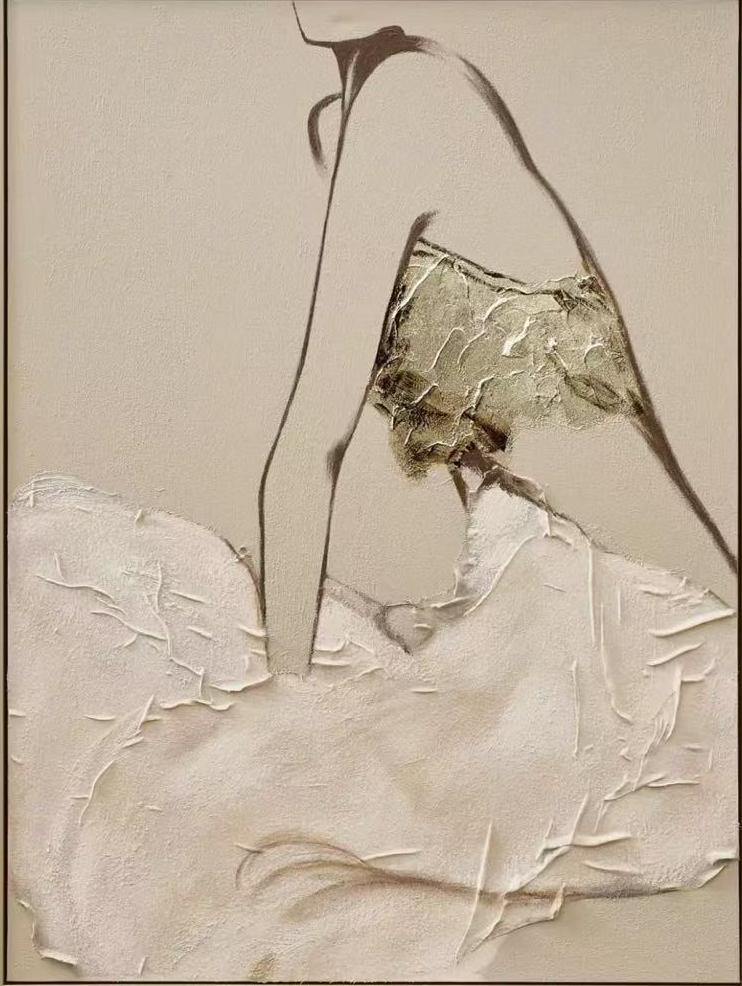
Reclined Pause is a hand-painted canvas that reads as both a drawing and a sculpture. A single sketched line traces a bent figure across a warm plaster ground, while a thick, textured white mass suggests draped fabric below. It suits soft modern, Japandi, and wabi-inspired rooms where restraint and material feel matter more than color or ornament.
Quick read
Drawing meets sculpting — a line above, a weight below, and a room that quiets around it.
Product reference
Reclined Pause opens with a contradiction. A thin charcoal line arcs across the canvas — the bend of a leg, the curve of a shoulder — and just below it, the surface thickens into a heavy, plaster-white mass that reads like draped cloth or a resting body. One half is drawn. The other half is built. That tension is the whole piece.
It sits in the abstract figure category but leans closer to a textured study than a portrait. There is no face, no finish, no resolution. A small patch of muted gold-green marks where limb meets fabric, and it shifts subtly depending on whether the room is lit by daylight or a warm lamp.
How It Reads in a Room
From across the room, you register the silhouette first: a tall, quiet composition on a warm neutral ground. Step closer and the surface takes over — ridges of impasto, dry brush edges, the raised weight of the white mass. It is a piece that rewards proximity without needing it.
Because the palette stays inside taupe, bone, and warm off-white, it does not fight linens, upholstery, or wood tones. It behaves more like a textured wall panel than a graphic print, which is why it tends to calm a room rather than sharpen it.
Who It Suits
This one is for rooms already leaning soft modern, Japandi, or contemporary wabi-inspired — spaces with light oak, warm taupe upholstery, linen, and unlacquered brass. If your walls are mostly quiet and your furniture is honest about its materials, Reclined Pause fits without effort.
It is less suited to high-contrast, color-forward interiors or rooms styled around bold graphic art. Placed next to a saturated abstract or a heavy black-framed print, its subtlety can get flattened.
Focal Point or Supporting Piece?
It works as both, depending on scale and placement. Hung alone above a low dresser or a taupe sofa, it becomes the quiet anchor of the wall. Used in a hallway or foyer where you approach it from a distance, it functions almost architecturally — a shape first, a figure second, a texture last.
What it will not do is act like a statement canvas in the traditional sense. There is no dramatic color moment, no sharp focal contrast. Buyers expecting a bold centerpiece sometimes misread the restraint as understatement. It is understated on purpose.
A Real Styling Scenario
Picture a bedroom with a light oak platform bed, a linen duvet in warm white, and a low walnut dresser on the opposite wall. Reclined Pause hangs centered above the dresser, slightly oversized for the furniture below it. In the morning, the gold-green patch catches window light. At night, a nearby table lamp throws shadow across the impasto ridges, and the piece looks like a different painting entirely.
How It Compares
Against a flat printed figure canvas, Reclined Pause reads more like an object — the texture is real, not simulated. Against a fully abstract plaster-style piece, it holds more narrative because of the line drawing. It sits between minimalist nude line art and 3D plaster wall decor, borrowing from both without fully committing to either.
Product Details
- Type: Hand-painted canvas wall art
- Style: Abstract, organic modern, figure study
- Palette: Warm plaster ground, bone white, charcoal line, muted gold-green accent
- Surface: Heavy impasto texture in the lower field; smooth ground above
- Best rooms: Bedroom above a low dresser, living room above a taupe or bouclé sofa, foyer or hallway end wall
- Pairs with: Light oak, warm taupe upholstery, linen, unlacquered brass
- Interior directions: Japandi, soft modern, contemporary wabi-inspired
For rooms built around texture, warmth, and restraint, consider the Textured Figure Study Reclined Pause as the quiet weight that pulls the whole space together.