
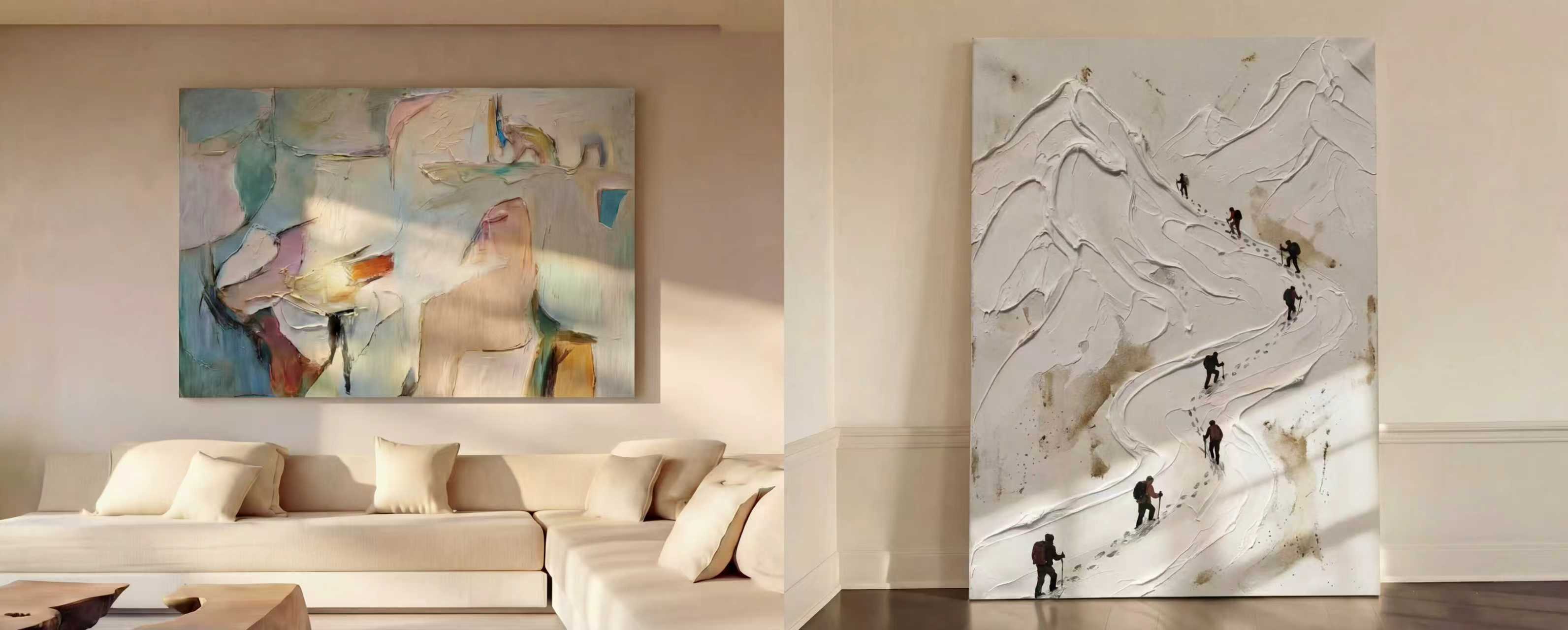
Quiet Blocks: A Textured Abstract That Reads Like Architecture
This hand-painted abstract layers taupe, warm grey, olive-brown, and ivory into a soft geometric grid with visible relief. The palette stays quiet, the composition stays balanced, and the surface texture gives the piece real presence without pulling focus. It works best in rooms that lean minimalist, wabi-sabi, or texture-forward.

Quick read
A quiet grid of earth-toned rectangles, hand-built in plaster-like layers that catch light instead of demanding it.
Product reference
Textured Geometric Abstract Quiet Blocks reads like a piece of soft architecture. Rectangles of taupe, sand, warm grey, and olive-brown interlock across the canvas in a loose grid, with two ivory panels breaking the density and letting the eye rest. The surface is heavily worked, almost plaster-like, so the blocks sit at slightly different depths and catch light along their edges.
It is a hand-painted abstract, not a print, and that shows up in the details — ridges where the palette knife stopped, thinner passages near the framed edges where the color fades into the raw canvas tone, and the low-relief quality that changes throughout the day.
How it reads in a room
At first glance, the piece feels grounded and quiet. There is no single focal shape pulling your eye, no bright accent color, no expressive gesture. What you notice instead is rhythm: the way the darker olive rectangles balance against the ivory pauses, and how the whole composition holds together like a small facade.
In daylight, the texture reads clearly and the palette warms up. Under lamplight, the relief becomes more dramatic — shadows deepen along the block edges and the surface starts to feel sculptural. That shift is part of what makes a textured canvas worth choosing over a flat print.
Who this piece suits
This one leans toward buyers who are building calm, layered rooms rather than high-contrast ones. If your interiors already include oak, rattan, linen, travertine, or plaster walls, the palette slots in without any styling gymnastics. It also holds its own in minimalist and wabi-sabi rooms where most of the visual interest comes from material and surface.
It is less suited to rooms built around saturated color, glossy finishes, or bold graphic art. Next to a bright modern abstract, it will read as background. On its own wall, it becomes the quiet anchor.
Placement that actually works
Above a low sofa, the horizontal weight of the composition sits naturally with the seating line and gives the wall structure without crowding it. Behind a headboard, it pairs well with warm wood and linen bedding — the neutral geometry keeps the bed area feeling intentional but restful. In a home office, hung on the wall facing the desk, it holds enough structure to feel considered without becoming a distraction on a working day.
Foyers and dining rooms are also strong fits, especially where you want a single piece to do the work instead of a gallery arrangement.
Where buyers get it wrong
Two common misreads: expecting a flat, graphic look based on a thumbnail, and expecting the neutrals to disappear on a beige wall. The texture is the point — it reads more like relief sculpture than a painting from certain angles. And against a warm white or greige wall, the shadowing keeps the piece visible; against a very saturated wall color, it can quiet down more than expected.
Compared with a printed geometric canvas at a similar size, this piece trades crispness for depth. Compared with a heavy oil-textured landscape, it trades drama for restraint.
Product details
- Type: Hand-painted textured canvas wall art
- Style: Abstract, minimalist, wabi-sabi
- Palette: Taupe, sand, warm grey, olive-brown, ivory
- Surface: Heavy plaster-like texture with low-relief blocks and visible knife work
- Composition: Loose architectural grid of rectangular fields, softened at the edges
- Best rooms: Living room above a low sofa, primary bedroom behind the headboard, home office facing the desk, foyer, dining room
- Pairs well with: Oak, rattan, stone, travertine, linen, plaster walls, warm whites and greiges
For a full look at the piece, sizing, and framing options, see Textured Geometric Abstract Quiet Blocks.