
The Quiet Weight of Textured Green Landscape Waves
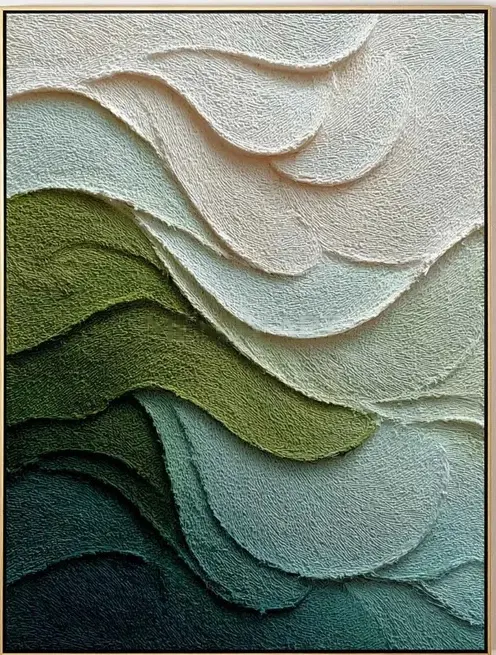
This piece is a hand-painted, heavily textured canvas that moves from soft cream at the top to shadowed forest green at the base. It behaves as a calm focal point in living rooms, bedrooms, and home offices leaning toward Japandi, Scandinavian, or wabi-inspired interiors.
Quick read
More relief than brushwork — a topographic study in sage, olive, and ivory.
Product reference
The first thing you notice about Textured Green Landscape Waves isn't the color — it's the surface. Ridges of plaster rise off the canvas in long, overlapping curves, catching light along their edges and dropping soft shadows into the troughs below. The palette moves slowly from ivory at the top through sage and olive, then compresses into a shadowed teal-black at the base. It reads less like a painting and more like a piece of quiet topography.
What it actually looks like on the wall
From across the room, the piece registers as a calm gradient — cream fading into green. Step closer and it turns tactile: raised edges, slightly frayed ridges, real depth you can see from the side. In daylight, the shadows are subtle and the greens feel airy. Under lamplight, the relief sharpens and the darker base pulls forward, giving the whole composition more weight after sunset.
That shift is part of the appeal. A flat print holds one mood all day. This one keeps changing.
How it behaves in a room
The composition is grounded but not heavy. Because the pale half sits at the top and the density collects near the bottom corner, the piece feels visually stable — a good trait for anything hung above a sofa or bed. It anchors without crowding.
It works best as a focal point on a wall that isn't already competing for attention. Pair it with quieter surroundings: light oak, warm white linen, unbleached textiles, stone-toned paint. In rooms with a lot of pattern or strong contrast, the subtlety of the gradient gets lost.
Who this piece is really for
If you're drawn to Japandi, Scandinavian, or wabi-inspired interiors — rooms built on natural materials and restrained color — this fits naturally. It also suits contemporary spaces that want a hit of green without going botanical or tropical. It's not the piece for maximalists, gallery-wall builders, or anyone looking for bold graphic contrast.
Buyers comparing textured plaster art to flat abstract prints should know the tradeoff up front: you gain dimension, shadow play, and a handmade surface, but you lose the crisp, high-contrast punch a printed canvas can deliver. This one whispers.
A quick styling scenario
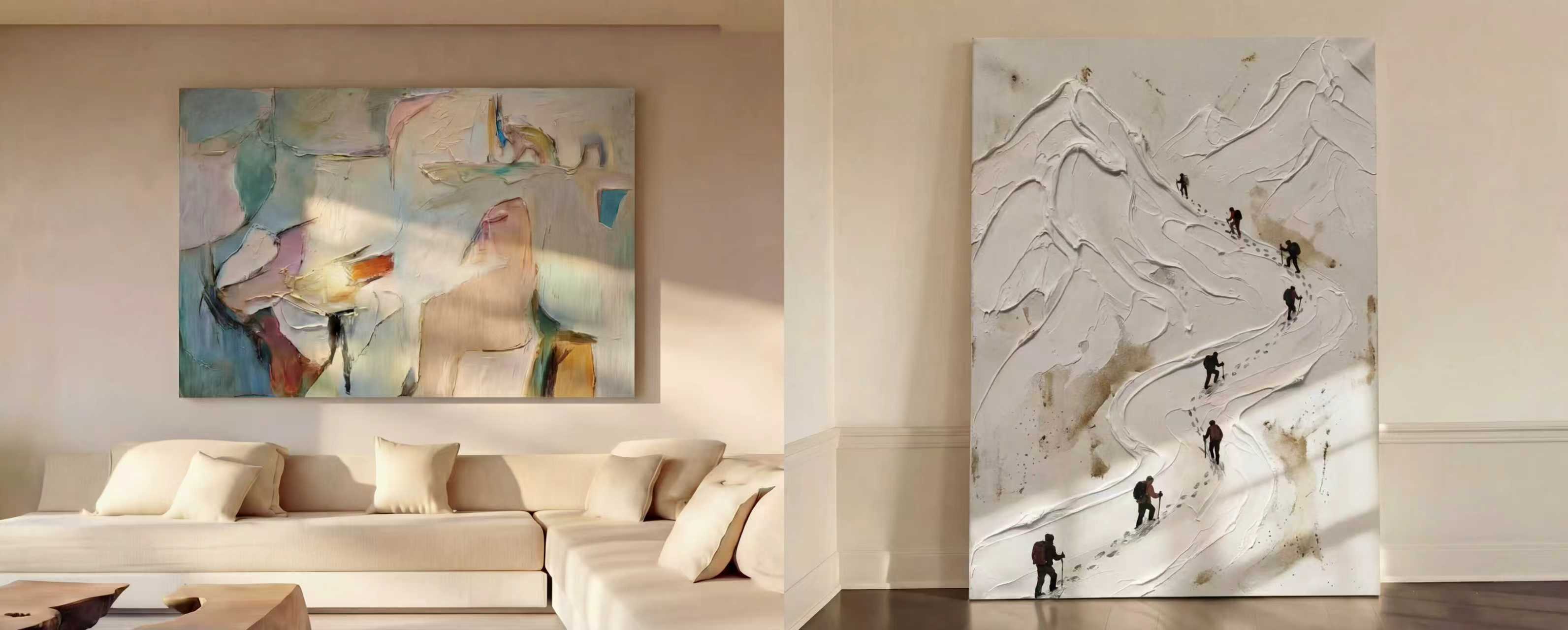
Picture a low, linear sofa in oatmeal boucle against a warm white wall. A light oak coffee table, a ceramic lamp, a woven throw. Hung centered above the sofa, Textured Green Landscape Waves pulls the room's neutrals together and introduces the only real color in the space — but softly, in layers. The greens echo a single plant in the corner. Nothing fights.
The same logic works behind a headboard in warm oak, or on the wall opposite a home-office desk, where the slow rhythm of the ridges gives your eyes somewhere restful to land between tasks.
Product details
- Type: Hand-painted textured canvas wall art, finished with layered plaster relief
- Style: Abstract, organic modern, 3D textured
- Palette: Ivory and cream at the top, sage and olive through the middle, deep forest and teal-black at the base
- Surface: Heavy built texture — raised ridges, visible shadow lines, tactile edges
- Best rooms: Living room (above a sofa), bedroom (behind the headboard), home office, dining room, foyer
- Pairs well with: Light oak, warm white linen, sage textiles, stone and clay tones
- Interior directions: Japandi, Scandinavian, contemporary wabi-inspired
Because each canvas is hand-finished, small variations in ridge height and edge texture are part of the piece — not flaws, but part of what keeps it from feeling machine-made.
For readers weighing this against a smoother abstract or a framed print, the deciding factor usually comes down to whether you want your wall art to sit quietly and change with the light, or to make an immediate graphic statement. If it's the former, take a closer look at Textured Green Landscape Waves.