
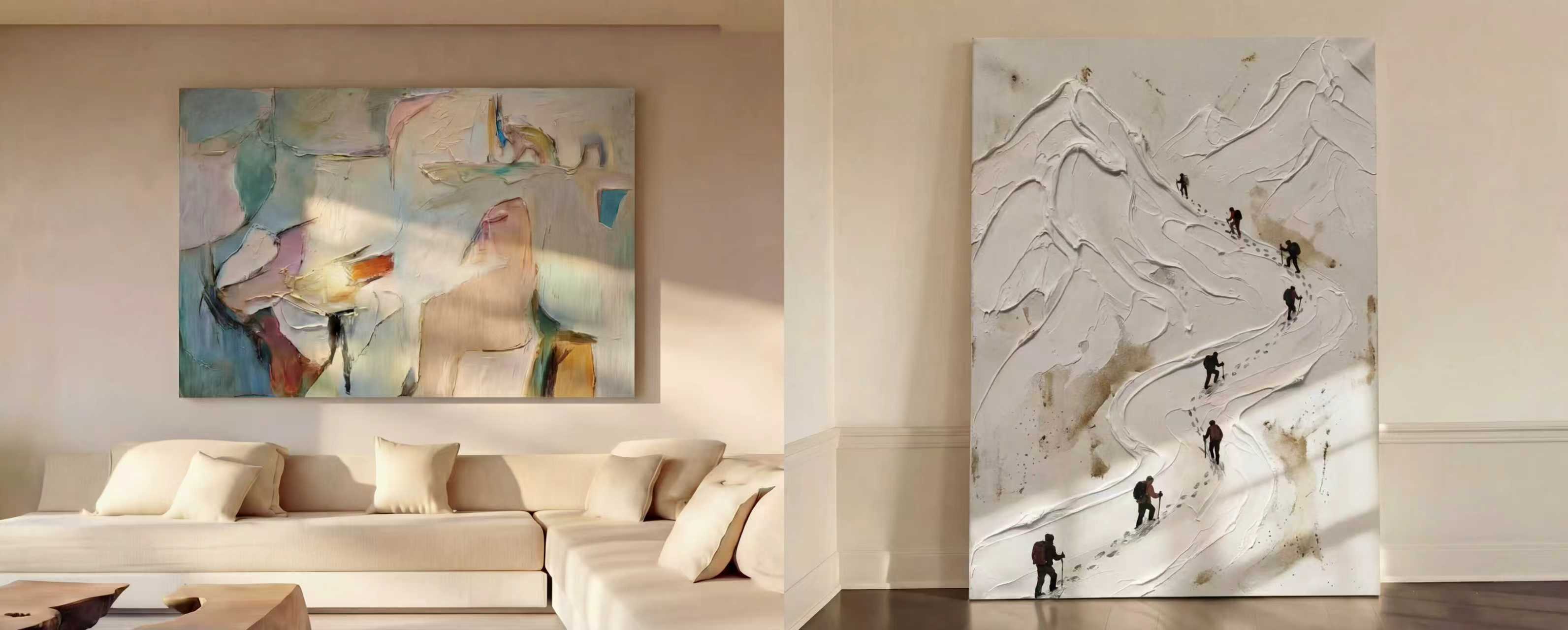
Textured Grooves Quiet Current: A Sculpted Canvas That Moves With the Light
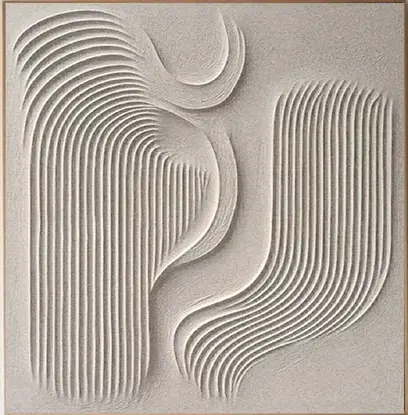
A pale, sand-toned canvas built around carved parallel grooves, Textured Grooves Quiet Current reads as sculpted rather than painted. Its neutral surface leans on light and shadow to create movement, making it a strong fit for wabi-sabi, Japandi, and minimalist interiors that value texture over color.
Quick read
One tone, many shadows — a quiet piece that keeps changing as the room's light changes.
Product reference
At first glance, Textured Grooves Quiet Current doesn't look like a painting so much as a shallow plaster relief. Deep parallel channels run across a pale, sand-colored ground, curving in some passages and straightening in others, like raked sand caught mid-motion. There's no second color, no contrast pigment, no printed detail. The entire composition depends on light hitting ridges and slipping into the shaded valleys between them.
That single decision — to let shadow do the drawing — is what gives the piece its presence. In flat overhead light it reads calm and almost graphic. In side light from a window or a nearby lamp, the grooves deepen, the spiraling form at the upper center pulls forward, and the whole surface starts to feel alive.
What kind of wall art this actually is
This is hand-painted, three-dimensional textured canvas wall art in a wabi-sabi and minimalist direction. The surface is built up in plaster-like material and then carved, so the artwork has real depth you can see from an angle, not a printed illusion of texture. The palette stays in one warm neutral throughout, which is why it slots so easily into rooms already working in oak, linen, bouclé, and taupe.
If you've been comparing neutral abstract canvases, framed line art, and 3D carved wall decor, this piece sits firmly in the sculpted-relief category. It has more physical presence than a flat print, and more restraint than a bold abstract painting.
How it reads in a room
The mood is quiet, grounded, and a little architectural. Two vertical groupings anchor the left and right edges, while a looser spiral breaks the rhythm at the top center — enough movement to hold your eye, not so much that the wall feels busy. It behaves like a focal point without demanding to be one, which is a useful quality above a long sofa or behind a low headboard where you don't want a loud image competing with the furniture.
Because the tone is so restrained, the piece tends to warm up rooms with a lot of white and cool down rooms that lean beige. It reads differently in daylight than under lamplight, and that shift is part of its appeal. Buyers who love bold color or high-contrast graphic art will probably find it too quiet. Buyers drawn to Japandi, wabi-sabi, and slow, material-driven interiors usually respond to it immediately.
Where it works best
- Living room: above a low, linear sofa, or on a light-facing accent wall where afternoon sun can rake across the grooves.
- Bedroom: behind a low platform headboard, or on the wall facing the bed so morning light picks up the carved texture.
- Foyer: on a narrow side-lit wall or above a slim console, where a single wall sconce can exaggerate the shadows.
- Dining area or home office: works as a calm anchor behind a banquette or desk, especially in rooms already leaning neutral.
Common assumptions worth adjusting
A few things buyers often misjudge with sculpted neutral art like this. It is not a small accent — the texture needs enough wall space to breathe, and it looks best when it's the clear visual anchor rather than one of several competing pieces. It is also not a color piece; if you're hoping it will introduce a new tone into the room, it won't. What it introduces is depth, rhythm, and shadow.
It pairs comfortably with light oak, warm white linen, soft taupe upholstery, and matte ceramics. It fights a little with heavily patterned wallpaper, glossy lacquered furniture, or rooms already crowded with framed gallery walls.
Product details
- Type: hand-painted 3D textured canvas wall art
- Style: abstract, minimalist, wabi-sabi, Japandi-friendly
- Surface: matte, sand-like plaster finish with carved parallel grooves
- Palette: single warm neutral, monochrome throughout
- Composition: two vertical groove groupings with a spiraling form at upper center
- Best rooms: living room, bedroom, foyer, dining room, home office
- Pairs with: light oak wood, warm white linen, soft taupe upholstery, bouclé, pale plaster walls
- Lighting note: side lighting and directional daylight bring out the most depth
For rooms built around restraint and material warmth, this is the kind of wall art that earns its place slowly and then stays there. See the full piece and available options on Textured Grooves Quiet Current.