
Textured Ivory Ridges Cadence: A Quiet Study in Surface and Rhythm
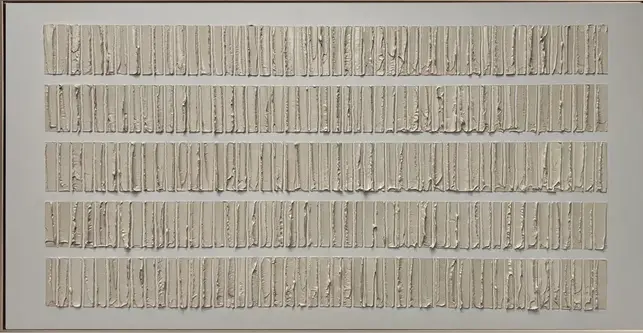
Textured Ivory Ridges Cadence is a wide, hand-painted canvas defined by rows of raised ivory strokes on a stone-toned ground. It works as a calm, sculptural focal point in minimalist, Japandi, and wabi-inspired living rooms, foyers, and dining areas where light can move across its surface throughout the day.
Quick read
Texture-forward, tonal, and quietly architectural — an abstract that behaves more like a relief than a painting.
Product reference
Textured Ivory Ridges Cadence looks, at first, like a single soft field of ivory. Step closer and it breaks open: five horizontal bands of raised, plaster-like strokes, each vertical mark cut with its own edge, aligned into steady rows across a pale stone ground. It behaves less like a painting and more like a low relief — something you read with your eyes the way you'd read a textured wall in person.
The palette stays close to ivory, bone, and a whisper of warm grey. There's no color story pulling for attention, which is the point. The composition works through surface, shadow, and rhythm instead.
What Makes It Visually Distinct
Most neutral abstract canvases lean on brushwork or wash. This one leans on structure. The ridges are physical, and they catch light differently depending on the hour — sharper and more graphic under morning sun, softer and more sculptural under a warm lamp at night. That daily shift is part of what you're buying.
The rows feel ordered without feeling mechanical. Small variations in stroke width and height keep the cadence human, and the generous margins above and below the banded rows let the piece breathe on a wall rather than crowd it.
How It Reads in a Room
In a living room, it holds a long wall calmly. Above a low linen or wool sofa, the tactile surface finds an easy echo in the upholstery, and the horizontal format reinforces the line of the seating rather than fighting it. In a foyer, hung above a narrow console, it sets a composed, considered tone the moment someone walks in — present, but not performative.
Dining rooms are another natural fit, especially on an end wall opposite a long table. The banded rhythm gives the eye something to settle on across the length of the room without competing with a pendant, a mirror, or tableware below.
Who It's For
This piece suits buyers who are drawn to minimalist, Japandi, and contemporary wabi-inspired interiors — rooms built around light oak, bleached wood, warm whites, and natural linen. If your instinct is to strip a room back to material and proportion, this artwork speaks the same language.
It's less suited to high-contrast, color-driven rooms or maximalist gallery walls. Dropped into a saturated space, its subtlety can get lost. Given room and light, it does the opposite — it quietly organizes the wall around it.
Realistic Expectations
A common mistaken assumption with textured neutral art is that it will read as a bold focal point from across a room. This one won't, and shouldn't. From a distance, it registers as a calm, banded rectangle of ivory. The reward comes with proximity and with daylight — the shadows between ridges shift, the edges sharpen, and the piece reveals its depth.
Compared with a flat printed abstract in a similar palette, you're trading graphic punch for material presence. Compared with a heavy, dark statement canvas, you're trading drama for tone. That tradeoff is deliberate.
A Quick Styling Scenario
Picture a living room with a low, warm-white linen sofa, a light oak coffee table, and a tall arched floor lamp in the corner. The wall behind the sofa has been bare because nothing felt right — anything too colorful pulled focus, anything too small looked lost. A wide, horizontal textured canvas centered above the sofa closes the composition. During the day, the ridges catch the window light and animate the wall. At night, the lamp throws a soft rake across the surface, and the whole piece deepens.
Product Details
- Type: Hand-painted textured canvas wall art
- Style: Abstract, 3D textured, minimalist, wabi-sabi
- Palette: Ivory, bone, soft warm grey — tonal, low contrast
- Finish: Raised plaster-like ridges arranged in five horizontal bands with quiet negative space above and below
- Best rooms: Living room, foyer, dining room, bedroom
- Pairs well with: Light oak, bleached wood, warm white linen, wool upholstery
- Placement notes: Above a low sofa, centered on a long wall, above a narrow console in an entry, or on a dining room end wall opposite a long table
- Light: Rewards rooms with natural daylight; also reads beautifully under warm lamplight
For a closer look at scale, texture, and available options, see Textured Ivory Ridges Cadence.