
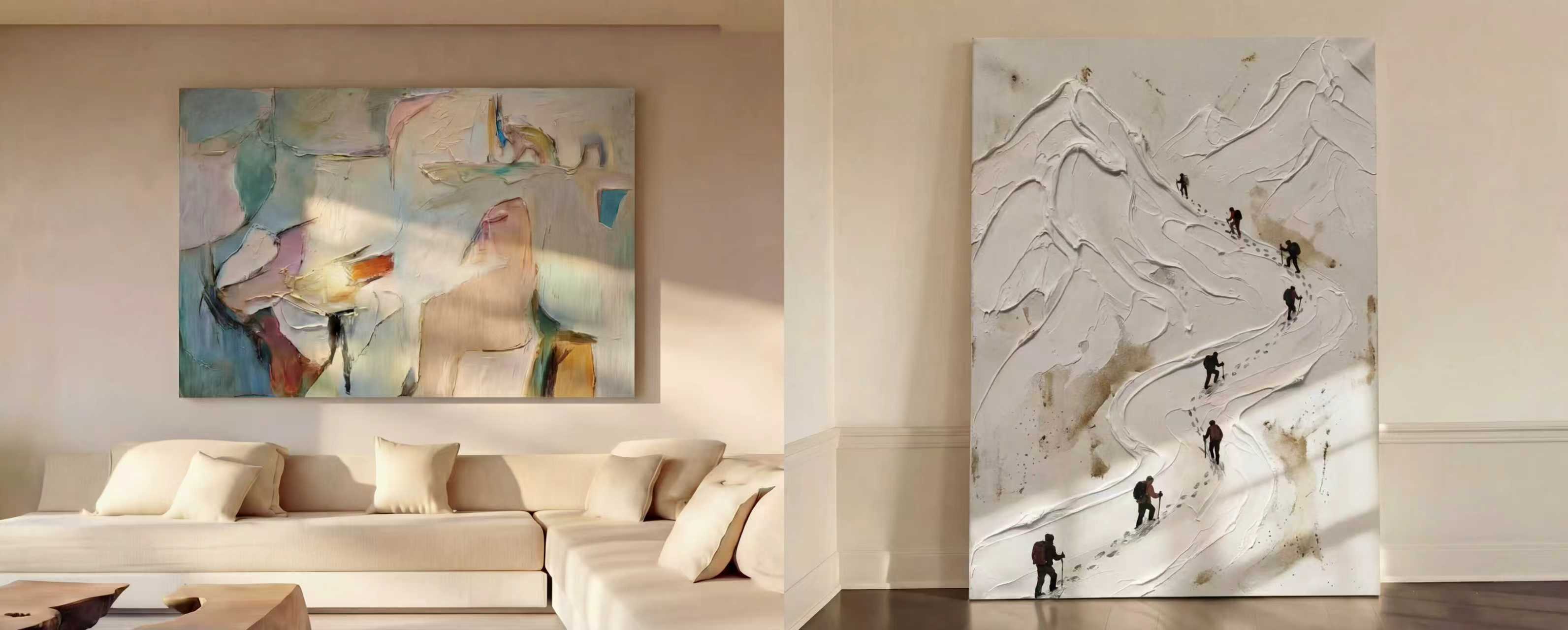
The Quiet Weight of Textured Monstera Leaves Verdant Hush
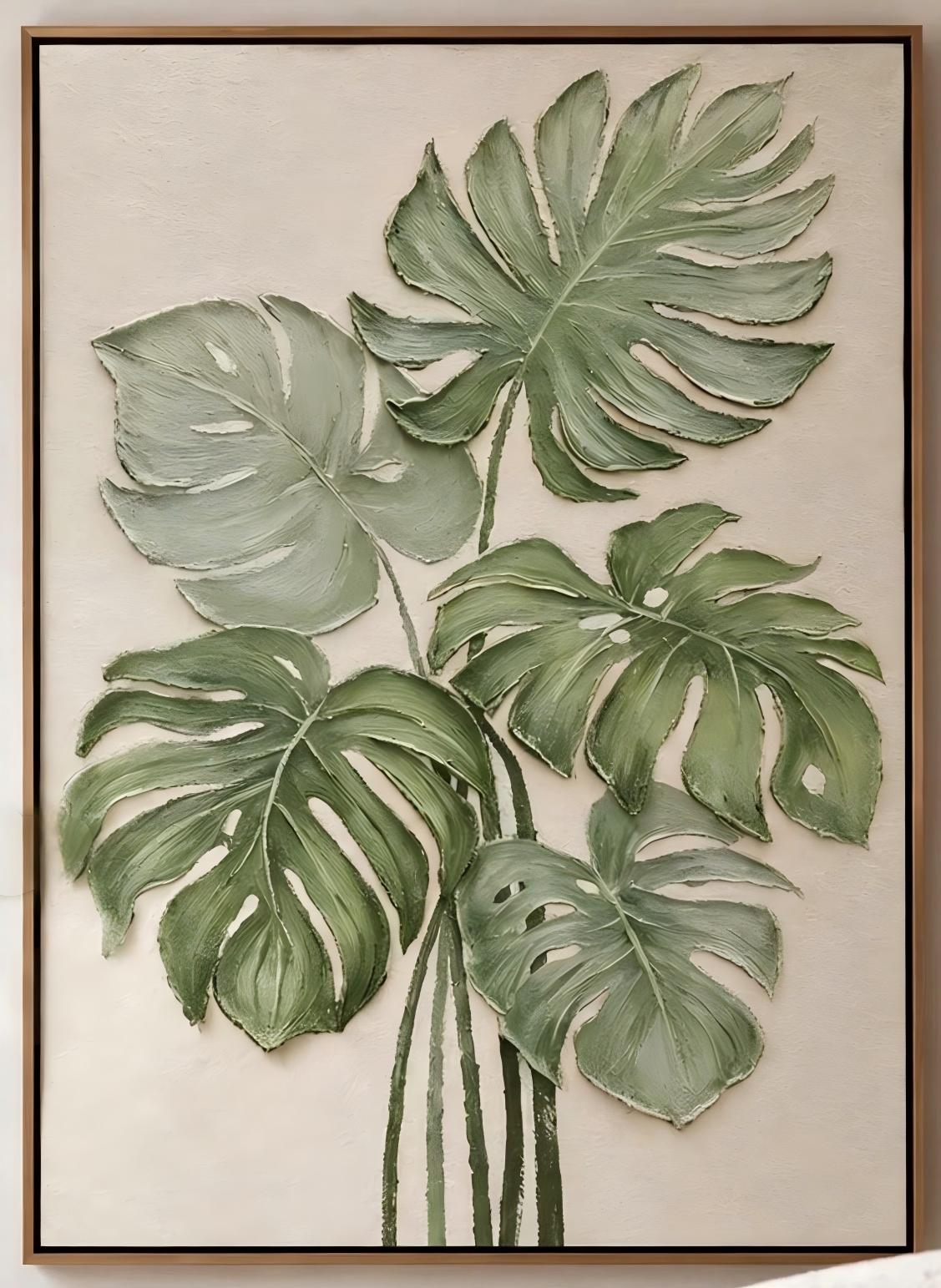
Textured Monstera Leaves Verdant Hush is a hand-painted canvas built up in thick plaster-like layers, with monstera fronds rising from a soft neutral ground. The palette stays in sage, olive, and grey-green territory, and the raised edges give the piece real dimension on the wall. It works best in warm neutral rooms leaning Japandi, Scandinavian, or coastal, where its calm structure can anchor a sofa, headboard, or dining wall without shouting.
Quick read
Sculptural monstera fronds in sage and olive, painted with a heavy hand and a quiet eye.
Product reference
The first thing you notice about Textured Monstera Leaves Verdant Hush isn't the color. It's the surface. The monstera fronds sit up off the canvas in raised ridges and troweled edges, closer to a low-relief plaster panel than a traditional botanical painting. From a few steps back it reads as a calm green study. Up close, it behaves like sculpture.
The palette stays deliberately soft — sage, olive, and grey-green worked into a plaster-toned background. Some leaves cool toward the top, others deepen below, so the composition has a quiet gradient instead of one flat green. It's botanical art, but not the bright tropical kind.
What Kind of Wall Art This Actually Is
This is a hand-painted textured canvas, not a print. The dimension is built into the paint itself, which is why it catches daylight differently through the day and softens under warm lamplight at night. If you've been comparing flat botanical prints and wondering why they feel a little thin on the wall, this is the other end of that spectrum: a piece with real physical presence.
The composition builds from a cluster of long stems into overlapping monstera fronds, with the natural leaf splits creating irregular negative space. There's structure, but also breathing room — the wall stays part of the picture.
How It Reads in a Room
In a living room, hung above a low sofa, it acts as an organic anchor. It gives the seating area weight without competing with pillows, throws, or a coffee table styled below. Because the palette is muted, it doesn't fight surrounding wood tones or upholstery.
In a bedroom, it sits comfortably behind a headboard or on the wall facing the foot of the bed. The scale is generous enough to feel like a real focal point, but the tones stay restful — closer to a quiet landscape than a graphic statement.
A dining room end wall is another strong placement, especially opposite a window. Daylight moving across the raised texture is part of what this piece is designed to do.
Who It's For
This one suits interiors built on warm neutrals rather than high contrast. Think Japandi rooms with light oak and linen, Scandinavian spaces with pale walls and rattan, or coastal interiors that lean earthy rather than nautical. If your room already has natural wood, warm whites, and soft textiles, the monstera palette slots in without adjustment.
It's less suited to rooms driven by bold color blocking, glossy black accents, or heavy jewel tones. The piece is quiet by design. In a high-contrast space, that quietness can read as underpowered.
Realistic Expectations
A few things worth knowing before you commit. Because the texture is hand-built, no two pieces are identical — small variations in ridge height, edge thickness, and brush direction are part of the medium. The greens are muted, not saturated, so if you're hoping for a vivid jungle look, this isn't that painting. And texture-forward work like this tends to photograph flatter than it looks in person; the raised paint really only shows itself in the room.
Compared With Other Botanical Wall Art
Against a framed botanical print, this piece trades crispness for depth. Against a large abstract canvas, it trades bold gesture for recognizable subject matter. Against a smaller gallery grouping of leaf prints, it trades variety for a single confident focal point. If you want one piece doing the work of a full wall, this leans toward that role.
Product Details
- Type: Hand-painted canvas wall art with heavy 3D texture
- Style: Organic modern, abstract botanical
- Palette: Sage, olive, muted grey-green on a plaster-toned ground
- Finish: Sculptural raised edges and ridges; visible brush and palette-knife work
- Best rooms: Living room, bedroom, dining room, foyer, home office
- Best placements: Above a low sofa, behind a headboard, on a dining end wall opposite a window
- Pairs with: Light oak, warm white linen, natural rattan, soft wool textures
- Interior directions: Japandi, Scandinavian, coastal-neutral
For rooms that lean warm, natural, and quietly styled, take a closer look at Textured Monstera Leaves Verdant Hush.