
Quiet Ridges: A Sculpted Landscape That Reads as Terrain, Not Image
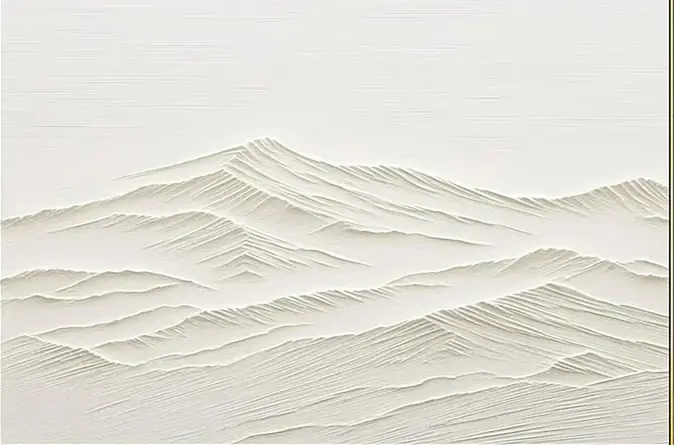
Quiet Ridges is a hand-painted, plaster-textured canvas built from overlapping ivory mountain forms and fine carved striations. It leans wabi-sabi and minimalist, sits comfortably above sofas, headboards, and consoles, and reads more like a topographic surface than a traditional landscape painting.
Quick read
A landscape you read by shadow, not by color.
Product reference
At first glance, Textured Mountain Landscape Quiet Ridges doesn't look like a painting so much as a low-relief surface. Rows of ivory peaks rise from a pale plaster ground, each ridge carved with fine parallel grooves that pick up light along their edges. There is no color story to decode — just bone, chalk, and shadow — which is exactly what makes the piece hold a wall the way it does.
The composition is horizontal and layered, with deeper, more directional grooves in the foreground and softer, flatter ridgelines receding toward the horizon. Above the mountains, the canvas opens into quiet negative space. That breathing room is doing real work: it keeps the piece from feeling heavy, even at larger sizes.
What Kind of Wall Art This Actually Is
This is a hand-painted, 3D plaster-textured canvas in the abstract landscape family, closer in spirit to wabi-sabi and Japandi interiors than to traditional mountain scenery. The subject isn't really the mountains — it's the surface. The striations shift as daylight moves across the room, then settle into a softer, more shadowed read under warm lamplight in the evening.
If you've been comparing textured mountain wall art, neutral ivory canvas art, or sculptural landscape paintings, this one sits firmly on the quieter, more architectural end of that category. It rewards a slow look rather than an immediate one.
How It Feels in a Room
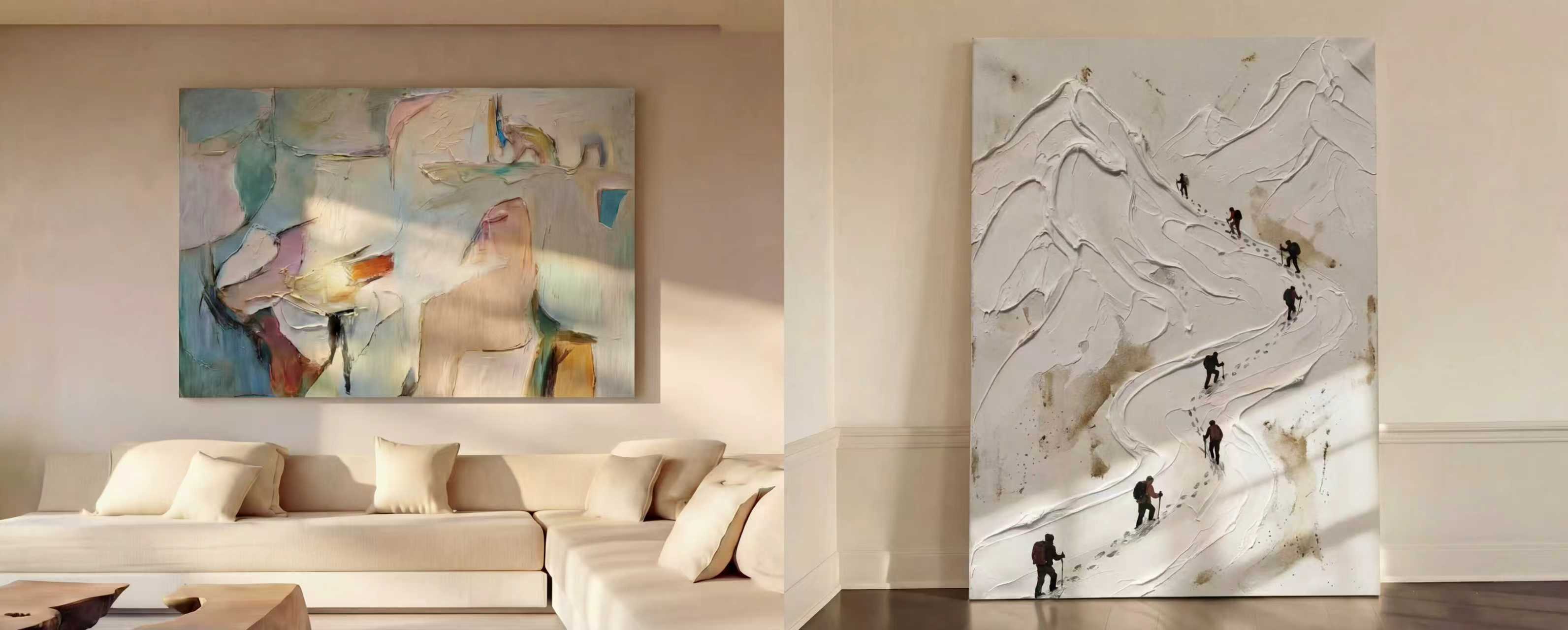
Quiet Ridges tends to calm a room rather than dominate it. Because the palette holds to a single tone, it doesn't compete with sofas, rugs, or accent pieces — it works with them. The texture gives the wall dimension without introducing new color decisions, which is often the hardest part of choosing large-scale art.
It reads best against light, matte backdrops: warm white walls, natural plaster finishes, or soft greige. Against very dark or high-contrast walls, the ivory tone will pop more aggressively than the piece is designed to, so keep that in mind if your room leans moody.
Who It Suits
- Homes with light oak, raw linen, and plaster-toned surfaces
- Minimalist, wabi-sabi, and Japandi interiors
- Rooms that already have pattern or color and need a quieter focal wall
- Buyers who prefer texture-forward art over graphic or pictorial work
It's less suited to maximalist rooms, saturated color palettes, or gallery walls built around bold prints. In those settings, its subtlety gets lost.
A Realistic Styling Scenario
Picture a living room with a low, linen-upholstered sofa in warm oatmeal, a light oak coffee table, and a chunky wool rug. The walls are a soft off-white. Centered above the sofa, Quiet Ridges reads as a long, horizontal band of texture — grounding the seating area without adding another color. In the morning, side light rakes across the ridges and the piece feels sculptural. By evening, under a nearby table lamp, the grooves soften and the whole wall goes quieter. Same artwork, two moods.
Common Assumptions Worth Correcting
Because it's monochrome, some buyers assume the piece will feel flat or plain in person. In practice, the opposite is true — the 3D plaster relief carries the visual weight that color usually would. On the flip side, this isn't a loud statement piece. If you want art that announces itself the second someone walks in, a high-contrast abstract or a saturated landscape will do that job better.
Product Details
- Type: Hand-painted canvas with 3D plaster texture
- Style: Abstract, minimalist, wabi-sabi
- Subject: Layered mountain ridgelines, horizontal composition
- Palette: Bone, ivory, and chalk — single-tone monochrome
- Finish: Matte, sculpted relief; light-reactive surface
- Best rooms: Living room (above a low sofa), bedroom (above a headboard or opposite a window), home office (facing the desk), dining room, foyer
- Pairs with: Light oak, warm white linen, natural plaster walls
Because the surface is hand-worked, expect small variations between pieces — that's part of the wabi-sabi character rather than a flaw.
If a quieter, texture-led focal wall is what your room is missing, take a closer look at Textured Mountain Landscape Quiet Ridges.