
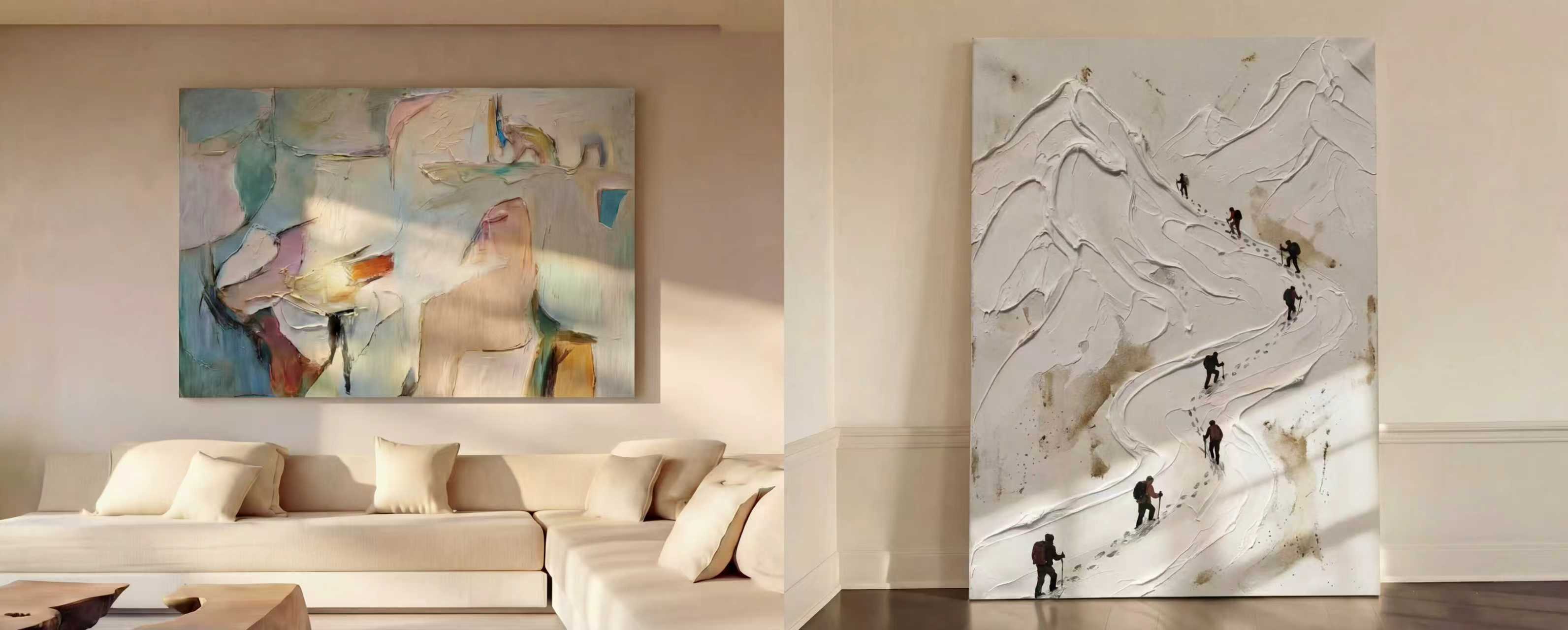
The Quiet Weight of Ridges: Inside Textured Mountain Ridge Quiet Summit
This piece is a neutral, sculptural wall art built from raised ridge lines that read like folded paper or plaster. It stays quiet on the wall, adds dimension without color, and suits Scandinavian, Japandi, and minimalist rooms where texture is doing most of the styling work.
Quick read
A mountain built from shadow lines instead of pigment — quiet, tactile, and unmistakably hand-worked.
Product reference
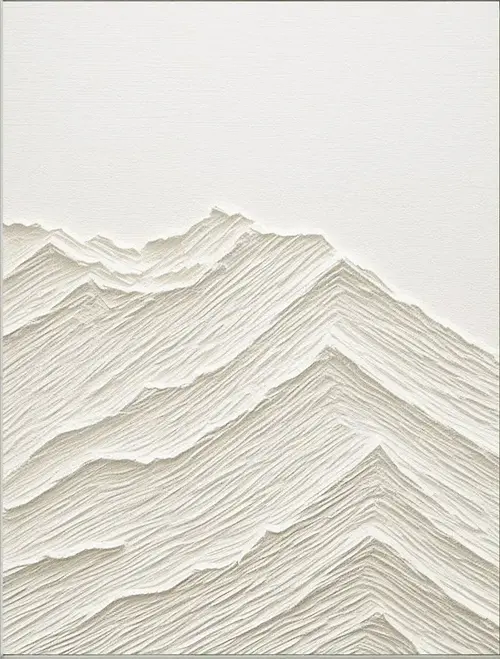
The first thing you notice about Textured Mountain Ridge Quiet Summit isn't the mountain shape — it's the surface. Rows of raised ridges run across the lower half of the canvas, each line cut with a steady, deliberate stroke, stacking into a dense field that catches light unevenly. The palette barely moves, staying inside a narrow band of ivory and bone. Color isn't doing the work here. Texture is.
Read from a few steps back, the ridges resolve into a mountain silhouette: sharper diagonal peaks on one side, softer rounded folds on the other, with plain untouched canvas opening above. That upper negative space is a big part of why the piece feels calm instead of busy. The composition breathes.
What kind of wall art this actually is
This is a hand-painted textured canvas — closer in feel to a low-relief plaster panel than a printed landscape. The ridges cast their own shadow lines, so the artwork shifts subtly depending on where the light is coming from. In morning daylight it looks crisp and graphic. Under a warm lamp or wall sconce in the evening, the shadows deepen and the surface reads almost sculptural.
It sits in the space where abstract landscape, wabi-sabi, and 3D plaster wall decor overlap. If you've been comparing neutral abstract paintings, textured mountain wall art, or ivory dimensional canvases, this piece leans into the tactile side of that category rather than the painterly one.
How it changes a room
Because the color stays so restrained, the piece doesn't compete with anything already on the wall or floor. What it adds is depth. A room that felt flat — white walls, light wood, soft upholstery — suddenly has a surface that holds the eye. It works as a focal point without behaving like a loud one.
Above a low, linear sofa, it anchors the seating area and gives a plain wall something to do. Behind a neutral upholstered headboard, it reads like a continuation of the bedding's texture rather than a separate object. On a narrow foyer wall lit by a sconce, it becomes something you notice differently every time you walk past.
Who it suits, and who it doesn't
This piece rewards restraint. It's a natural fit for Scandinavian, Japandi, and quiet minimalist interiors, and it pairs cleanly with oak, ash, or bleached wood furniture and warm-white linen. If your room is already layered with pattern, saturated color, or lots of competing artwork, the subtlety here can get lost. It's built for rooms that are mostly settled and want one more layer of texture — not rooms looking for a color statement.
One common misread: people sometimes expect a textured canvas to feel heavy or dark. This one doesn't. The ivory ground and open upper space keep it airy. It grounds a wall without weighing it down.
A quick styling scenario
Picture a living room with a low, linen-upholstered sofa in warm oatmeal, a light oak coffee table, and a wide woven rug. The wall behind the sofa is warm white and empty. Hang Textured Mountain Ridge Quiet Summit centered above the sofa, roughly eight to ten inches above the back cushions. Add a slim floor lamp angled toward the canvas. In the evening, the ridges throw soft shadow lines across the surface, and the whole seating area gains dimension without a single new color entering the room.
Product details
- Type: Hand-painted textured canvas wall art
- Style direction: Abstract landscape with 3D textured, minimalist, and wabi-sabi influences
- Palette: Ivory and bone — a narrow neutral range
- Surface: Raised ridge lines with visible depth; shadows shift with light
- Composition: Dense ridged lower half, open negative space above
- Best rooms: Living room, bedroom, foyer, dining room, home office
- Pairs well with: Light oak, ash, or bleached wood; warm-white linen; white or warm-white walls
- Placement notes: Above a low sofa, behind a neutral headboard, or on a hallway end wall lit by a soft sconce
For rooms that already feel calm and just need one more layer of quiet texture, take a closer look at Textured Mountain Ridge Quiet Summit.