
A Quiet Descent: Living With Textured Sage Scales on a Canvas
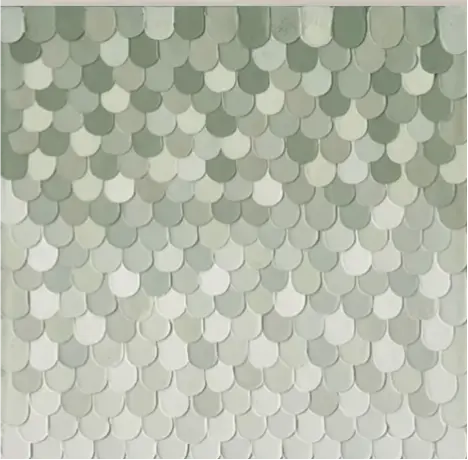
This piece works as a sculptural but soft-spoken wall statement. Rows of hand-built scalloped shapes catch light along their raised edges, while the sage-to-ivory gradient pulls the eye downward. It suits Scandinavian, Japandi, and soft modern rooms where texture matters more than color contrast.
Quick read
A canvas that behaves less like a painting and more like a quiet plaster wall you can hang.
Product reference
The first thing you notice about Textured Sage Scales Quiet Descent is the surface. Rows of overlapping scalloped shapes are built up by hand across the canvas, each one raised enough to catch light along its edges. From a few steps back, it reads as a soft green-to-ivory gradient with a steady rhythm. Up close, it feels closer to plaster relief than paint.
It's a hand-painted canvas in an abstract, organic-modern direction, but the effect is more architectural than expressive. There's no gesture, no brushy movement, no obvious focal point. The interest lives in the repetition and in how the sage clusters densely at the top before easing into pale, breathing space at the base.
How It Reads in a Room
Hung above a sofa, the downward pull of the gradient echoes the low horizontal of the seating without competing with it. The piece adds weight to the wall, but it's a quiet kind of weight — more like a textured panel than a statement painting. In daylight, the raised edges throw small shadows that shift through the day. Under a warm lamp at night, those same edges soften, and the whole surface feels more uniform and calm.
This is textured canvas wall art that behaves like a background you actually want to look at. It doesn't fight for attention against a bold rug or a sculptural light fixture. It sits alongside them.
Who It Suits
Rooms leaning Scandinavian, Japandi, or soft modern tend to be the natural fit. Light oak, warm white linen, pale plaster walls, ceramic and stoneware — the sage and ivory palette settles right into that world. If your space runs high-contrast, glossy, or heavily patterned, this piece will feel too quiet. It's built for restraint.
Buyers who usually compare framed prints, black-and-white photography, or bold abstract canvases will find this reads differently. It's less about image and more about surface. That's the tradeoff: you gain dimension and tactility, but you lose the sharp graphic punch a printed piece can bring.
A Real Styling Scenario
Picture a living room with a low linen sofa in warm oatmeal, a light oak coffee table, and a jute rug. The wall behind the sofa is currently bare or holding something too small. Centering this canvas above the sofa gives the seating wall a defined anchor without introducing a new color story. The green tones pick up any plant nearby; the ivory base keeps the wall from feeling heavy. Add a ceramic lamp on a side table, and the raised scales pick up the light in a way a flat print never would.
Common Misreads
A few things worth clearing up. This isn't a printed pattern — the shapes are individually built, so the surface has real depth. It also isn't a bold color piece. The sage is muted, closer to a dusty eucalyptus than a saturated green. And while the repetition is orderly, it's not mechanical; small variations in each shape keep it from feeling like wallpaper.
Product Details
- Type: Hand-painted textured canvas, abstract / organic-modern
- Surface: Raised scalloped forms with a plaster-like, tactile finish
- Palette: Muted sage green fading to soft ivory
- Best placement: Above a low sofa, on a dining room end wall, or eye-level in a foyer
- Pairs with: Light oak wood, warm white linen, pale sage upholstery, plaster or limewash walls
- Style fit: Scandinavian, Japandi, soft modern interiors
- Reads best in: Daylight for shadow play, warm lamplight for softness
For a closer look at scale, finish, and available options, see Textured Sage Scales Quiet Descent.